Save up to 60% on yearly plans and enjoy our biggest offer of the year. Limited time only. 🍂
See pricing

Straw polls 101: Definition, benefits & expert creation guide
Summarize with
Data-driven leadership relies on capturing the "room's pulse" before a final commitment is made.
As an expert in survey methodology, I have seen how straw polls act as a vital diagnostic tool to reveal hidden consensus or friction in real-time. By moving beyond assumptions, you can pivot strategies based on verified group sentiment.
This guide provides a professional framework for understanding the straw poll's technical application, strategic use cases, and a streamlined creation process. It includes validated questions templates and an FAQ to resolve common methodological challenges.
What is a straw poll?
At its core, a straw poll is an unofficial, non-binding vote used to gauge the pulse of a group or the general direction of public opinion.
Unlike formal elections or scientific surveys, its primary function is not to produce a final, legally binding result, but to provide a diagnostic snapshot of current sentiment before a definitive decision is made.
The origin: Why the "straw"?
The straw poll definition finds its roots in a centuries-old agricultural practice. Before the advent of modern meteorology, farmers and sailors would throw a piece of straw into the air to determine which way the wind was blowing.
The metaphor was famously captured by the 17th-century English jurist and scholar John Selden, who noted:
"Take a straw and throw it up into the Air, you shall see by that which way the Wind is."
In a modern organizational or political context, the straw represents the preliminary vote, and the wind represents the prevailing opinion of the assembly. By observing how the "straw" falls, leaders can identify consensus or friction early, allowing them to adjust their strategy before a formal, high-stakes commitment is required.
Straw poll vs. formal survey: Understanding the strategic shift
The primary distinction between a straw poll and a formal survey lies in intent.
A formal survey is designed to produce a representative data set that can be defended in a boardroom research paper, an investor presentation, a government report, a market research study, an academic thesis, a product strategy meeting, or a public policy decision. A straw poll, conversely, is a tactical tool used to catalyze a conversation or verify a "hunch" before resources are committed.
While a formal survey provides the truth of a population, a straw poll provides the temperature of a moment.
Feature | Straw Poll (Tactical) | Formal Survey (Scientific) |
|---|---|---|
Goal | Gauge immediate sentiment | Collect defensible data |
Accuracy | Directional / "Pulse" | Statistically significant |
Sample | Convenience (those present) | Controlled / Stratified |
Speed | Instantaneous | Days to weeks |
Use Case | Breaking meeting deadlocks | High-stakes R&D/Market research |
The Gap | Social Dynamics: Measures the visible mood | Anonymity: Measures the private, isolated truth |
5 Strategic benefits of implementing a straw poll
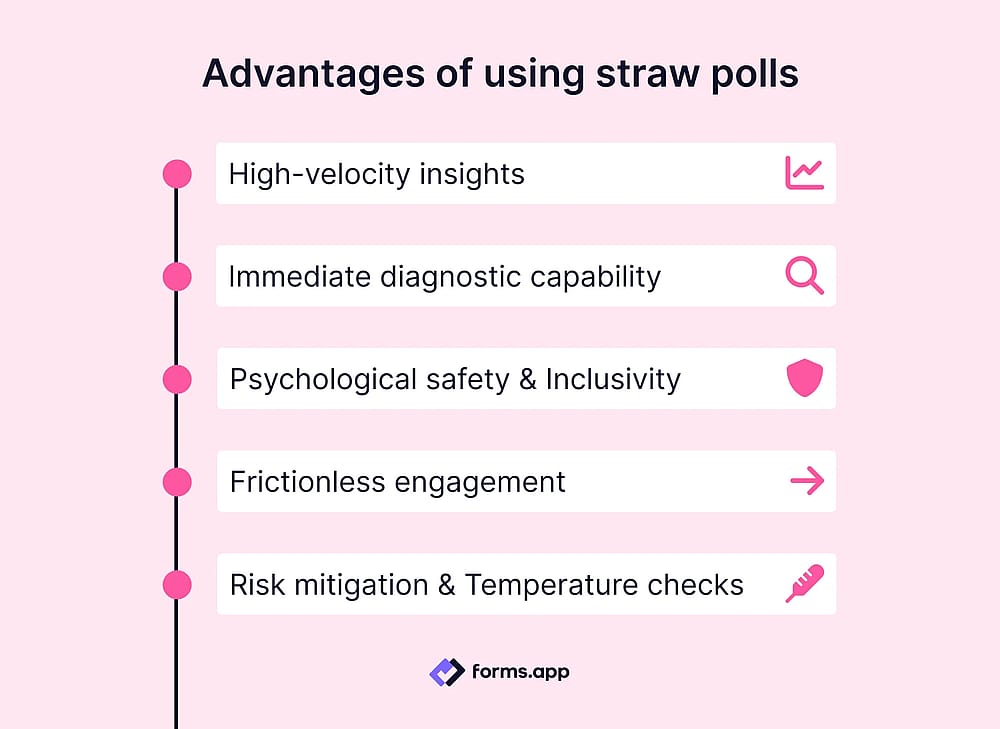
Pros of using online straw polls
From a methodological standpoint, the online poll’s value lies in its low barrier to entry. While formal research requires rigorous planning, straw polls provide immediate utility by addressing the "human element" of decision-making.
1. High-velocity insights
In high-stakes environments, the cost of a delayed decision often outweighs the risk of imperfect data. Straw polls provide instantaneous feedback, allowing leaders to bypass the lengthy lead times required for stratified sampling and complex survey design.
2. Immediate diagnostic capability
Traditional data collection often creates a lag between sentiment and action. Because straw poll results are typically visualized in real-time, they act as a live diagnostic tool, enabling a group to pivot their discussion the moment a consensus or a significant rift becomes apparent.
3. Psychological safety & Inclusivity
Research into group dynamics suggests that the loudest voice often dominates verbal discussions. An anonymous straw poll levels the playing field, ensuring that every participant's perspective is captured. This inclusivity prevents "Groupthink" and ensures that the final decision is informed by the collective, not just the most assertive.
4. Frictionless engagement
The "Survey Fatigue" common in corporate settings stems from complex, multi-page questionnaires. A straw poll reduces the cognitive load on participants by focusing on a single, clear objective. This low-friction approach typically results in much higher response rates than formal alternatives.
5. Risk mitigation & Temperature checks
Before committing significant resources to a formal vote or a new project, creating a poll straw poll identifies potential deal-breakers or "red flags" early in the process, saving the organization from the reputational or financial cost of a failed formal initiative.
How to create an online straw poll (step-by-step)
Creating a straw poll in 2026 is a streamlined process, but as an expert in digital data collection, I recommend following these technical steps to ensure your quick pulse check doesn't result in skewed or manipulated data.
Step 1: Define your objective & Question
Start with a single, neutral question. To avoid leading-question bias, ensure your phrasing doesn't nudge the participant toward a specific answer.
Ineffective: "Don't you think we should move the deadline?" Professional: "Which deadline best aligns with our current resources?"
Step 2: Select a reliable polling platform
Choose a straw poll maker tool based on your needed level of security and intended user experience. There are numerous free poll maker tools; however, most of them come with limitations such as limited customization or restricted integrations.
forms.app’s online poll maker is a solid choice if you want to make a quick start. We’ll share the steps on this platform by showing its advanced features and how you can use them to create more engaging and effective polls easily.
Step 3: Choose a template or use AI
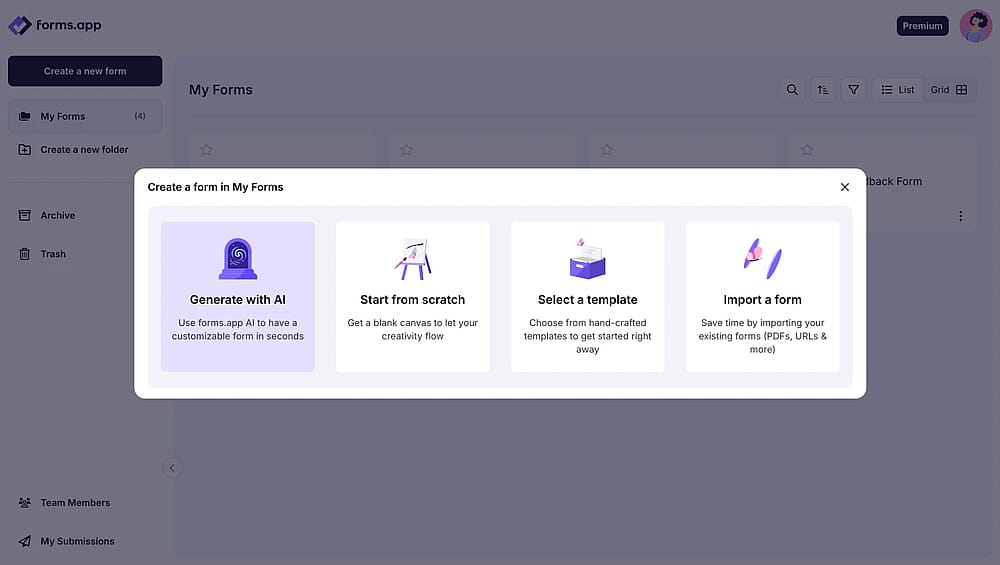
Choose a way to start
You can choose the ready to use straw poll example. If you choose a poll template, you can change the questions or edit the visuals based on your own needs. It is also possible to immediately create one by using AI.
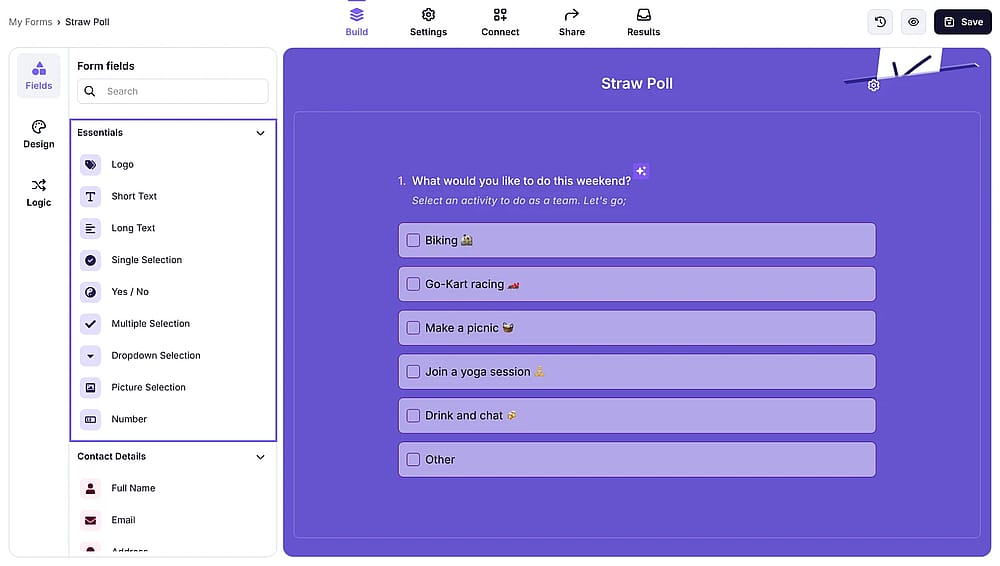
Add essential fields
Add your questions as in single selection or multiple choice questions. If you’d like, picture selection is another possible option you can consider.
💡 Expert tip: Adding visuals to my straw poll made it much easier for people to understand the options quickly and increases the chances that they actually vote.
Step 4: Customize the visuals & settings
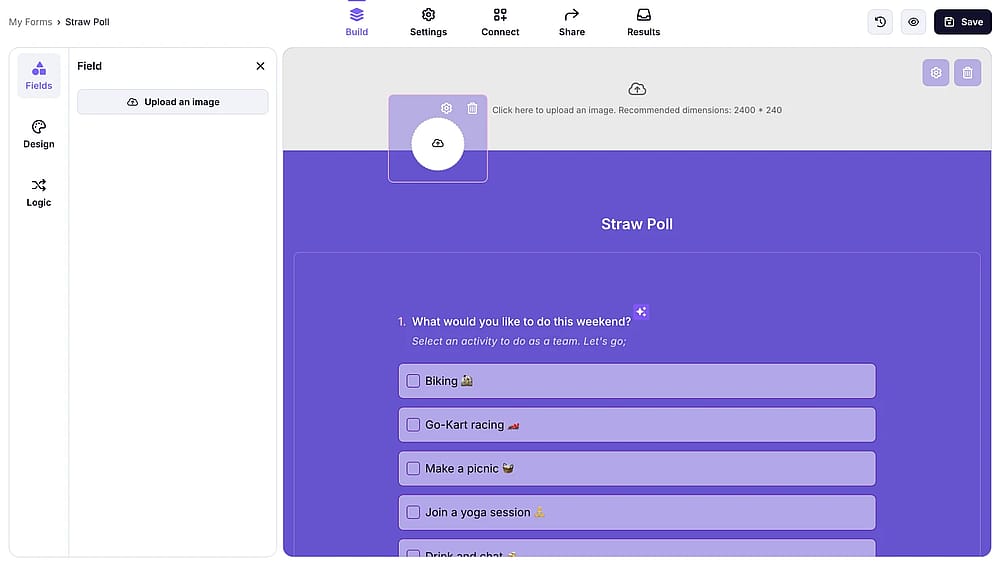
Add your own logo and cover
After adding your poll questions, it’s time to customize. Adding a logo & cover makes your straw poll look more professional. Similarly, you can change the background, other colors, and align the online poll with your own brand.
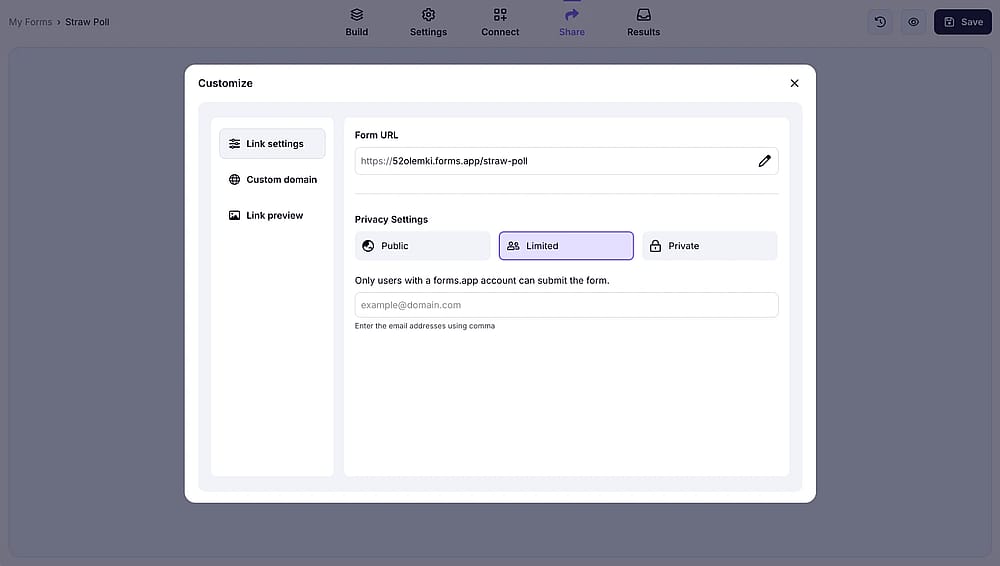
Change the privacy settings
If the straw is in-house, you can edit the privacy settings by choosing “Limited” to make sure only your team or invited participants can access and vote in the poll. Also, you can customie scheduling settings to make your online poll available in specific timelines and dates.
💡 Expert tip: Sharing my straw poll in multilingual languages made it possible to each a wider audience and collect more accurate responses from people in different regions.
Step 5: Share your poll
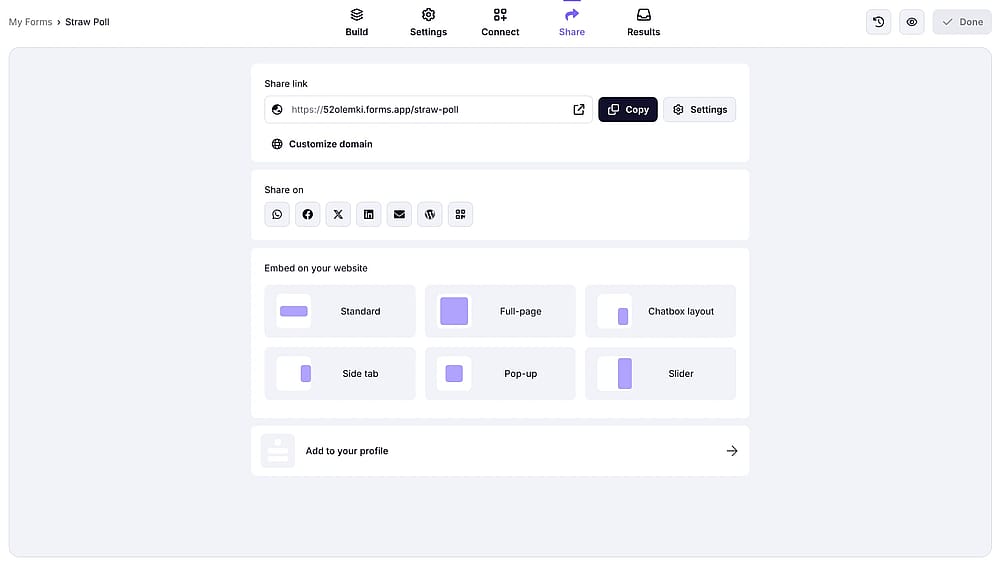
Share your straw poll
Distrubuting your online poll is possible in simple steps. Go to the Share tab and on this tab, you can share it in multiple ways. You can generate a QR code, copy the poll link, email it, or share it on the social media channels.
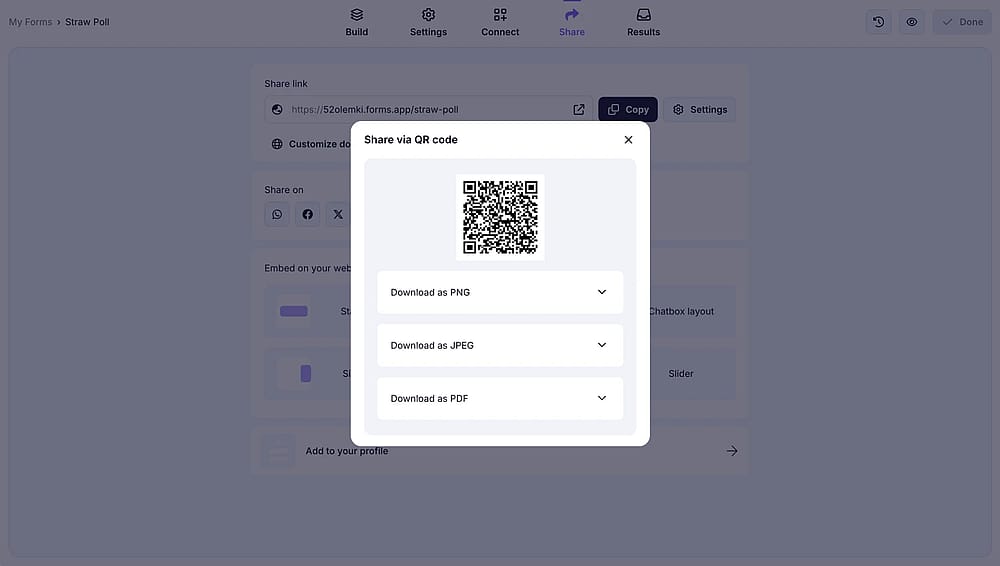
Share the QR code with your respondents
💡 Expert tip: Sharing the straw poll via a QR code lets respondents to answer your poll immediately in a meeting or during a live event without needing to search for the link.
Conclusion
Effective leadership requires knowing when to use a pulse check and when to deploy a formal study. While a straw poll lacks the rigorous security of a presidential election, its strength lies in its agility. By selecting the right question type, from simple binary choices to nuanced Likert scales you can capture the room's pulse without the friction of a well-designed straw poll.
As you collect this sentiment, remember that even informal feedback involves personal data. Utilizing a professional tool ensures this data remains secure while providing the clarity needed to move from a hunch to a confident, collective decision.
Frequently asked questions (FAQs)
No. By definition, a straw poll is non-binding. Its purpose is to gauge sentiment and provide a temperature check to inform further discussion. It is a precursor to a formal vote, not a replacement for it.
While both are informal, the timing and intent differ:
- Straw poll: Conducted before a final decision to see "which way the wind is blowing."
- Exit poll: Conducted after a formal vote to predict the outcome before official results are released.
They typically lack randomized sampling. Because participants usually "opt-in" (self-selection bias), the results represent the opinions of those present rather than a statistically perfect cross-section of a larger population.
Contributors
Researched & written by
forms.app, your free form builder
- Unlimited responses
- Unlimited questions
- Unlimited team members