
Save up to 60% on yearly plans and enjoy our biggest offer of the year. Limited time only. 🍂
See pricing

How to write good survey questions: A professional research guide
Summarize with
Peter Drucker once said, "The most serious mistakes are not being made as a result of wrong answers. The truly dangerous thing is asking the wrong questions." In the world of data science and market research, this is more than a quote; it’s a warning.
Low-quality questions lead to “garbage in, garbage out” data, resulting in wasted budgets and flawed business strategies. While there is no "one-size-fits-all" template, applying rigorous academic and psychological standards to your phrasing can drastically improve your data accuracy.
In this guide, we explore how to write good survey questions with examples backed by expert tips.
TL;DR: Quick guide to high-quality surveys
Method | Benefit |
One topic per question | Prevents confusion |
Max 5–7 min length | Lowers drop-off |
Use neutral phrasing | Eliminates bias |
Personal info at the end | Reduces abandonment |
Run a 10-person pilot | Catches logic errors |
The 5-step framework for survey design
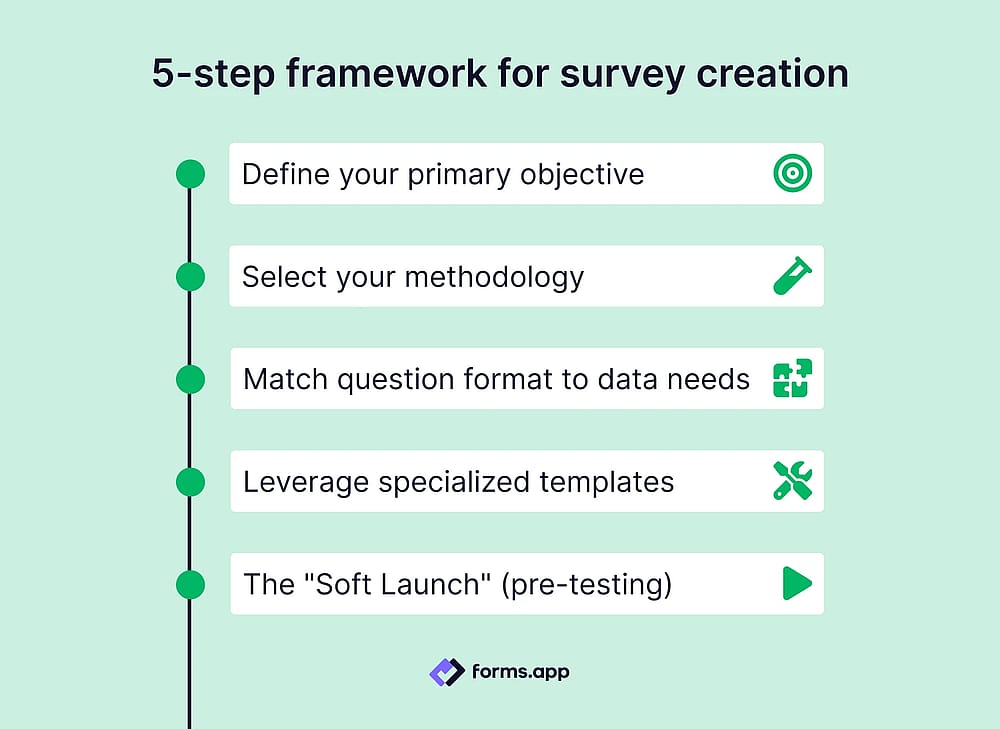
Steps to follow for survey questions
Creating a survey is a technical process. To move from “guessing” to “gathering”, follow these steps used by professional researchers. Check the steps to learn how to write survey questions for research or any kind of survey with basic survey questions:
Step #1: Define your primary objective
Before writing a single word, define the Actionable Insight you need. For example, if you are measuring Customer Satisfaction (CSAT), avoid “scope creep” by cutting questions that don't directly relate to the user's recent interaction.
💡 Expert insight: HubSpot notes that for certain types of customer surveys, every additional question can decrease the response rate by as much as 30%–50% if the survey feels irrelevant or too long.
Step #2: Select your methodology
To maximize survey results, ensure your answer choices align with specific "Data Scales" (Nominal, Ordinal, Interval, or Ratio). Choosing the correct format improves data accuracy and your final survey results.
- Mobile/pop-up surveys: Keep it to 1-3 questions.
- Email/Post-event surveys: Can handle 5-10 questions.
- In-person interviews: Best for complex, open-ended qualitative data.
Step #3: Match question format to data needs
Select the right format for your data: closed-ended questions create quantifiable Nominal or Ordinal scales, while others yield Interval or Ratio data. Ensure your question type matches your required analysis.
- Use Likert Scales for attitudes.
- Use Multiple choice for categorical data.
- Use Ranking for feature prioritization.
Step #4: Leverage specialized templates
Don't reinvent the wheel. Using a validated survey template (such as those for Patient Engagement or Market Research) ensures you use industry-standard phrasing that has been tested for clarity and bias.
Step #5: The "Soft Launch" (pre-testing)
Avoid blasting lists. Pilot your survey with 10 people first to refine customer service questions. Use this “soft launch” to catch errors before starting face-to-face or digital data collection.
- Analyze friction: Ask your pilot group specifically which questions felt "heavy" or confusing.
- Check for "Logic": If you use skip logic (branching), does it actually send users to the right page?
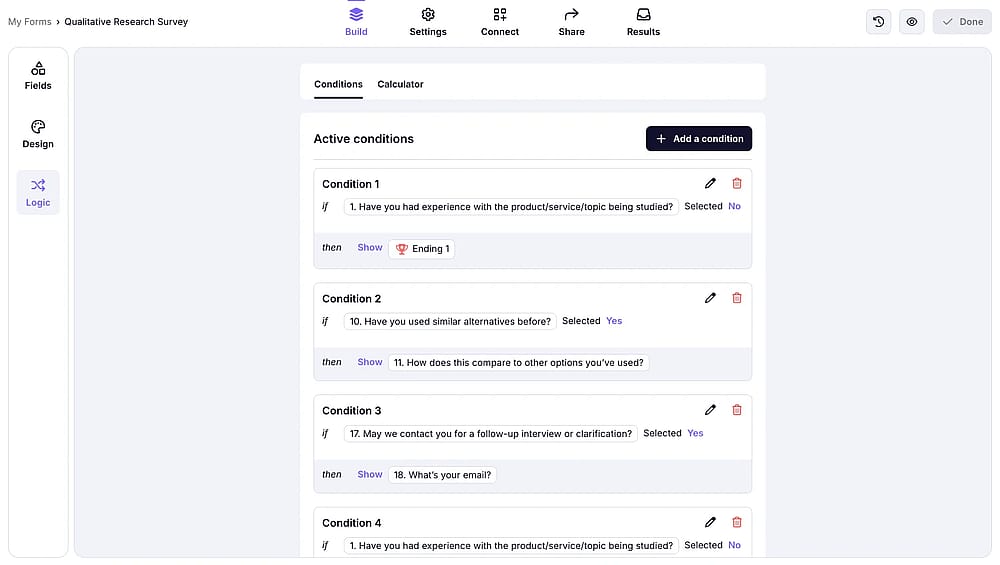
Check the Conditional Logic before publishing
7 Expert tips for high-integrity data
Mastering how to write good survey questions for research requires choosing the right research method. Focus on neutral phrasing and logical flow to ensure every response delivers high-integrity, actionable data.
- Use plain language: Avoid industry jargon. If a respondent has to Google a word in your question, they will likely close the survey.
- Maintain balanced scales: If you offer "Very Satisfied" and "Satisfied," you must offer "Dissatisfied" and "Very Dissatisfied." An unbalanced scale is a form of Survey Bias.
- Eliminate “Leading questions”: Don't ask, "How much did you enjoy our world-class service?" Instead, ask, "How would you rate your experience with our service?"
- The 10% open-ended rule: Open-ended questions provide rich "Experience" data but are mentally taxing. Keep them to less than 10% of your total survey to prevent respondent fatigue.
- Respect the "Cognitive load": Keep questions under 20 words. The faster a user can process the question, the more accurate their "gut" response will be.
- Social proof & feedback: If you are surveying colleagues or a focus group, explain why their data matters. Transparency increases the trustworthiness of the study.
- Avoid "double-barreled questions": Never ask: "Was our staff friendly and fast?" What if they were friendly but slow?. Split these into two distinct questions.
Survey question types & examples
If you want your respondents to answer, you need to stop there and think about your to-do list. Since I have paid attention to the items listed below, I have started collecting more meaningful data and increasing the response rate.
Here is the secret sauce of survey question types with applicable examples:
1. Multiple-choice (Categorical)
💡 Editor’s experience: In my experience, multiple-choice questions are the gold standard for speed. I’ve seen data clarity spike immediately because these standardized options eliminate the ambiguity of open-ended text.
✅ Good: "Which social media platform do you use most for business news?" (Provides specific context).
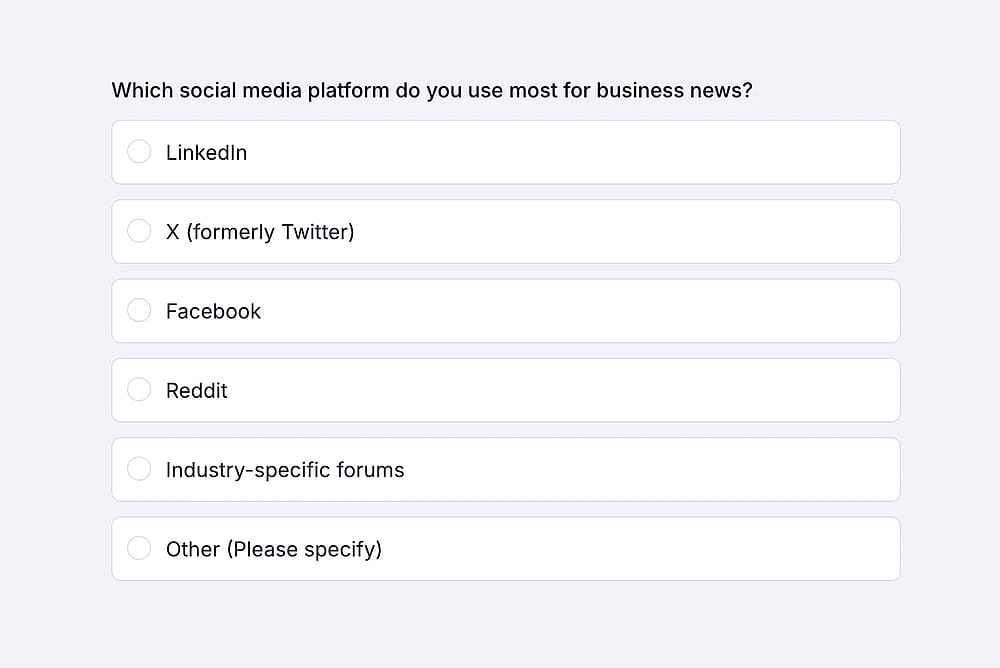
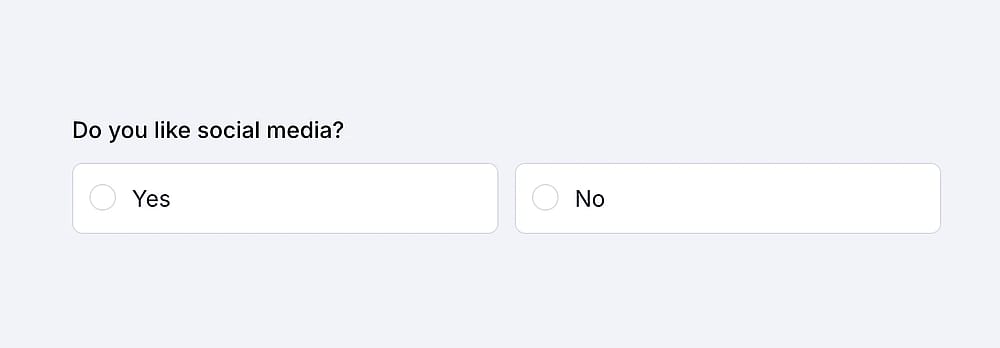
❌ Bad: "Do you like social media?" (Too broad; binary answers lack depth).
2. Likert Scale (Attitudinal)
💡 Editor’s experience: I've found that Likert Scales are unbeatable for tracking nuances. In one project, switching to a 5-point spectrum revealed a neutral majority that our previous binary questions had completely missed.
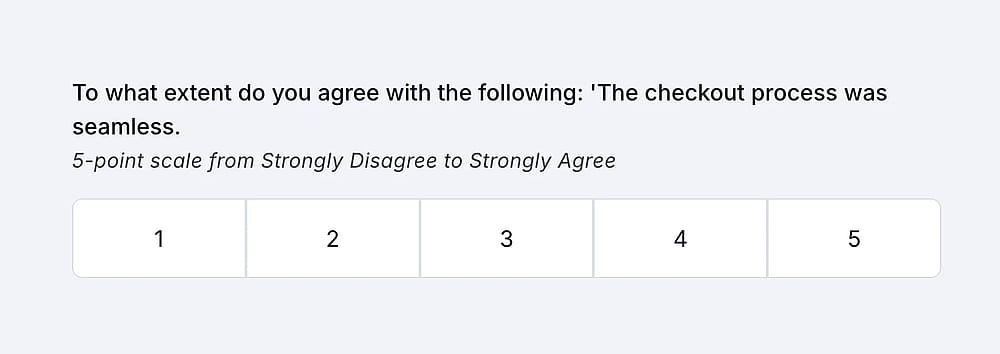
✅ Good: "To what extent do you agree with the following: 'The checkout process was seamless.'" (5-point scale from Strongly Disagree to Strongly Agree).
❌ Bad: "How great was the checkout?" (Leading and lacks a neutral midpoint).

3. Ranking questions (Prioritization)
💡 Editor’s experience: I’ve used ranking questions to settle internal team debates. By forcing users to prioritize features, I saw immediately which "roadmap" ideas were essential versus those that were just “nice-to-have”.
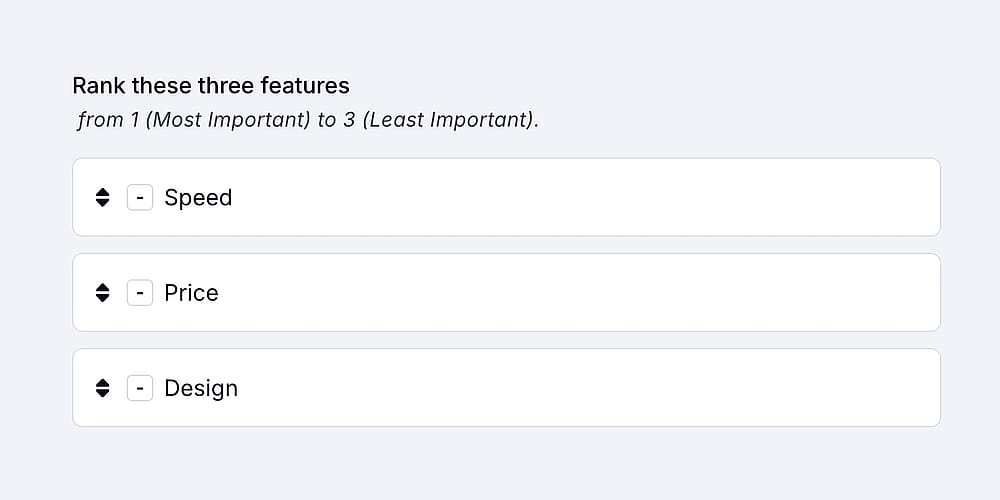
✅ Good: "Rank these three features (Speed, Price, Design) from 1 (Most Important) to 3 (Least Important)."
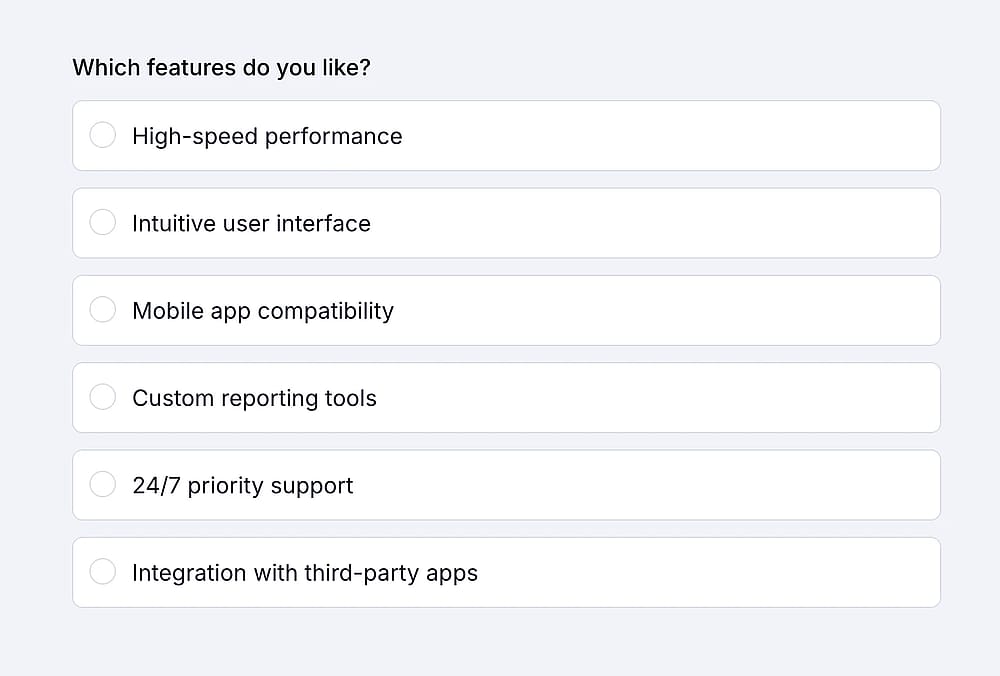
❌ Bad: "Which features do you like?" (Doesn't force the respondent to make a trade-off).
4. Demographic questions (Profiling)
💡 Editor’s experience: I’ve seen completion rates plummet when sensitive questions lead. By moving demographics to the end, I noticed users felt more invested after answering the fun stuff, significantly reducing Survey Abandonment.
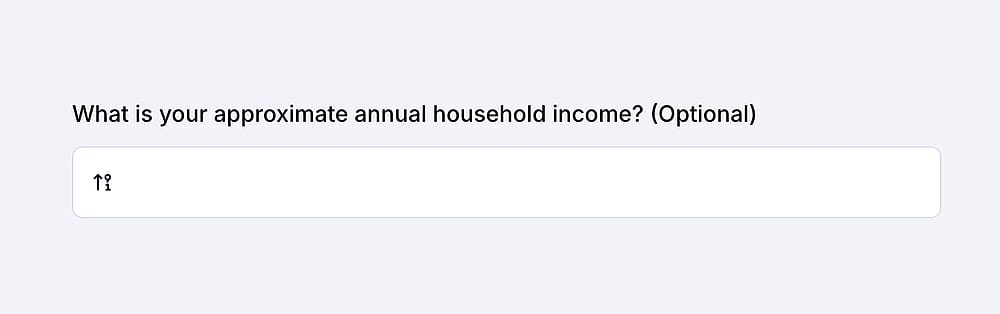
✅ Good: "What is your approximate annual household income? (Optional)", Always include a "Prefer not to answer" option.
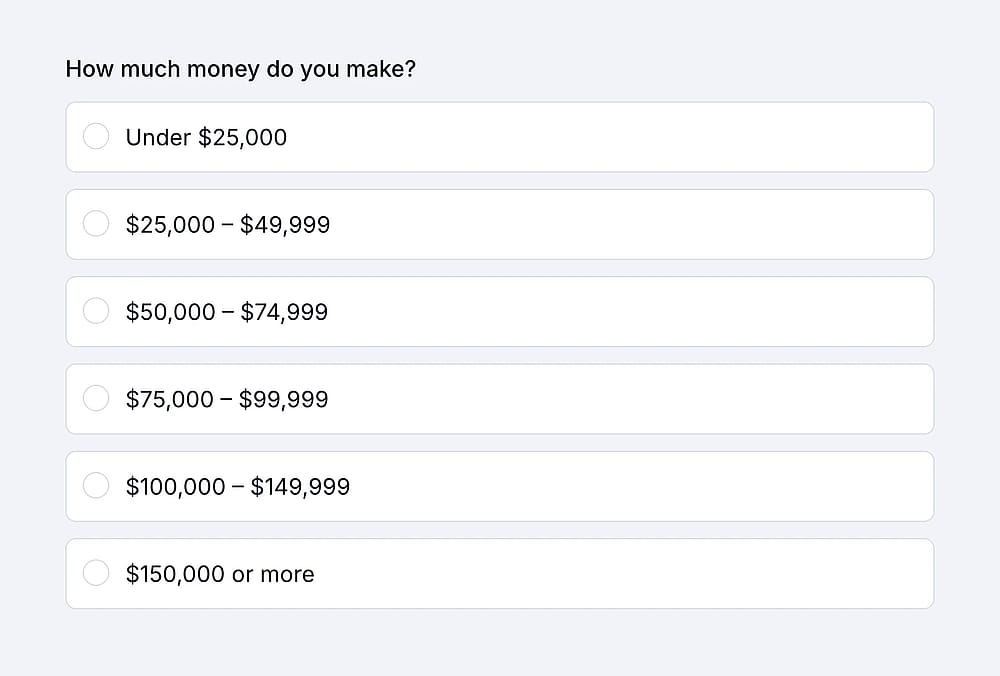
❌ Bad: "How much money do you make?" (Too intrusive and lacks a 'skip' option).
Final takeaway: Accuracy starts with intent
To wrap things up, writing good survey questions is a delicate balance of psychology and technical structure. By focusing on neutral phrasing, avoiding double-barreled traps, and keeping your "cognitive load" light, you ensure that the data you collect is actually actionable rather than just noise.
Ultimately, remember that trust is your most valuable currency. I’ve seen results improve immediately when authors prioritize transparency, use balanced scales, and save sensitive demographics for the end. Whether you are conducting face-to-face interviews or digital polls, always pilot your questions first. This "soft launch" is the best way to catch errors and guarantee that your how to write good survey questions for research leads to meaningful, high-integrity insights.
Frequently asked questions (FAQs)
The most frequent error is asking double-barreled questions. This occurs when you ask two things in one sentence (e.g., "Do you feel good mentally and physically?"). This ruins your research method because a survey respondent might feel good physically but bad mentally, making their "Yes" or "No" answer inaccurate and unusable.
The best way to identify bias is through a "soft launch." Send your survey to 5–10 people and ask them if any questions felt like they were "leading" them toward a specific answer. If you ask about customer service, ensure your scale has an equal number of positive and negative choices.
Transparency is key. Including a "Prefer not to answer" option actually prevents people from quitting entirely when they feel cornered by a question.
Contributors
Researched & written by
forms.app, your free form builder
- Unlimited responses
- Unlimited questions
- Unlimited team members