Save up to 60% on yearly plans and enjoy our biggest offer of the year. Limited time only. 🍂
See pricing

Consent Forms 101: Tips, how to create & more
Summarize with
If you plan to organize or execute any activity involving another person, whether it is academic research, a student field trip, or a medical procedure, a signed form of consent is essential. While managing physical, hardcopy paperwork can be a logistical headache, switching to digital consent form templates saves an enormous amount of time for both you and your participants.
This comprehensive guide covers everything you need to know: definitions, core use cases, the legal benefits, a step-by-step creation guide, and expert tips for compliance.
What is a consent form?
If you are looking for a formal consent form definition, it can be summarized as follows:
A consent form is a legal document used to request explicit permission from individuals to carry out specific tasks or include them in certain activities.
A signature on a form of consent certifies that the signatory fully understands the terms, risks, and scope of the activity, and agrees not to hold the organizing party liable for standard inherent risks.
Primary objectives:
- Inform: Clearly notify individuals or groups about the nature of a specific activity or process.
- Educate: Ensure participants comprehend both the benefits and potential risks involved.
- Authorize: Obtain explicit, documented, and voluntary agreement to participate.
- Clarify: Provide the participant an opportunity to ask questions before making a binding decision.
Common use cases for consent forms
Consent forms are utilized far beyond standard medical offices. Here are the eight most common areas where they are legally or ethically required:
1. Corporate regulations & Codes of ethics
Consent forms establish a baseline of behavioral expectations during onboarding or policy updates. Digital forms make it easy to distribute updates, track changes, and monitor exactly who has signed and initialed new agreements as a company scales.
2. Academic research & Behavioral studies
A research form of consent informs prospective participants of a study’s purpose, duration, and procedures. It explicitly states that their participation is voluntary, they may withdraw at any time without penalty, and their personal data will remain strictly confidential.
3. Medical & Aesthetic procedures
In clinical environments, a medical consent form sample for patients is utilized for surgeries and invasive procedures. However, these forms are also mandatory for aesthetic and beauty services like tattooing, botox injections, body sculpting, laser hair removal, and waxing.
4. Schools & Educational institutions
Forms signed by parents or legal guardians are essential for minors (often paired with "assent forms" for the children themselves). They outline the inherent risks of sports, field trips, or digital media distribution, protecting schools from unnecessary legal disputes.
5. Media & Entertainment release
In the creative industries, determining who owns, credits, and receives payment for artwork, video, or photography can get messy. Production companies, videographers, and photographers use model and talent releases to legally secure the distribution rights to an individual’s likeness or work.
6. Employment & HR background checks
Employers use background check consent forms to secure written approval before pulling a candidate's criminal history, credit reports, or educational background. This ensures absolute transparency and keeps the company compliant with employment laws.
7. Photography & Videography model releases
Because state laws strictly protect an individual's right to privacy, a business cannot commercially profit from someone’s likeness without a signed release. A model release transfers the usage rights to the photographer.
8. Digital cookies & Privacy policies
Modern data privacy laws require websites to get explicit consent before dropping tracking cookies onto a user's browser. A compliant cookie policy uses simple language to outline what data is tracked, how it is used, and how a user can opt out.
Reasons to use online consent forms
In most cases, the consent process are beneficial for not only the signatory, but also for your own organization and company.
Benefit | Impact on your Organization / Company |
|---|---|
Legal Compliance | Directly aligns data collection with strict global privacy frameworks like the GDPR and CCPA to avoid catastrophic fines. |
Customer Retention | Demonstrating deep respect for user privacy builds foundational trust, fostering long-term loyalty. |
Transparent Communication | Eliminates hidden clauses, establishing a clear, mutual dialogue regarding data usage from day one. |
Deep Personalization | When users voluntarily opt-in to share their preferences, marketing teams can deliver targeted experiences. |
Enhanced Credibility | Presenting digital forms elevates your brand identity and separates you from less secure competitors. |
How to create a consent form without coding
Using modern online form builders like forms.app, you can find a professional consent form sample, customize it, and build your own secure documents in just five steps:
1. Log in / Create an account
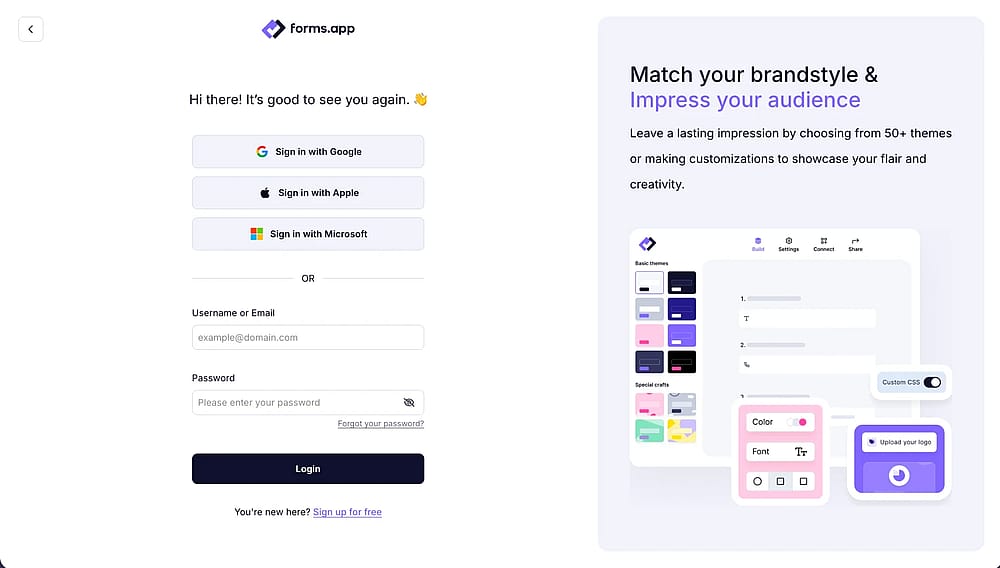
Open your account
Sign up for a free account via email, or log in instantly using your existing Google, Facebook, or Apple credentials.
2. Select your build method
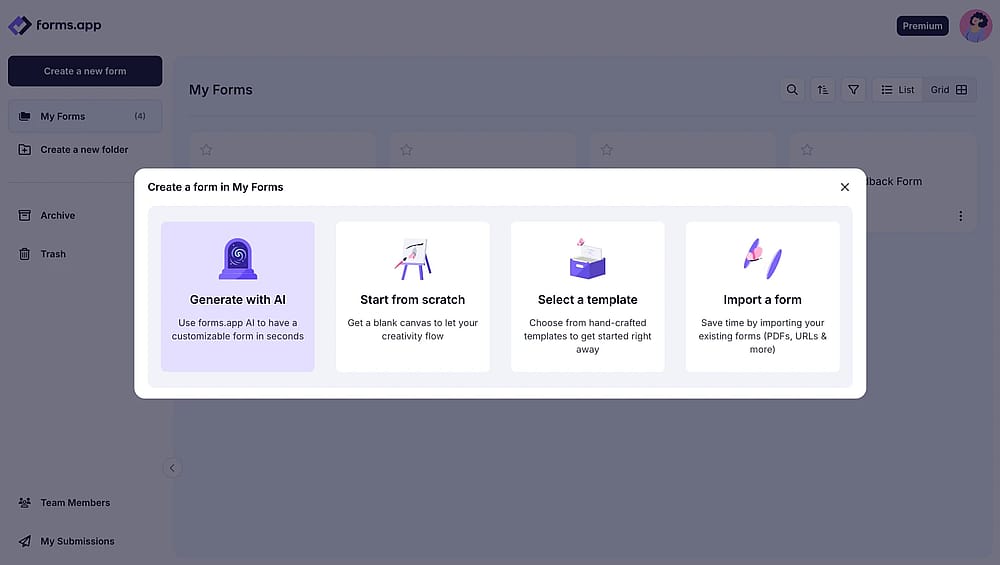
Choose a way to start
Choose to start from scratch using a clean list/step view, select from dozens of ready-to-use consent form templates, or use an AI form builder to auto-generate your layout based on a text prompt.
3. Customize your fields & Questions
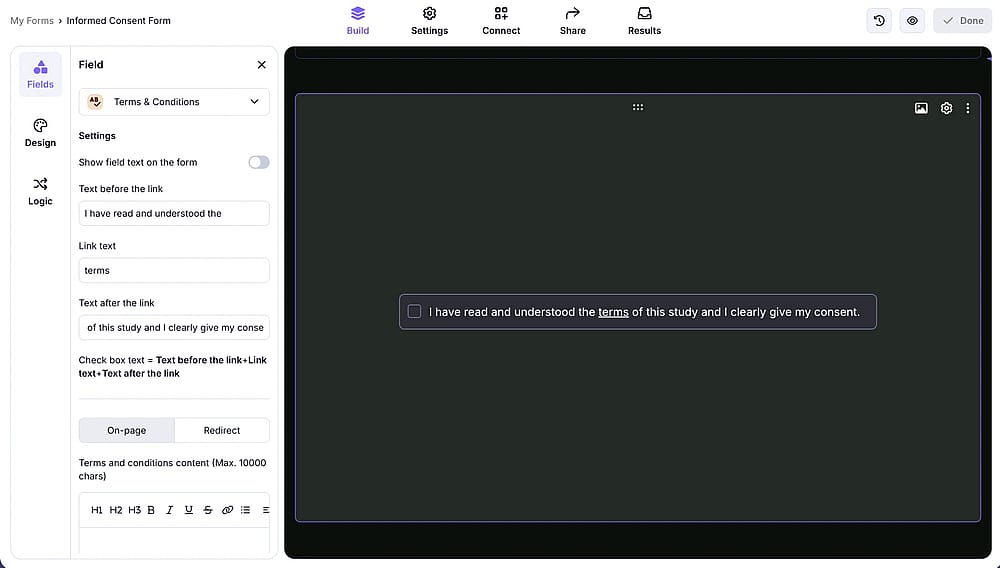
Add a term & conditions or signature field
Drag and drop required fields into the builder. Ensure you include essential contact details, legal text, digital signature boxes, and dates.
Tip: Use the AI rewriting tool to polish your questions for absolute clarity.
4. Configure privacy & Share
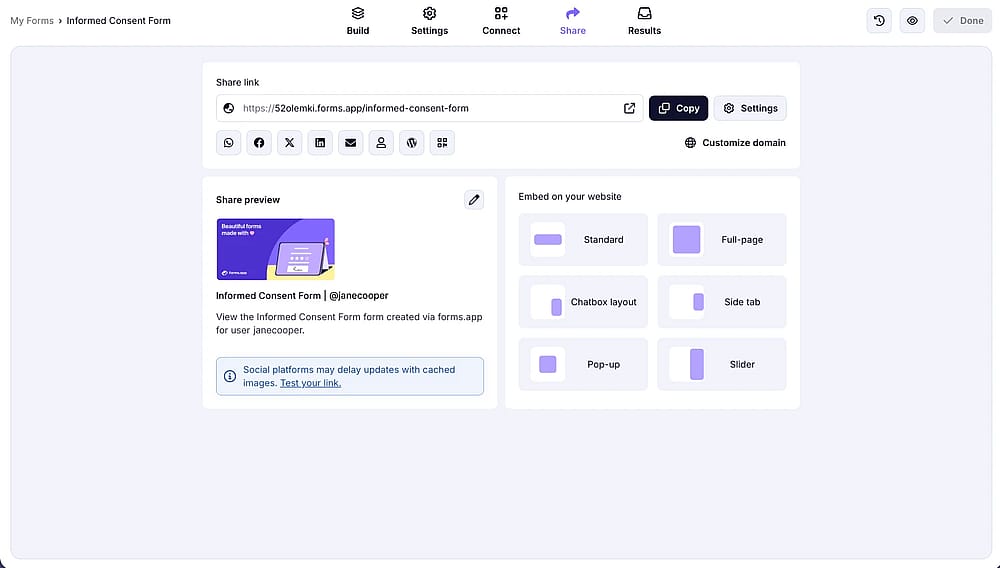
Share the form URL
Set your form accessibility to public, private, or restricted. Copy the direct link to share on social media/email, or generate an embed code to place the form seamlessly onto your website.
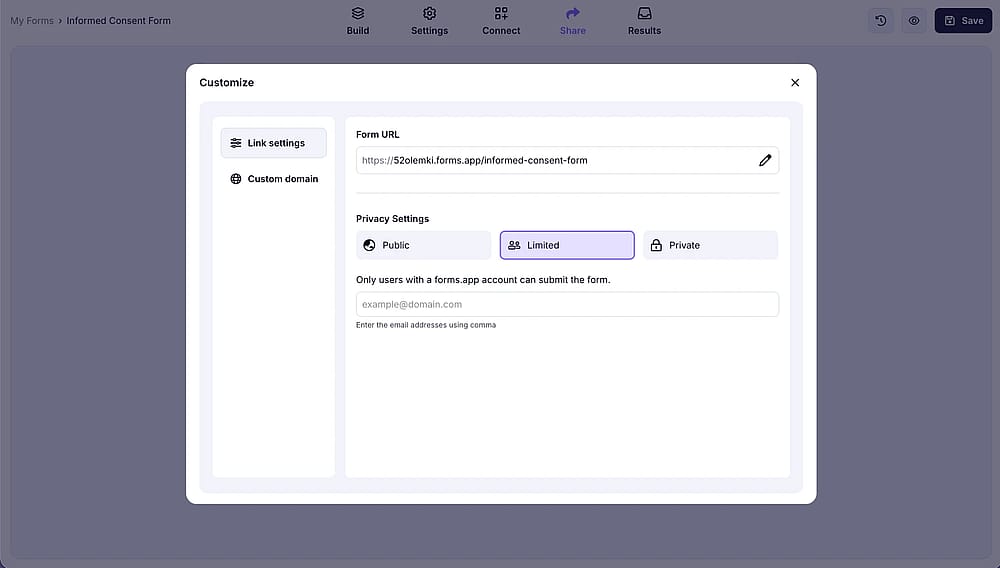
Customize the privacy settings
5. Analyze responses
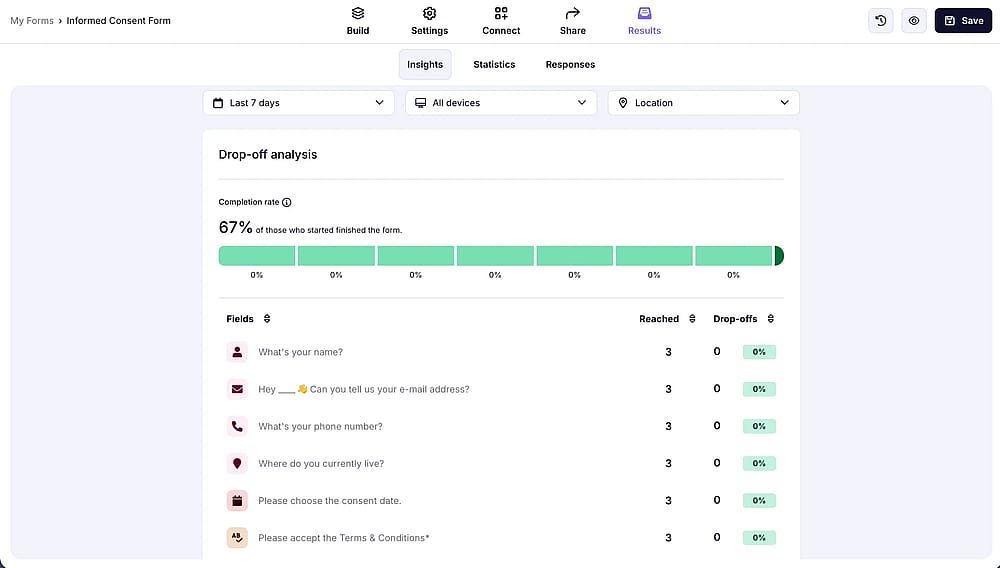
Analyze the repsonses
Navigate to the "Results" and "Statistics" tab of your form builder dashboard to securely view, sort, and analyze your legally binding digital signatures.
5 expert tips for bulletproof consent forms
- Provide crystal-clear context. Clearly state the exact purpose of the form right at the top. When participants understand their rights and interests are respected, it builds immediate confidence and eliminates downstream friction.
- Map out data security. Clearly state how the collected data will be processed, stored, and protected. If the explanation is lengthy, provide a direct link to your official Privacy Notice.
- Ensure true mutual understanding. Avoid a one-sided agreement. Detail the exact responsibilities of both parties. If you are ever uncertain about liability loops, always review a compliant consent form sample or consult an attorney.
- Ruthlessly cut the jargon. Avoid overly dense legalese or confusing technical terms. Forms should be highly readable regardless of the signatory's educational background.
- Outline the right to revoke. Legally, users must know how to access, edit, or entirely withdraw their consent at any given time. Providing an explicit mechanism or email address for consent revocation demonstrates compliance and integrity.
Frequently asked questions (FAQs)
An informed consent document is designed to protect both the participant and the organization by establishing absolute transparency. Its primary purpose is to clearly communicate what an activity entails, how personal data will be managed, and what rights the signatory retains. By signing, the participant acknowledges they have read, understood, and agreed to the stated terms voluntarily.
In institutional research studies, obtaining explicit consent is both a strict legal requirement and an ethical baseline. It ensures that human subjects are participating of their own free will, understand the scope of the study, and know they can withdraw at any time. Furthermore, institutional review boards (IRBs) require documented consent to ensure human welfare and data privacy protection.
A legally compliant form must provide a balanced overview of all potential risks and benefits associated with an activity or procedure. You should list any predictable positive outcomes alongside any potential liabilities, physical discomforts, or data privacy risks. Presenting this information clearly allows the participant to make an educated, uncoerced decision.
Yes. Any known side effects, even minor ones like redness from laser hair removal, swelling from cosmetic injections, or bruising from a tattoo, must be explicitly disclosed. Failing to outline common complications can leave your business vulnerable to unnecessary legal disputes, even if the procedure was performed perfectly.
- June 2026 - Revised and expanded the tips section
- June 2026 - Recreated the concept form creation steps
Contributors
Researched & written by
forms.app, your free form builder
- Unlimited responses
- Unlimited questions
- Unlimited team members