Save up to 60% on yearly plans and enjoy our biggest offer of the year. Limited time only. 🍂
See pricing

How to make a job application form in Google Forms (Easy-steps)
Summarize with
Creating a Job Application Form on Google Forms comes with many benefits. Employers may face a time-consuming job application process to find suitable candidates; this often includes getting cover letters, allowing file uploads, and replying to the candidates later on. Creating a job application form is one of the most effective ways to evaluate candidates and determine their suitability for the position. One way to manage this process more efficiently is to use Google Forms.
In this article, we will cover how to create a Google Form for job applications step-by-step, occasional tips, and a better method of creating a job application form so that you can find the best candidate for the job.
How to create a job application form in Google Forms step-by-step
A Google job application form streamlines the hiring process both for you and your candidates. It is easy to create and, like any online form, comes in handy for collecting files and reviewing applications later. Here are the steps to create your own Google Forms employment application form:
- Create a new Google Form
- Add a form title and application details
- Add form fields and screening questions
- Match the form design with your brand
- Configure form settings
- Set up conditions (Optional)
- Share your form
1. Create a new Google Form
To create a Google Form application for employment, first go to docs.google.com/forms, then sign in to your Google account. Then click the “+” button to start with a blank form, or open the “template gallery” at the top right to use the Google Forms job application template.
For this tutorial, we’ll go with the “Job application” template available in Google Forms. You can also use the Google Form employment template we created for this guide.
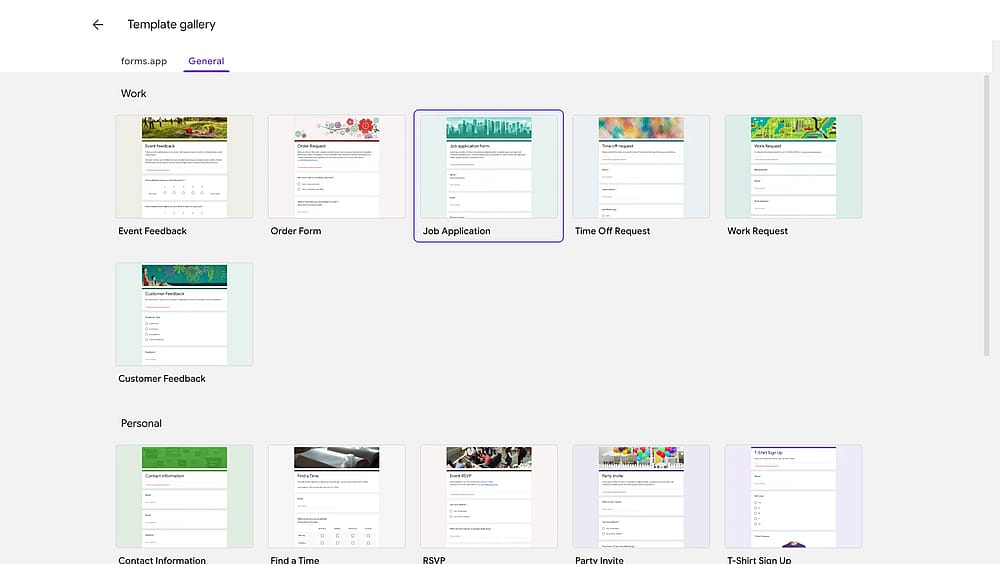
Creating a new Google Form using the “Job application” template
2. Add a form title and application details
Once you create a form or open the template, the next step is to add a title and description to your application form. This is to inform the candidate about the position, what’s expected, and the application process. In some cases, this section is on the webpage rather than the form; however, it is expected to include essential details on the form.
Example title: "Marketing Manager Application - [Company Name]"
Example Description: Thank you for your interest in the Marketing Manager position at [Company Name]. This application takes approximately 10-12 minutes to complete.
- Job title: Marketing Manager
- Department: Marketing
- Employment Type: Full-time
- Location: [City, State, or Remote]
Of course, you can add the full list of "Responsibilities" and "Qualifications" to this description. It is also possible to create another section within your Google Forms application form just for position details.
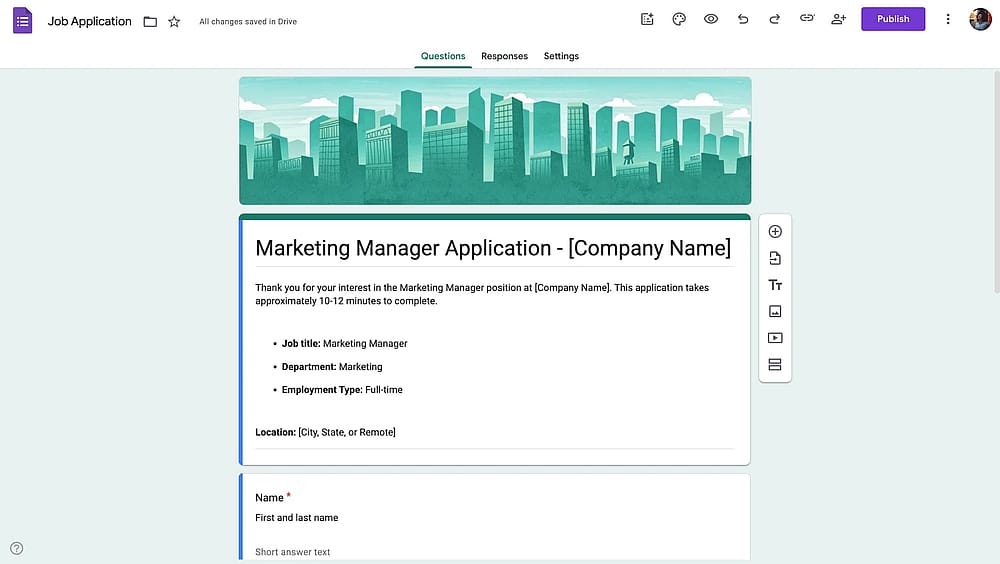
Adding a form title and application details
3. Add form fields and screening questions
Asking job applicants the right questions and organizing the questions in the right order is the most critical step. It is also important to show or hide specific questions depending on the job position and the company’s needs. But we’ll come to that in the next steps.
The Google Forms “Job Application” template comes with 5 questions: Name, email, phone number, position selection, and cover letter. You can add your own questions under them, and create a new section for other screening questions.
💡 Pro tip
Click the three dots (⋮) on the bottom right of a question and enable "Description" to add help text.
Here are some essential details you can ask:
- personal information, such as full name
- contact information, such as email address and phone number
- education level
- employment history
- work experience
- social security number
💡 Did you know?
Adding a multiple-choice grid to Google Forms is also possible. By using a multiple-choice grid, you can get answers from job applicants more clearly and quickly.
For this Job application form tutorial, we have created several sections. A section for essential details, a section for education and work experience, a section for screening questions, and a section for legal acknowledgement.
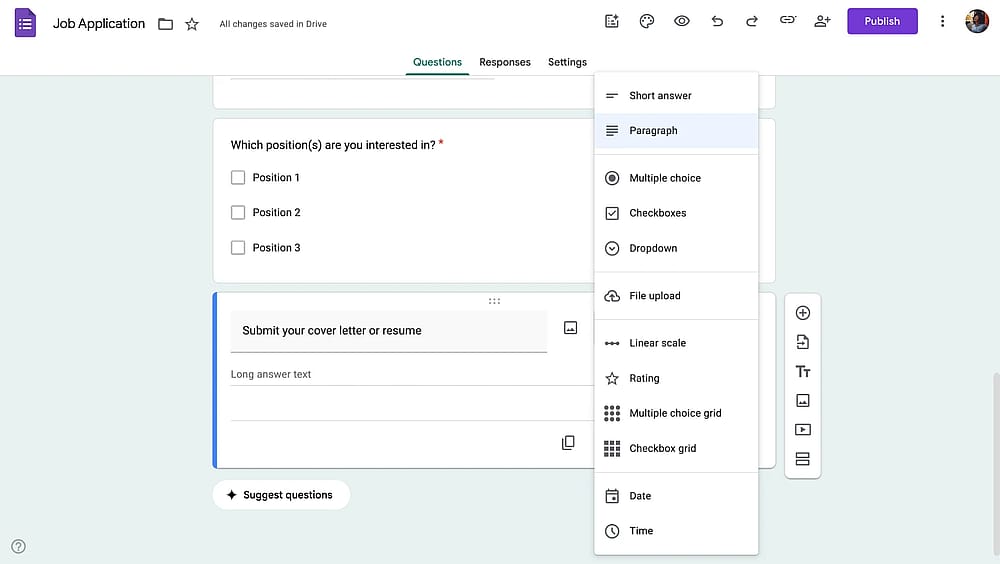
Adding employment questions to Google Forms
4. Match the form design with your brand
Adding a header image to Google Forms or changing the colors to your brand colors can go a long way in building trust.
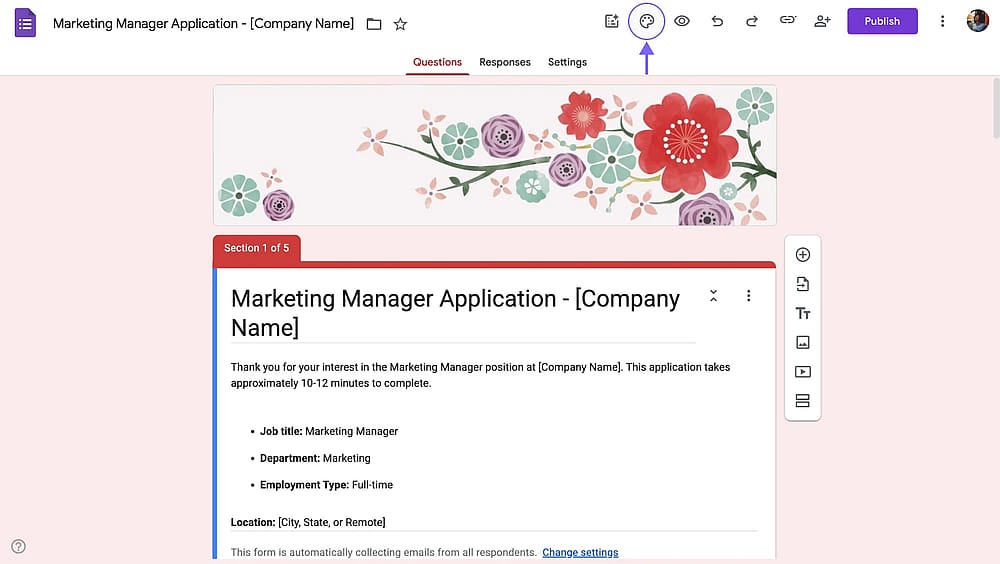
Opening the customization sidebar in Google Forms
5. Configure form settings
Switch to the “Settings” tab to configure your form settings. Here you can:
- Enable "Collect email addresses" (we recommend)
- Enable "Limit to 1 response" to prevent duplicate applications (we recommend)
- "Allow response editing" if you want to allow updates
- "Show progress bar" for multi-page forms
- Customize confirmation message that is shown after the candidate submits the form
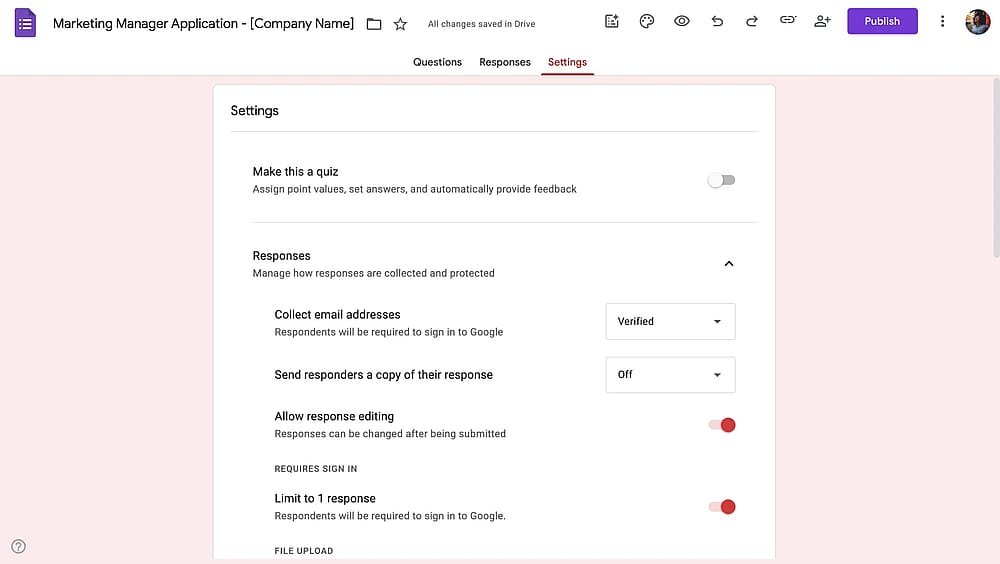
Configuring settings in Google Forms
6. Set up conditions (Optional)
In some cases, you may have multiple positions open and want candidates to choose. If that is the case, you can create sections for position-specific questions and show them only when the candidate selects that position. For detailed information, check out our Google Forms conditional logic guide. But here are the quick steps:
- Add a multiple-choice question for displaying different open positions.
- Click the three-dots (⋮) under your question and choose “Go to section based on response.”
- Select which option leads to which sections.
- If you have a shared section that the candidate must see, make sure position-specific sections lead to that shared section.
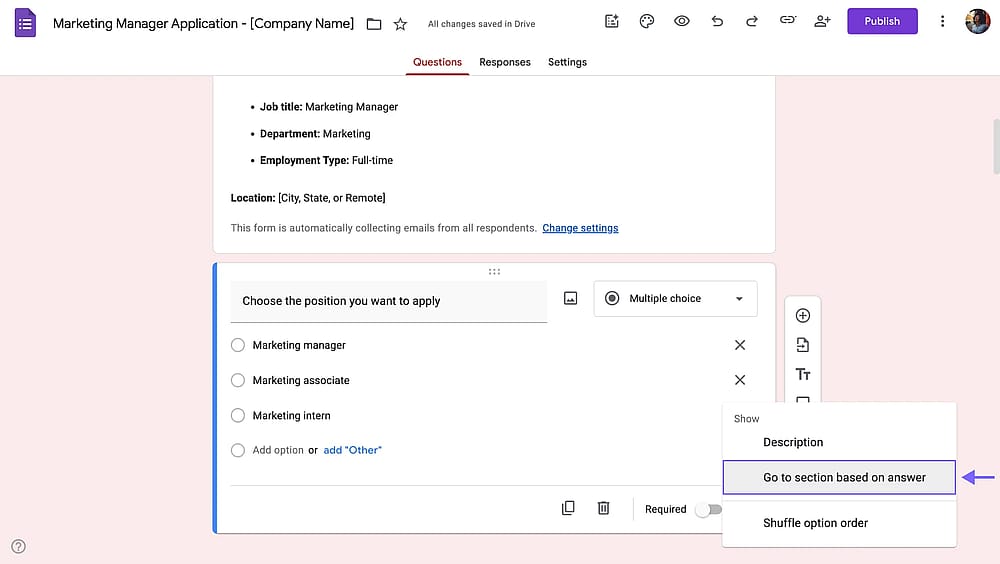
Setting up conditions for the questions in Google Forms
7. Share your form
Lastly, test your form using the eye icon and then click on “Publish” to share your Google Forms application form with your candidates. You can copy the link to share on your “open position” post, or you can embed the Google Form on a web page. After you start collecting applications, you can view the responses on the “Responses” tab or link them to Google Sheets.
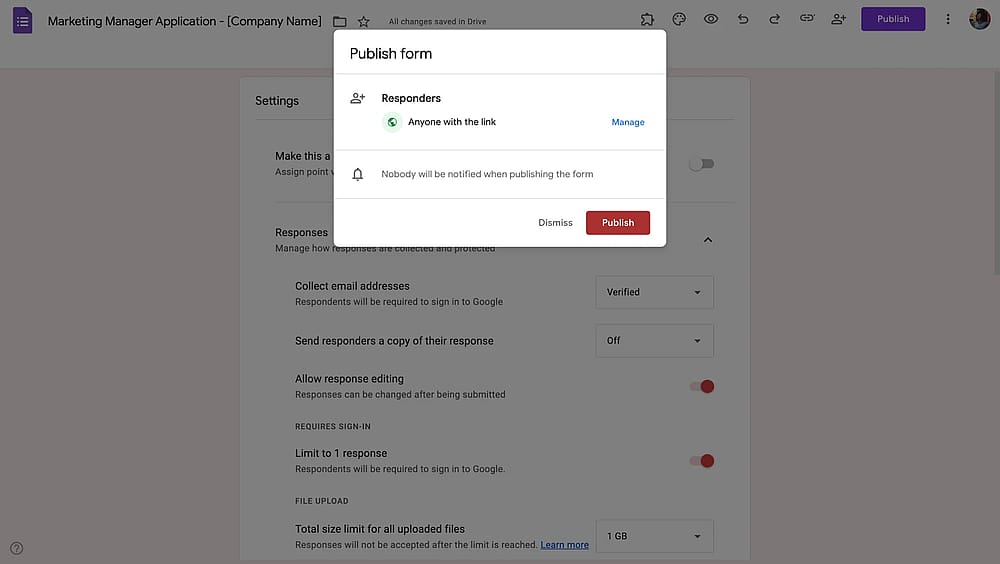
Publishing the Google Forms application form
forms.app: A more powerful alternative for job applications
While Google Forms is an excellent free tool, it has limitations that become apparent as your hiring needs grow. Understanding these constraints helps you decide when it's time to consider alternatives.
Why Consider an Alternative?
As your hiring needs evolve, you'll likely find yourself:
- Spending too much time manually organizing applications
- Losing track of candidates in spreadsheet chaos
- Missing qualified applicants because your form doesn't stand out
- Unable to provide candidates with professional experience
- Struggling to integrate applications with your existing tools
A dedicated form builder like forms.app stands out as a powerful and long-term solution. forms.app is a solid form builder alternative to Google Forms, a platform where you will find the ease of Google Forms, unmatched form aesthetics, and a significant feature set. Here’s a comparison:
Feature/tool | Google Forms | forms.app |
Form templates | Limited | 5,000+ free templates |
Customization | Very limited | Advanced |
Question types | 12 | 30+ |
File uploads | (Requires Google sign-in) | (No sign-in required) |
Conditional logic | Basic | Advanced |
Save & continue later | ||
E-signatures | ||
Custom domain | ||
Team collaboration | ||
Setting response limits | ||
Embedded forms | Basic embed | Popup, slide-in, full-page options |
How to create a job application form in forms.app
There are numerous features to customize and enhance the overall look of your form. You can create practical and professional-looking forms in minutes without writing code and without any expert knowledge. forms.app also has an AI form generator and other AI features like question paraphraser, answer option generator, PDF to form, and AI insights that will help you save your time and make the hiring process easy for yourself.
Follow these 4 steps and create your online job application form on forms.app for free.
1. Create your job application form on forms.app
Login to forms.app and click on “Create form” button to get started. forms.app gives you several options to create your form, such as:
- Starting with a blank form
- Choosing from job application form templates
- Generating a form using AI
- Importing a form from another platform
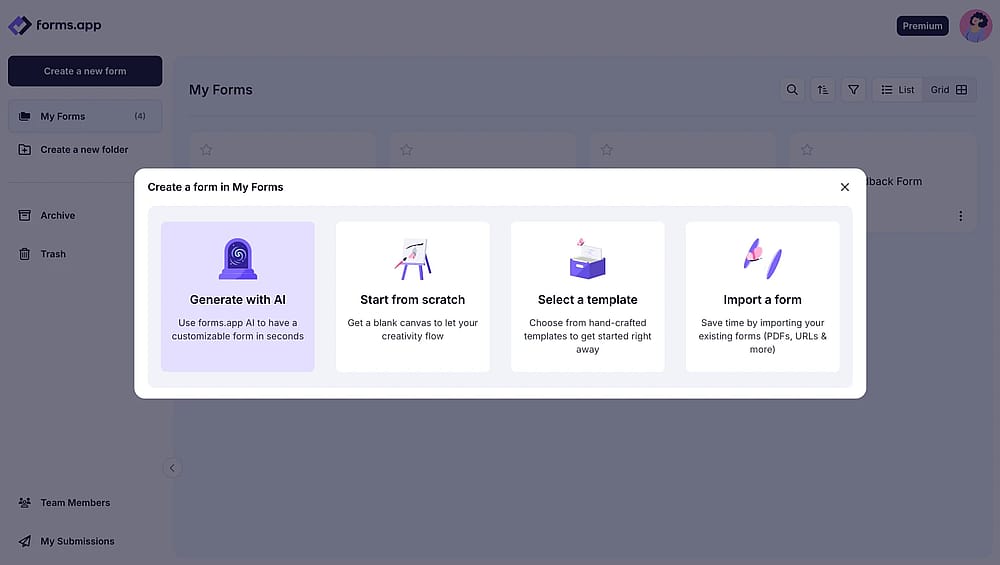
Creating a form on forms.app
2. Add questions to your job application form
After choosing a job application form template or using the AI option, you can change the questions in your job application form. While Google Forms offers only 12 field types, forms.app offers more than 30+ fields, so you can accurately communicate your questions about job details.
💡 When creating a job application form, you must ask the right questions of the person you are hiring. See these questions for online job applications if you want to ask more questions.
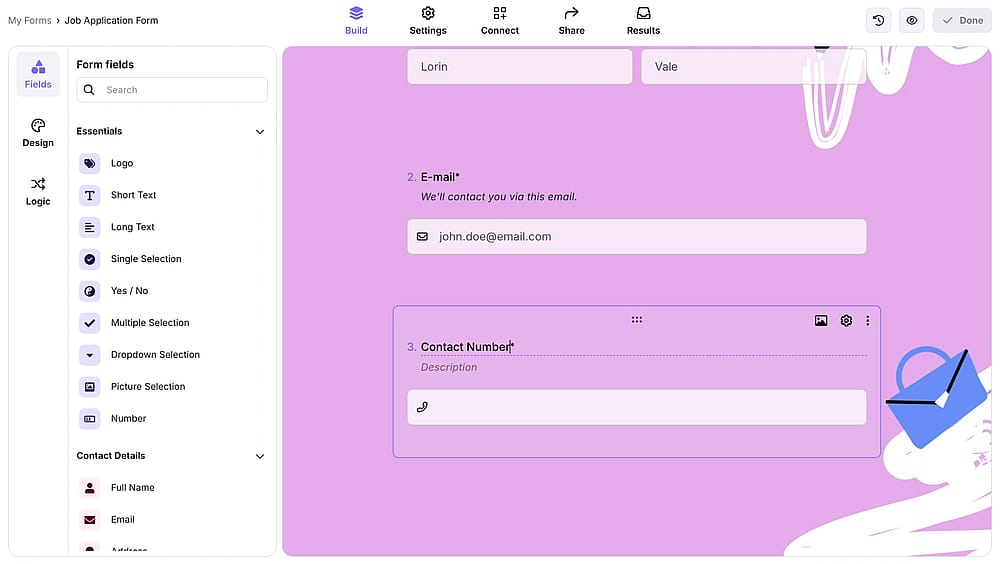
Adding questions and fields to your job application form
3. Customize the look of the form
The look and simplicity of your form are essential for the person filling it out. Well-designed forms get higher response rates. forms.app also offers many helpful templates and colorful themes. You can also set animated backgrounds for a more attractive form because the visual aspects of any form are equally crucial to its success. Plus, you can show your questions one by one or in a list. In any event, forms.app offers a smooth form-filling experience out of the box.
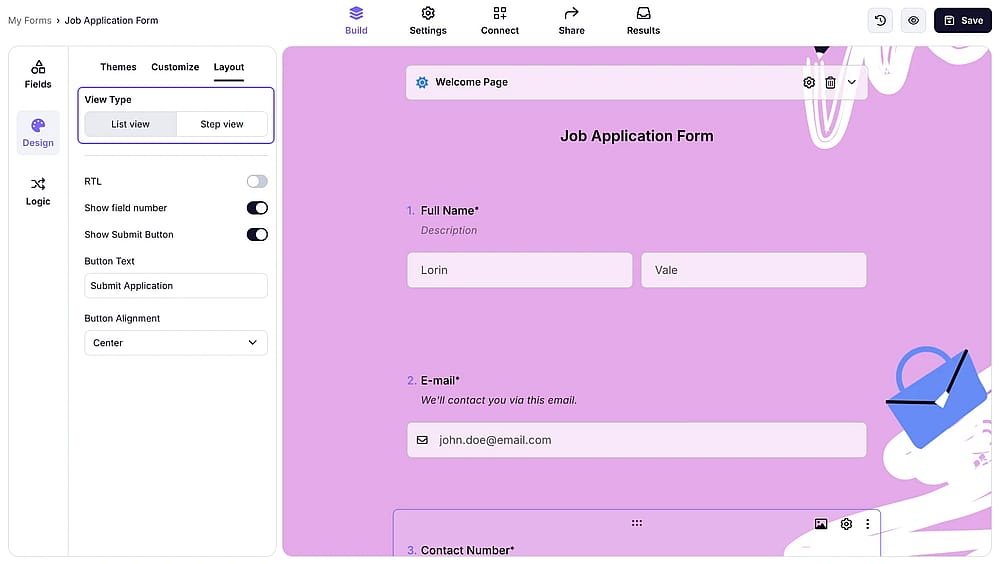
Customizing the design of your job application form
4. Share or embed it on your website
Lastly, go to the “Share” tab. Here, you can customize your form URL to share it with potential candidates. If your business has a website, you can embed your job application form on your website so that job applicants can apply by themselves.
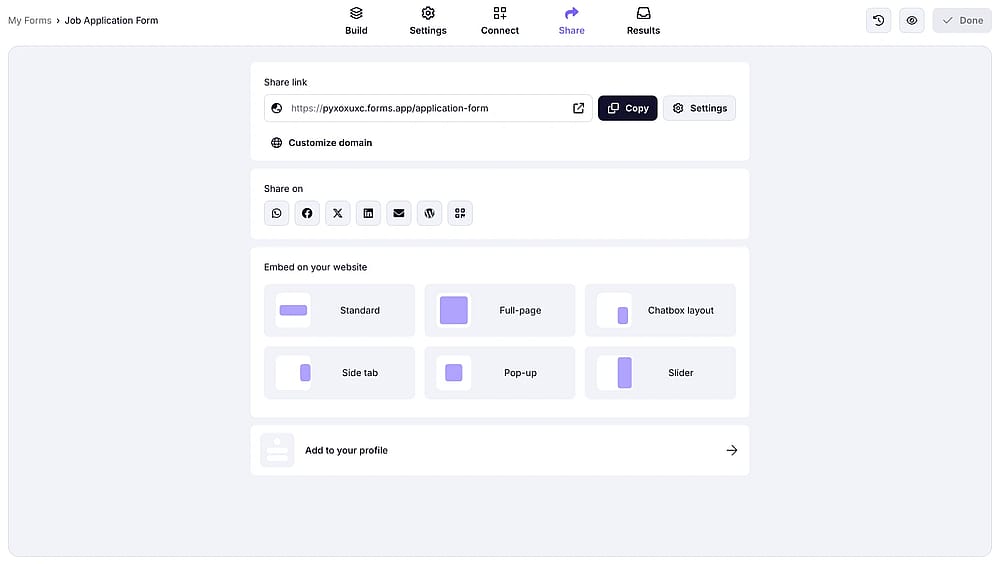
Sharing options available on forms.app
Frequently asked questions about creating a job application form in Google Forms
In addition to what you have learned from what you have so far, some questions asked when preparing a job application form can give you advice. Here are 3 frequently asked answers we have prepared for you when creating a job application form:
Yes. You can edit your Google Form anytime, even after sharing. All changes take effect immediately, though existing responses won't be modified. Just be cautious about removing or significantly changing questions if you've already received applications, as it may make existing data inconsistent.
In Google Forms settings, enable "Limit to 1 response" under the General tab. This prevents the same Google account from submitting multiple applications. However, applicants can use different email addresses to submit multiple times if they really want to.
Google Forms provides numerous advantages in the recruitment process: easy accessibility and time savings with a simple no-code interface, data collection and customization options, and more.
You can customize specific areas of Google Forms. You must select a blank template or open an existing form, then click on the paint palette icon on the top right. You will then see the fields you can edit in the open tab. You can customize the form’s themes, header image, background color, and text fonts.
Google Forms' file upload field accepts video files (MP4, MOV, AVI, etc.), but with file size limits. Alternatively, you can add a URL field where candidates can submit links to videos hosted on YouTube, Vimeo, or other platforms. forms.app offers similar options with more generous file size limits.
While Google Forms works well for basic needs, dedicated form builders like forms.app offer significant advantages: no Google account required for file uploads, better design customization, advanced automation, superior mobile experience, and integrations with business tools. The choice depends on your volume, budget, and desired features.
Key takeaways
Creating an effective job application form is one of the smartest investments you can make in your hiring process. Remember, your hiring form can be the first impression your potential candidate will get about your company.
Google Forms is an excellent starting point for basic needs. It's free, familiar, and surprisingly capable for small businesses or simple positions. The step-by-step guide in this article will have you up and running in under an hour.
Consider more advanced tools like forms.app for a better experience and easier data collection. When application volume increases, when you need better candidate experience, or when integration with your tech stack becomes important, purpose-built form builders offer significant advantages without breaking the budget.
Focus on candidate experience and legal compliance. The best forms balance data collection with respect for applicants' time. Keep it under 15 minutes, optimize for mobile, and ensure you're asking only legal, necessary questions.
In this article, we’ve covered creating employment application forms in Google Forms, the limitations, a better alternative to create job application forms, and frequently asked questions. We hope you learned the essentials and picked up the pro tips we sprinkled throughout the article.
Contributors
Researched & written by
forms.app, your free form builder
- Unlimited responses
- Unlimited questions
- Unlimited team members