Save up to 60% on yearly plans and enjoy our biggest offer of the year. Limited time only. 🍂
See pricing

How to create an order form in Google Forms
Summarize with
TL;DR: How to create a purchase order form in Google Forms
1. Go to docs.google.com/forms and use the Google Forms order form template
2. Add fields for all essential purchase order details, such as product list, quantities, delivery address, and payment terms
3. Choose a method to collect payments in Google Forms (e.g., Google Workspace Marketplace add-ons, payment link in the confirmation message, or embedding a QR code for payment platforms)
4. Link responses to Google Sheets for organized tracking, then set up email notifications
5. Test the form internally before sharing via link, email, or website embed
If you have a large company or a small business working in fields like catering, advertising, or managing stores, using online order forms is essential. For firms, online forms simplify order management and payment processes, reducing the chances of unexpected mistakes and ensuring smooth transactions. Also, your customers can order things easily from home, which is super convenient.
A Google Form order form is one of the first tools people reach for. It's free, requires not much technical setup, and most people already have a Google account.
This guide walks you through how to build an order form in Google Forms. We’ll also cover what goes into a Google order form, where Google Forms falls short, a better way to create online order forms, and frequently asked questions about Google Forms order forms.
What is an order form?
An order form is essentially a document that collects information about which products or services the buyer wants to purchase, in what quantities, and by what delivery date.
A good order form should be easy for customers to complete, clearly present your products or services with pricing, confirm the order back to the customer, and ideally collect payment in the same step. Google Forms handles the basics well. Product presentation and payment, however, require workarounds.
What Fields Should an Order Form Include?
Getting the fields right before you start building saves a lot of editing time later. A well-structured online order form should include:
- Customer name and email address (for order confirmation and follow-up)
- Phone number (useful for delivery coordination or quick clarifications)
- Delivery or shipping address (if you're delivering physical products)
- Product or service selection (what the customer wants, including options for variants like size, color, or flavor)
- Quantity (how many of each item)
- Pricing information (clearly shown per item so customers know what they're committing to)
- Order total (ideally calculated automatically; in Google Forms, this has to be handled manually or via an add-on)
- Preferred delivery or pickup date (relevant for made-to-order, catering, or scheduled services)
- Payment method or confirmation (how the customer will pay, or confirmation that payment was collected)
- Special instructions or notes (customization requests or anything else the customer needs to communicate)
Google Forms can collect all of these as form fields. The two it can't handle well are auto-calculated totals and inline payments. So, keep that in mind as you follow the steps below.
How to make an order form in Google Forms for your business
Google Forms, part of the Google Workspace suite, is a basic but effective form tool, and you can use it for getting online orders for your business.
Here’s a step-by-step guide on how to create an order form in Google Forms:
1. Open the Google Forms order form template or create a blank form
Go to docs.google.com/forms and sign in with your Google account. You have two options: start from a blank form, or select Google's built-in order form template from the template gallery.
The template gives you a rough starting structure, but it has no pricing logic and no payment field. You'll be customizing it significantly either way. Starting blank is often just as fast.
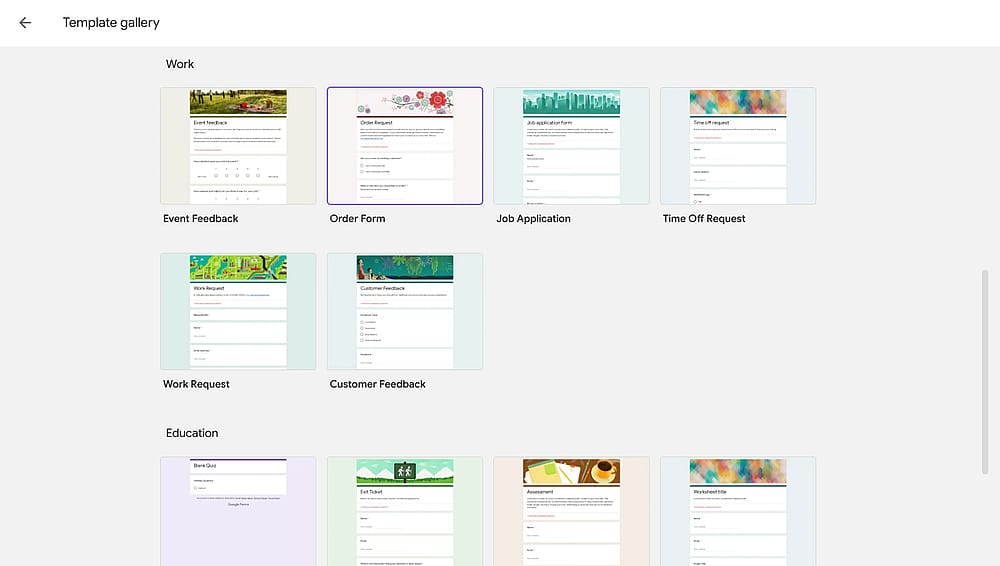
Choose a template
Pro tip Give your form a clear title like “[Whatever your product is] order form” and add a short description explaining what customers can order and what to expect after submitting.
2. Add your order fields
Click the Add question icon in the right-side toolbar to start building your form. Here's how to match each order element to a Google Forms question type:
- Customer name, email, phone, delivery address: Short answer
- Preferred delivery or pickup date: Date
- Product selection: Multiple choice or dropdown. List each product as an option and include the price in the label (e.g., "Vanilla Birthday Cake ($45)")
- Quantity: Dropdown with number options, or short answer with number validation
- Product variants such as size, color, or flavor: Multiple choice or dropdown, one per product
- Special instructions: Paragraph
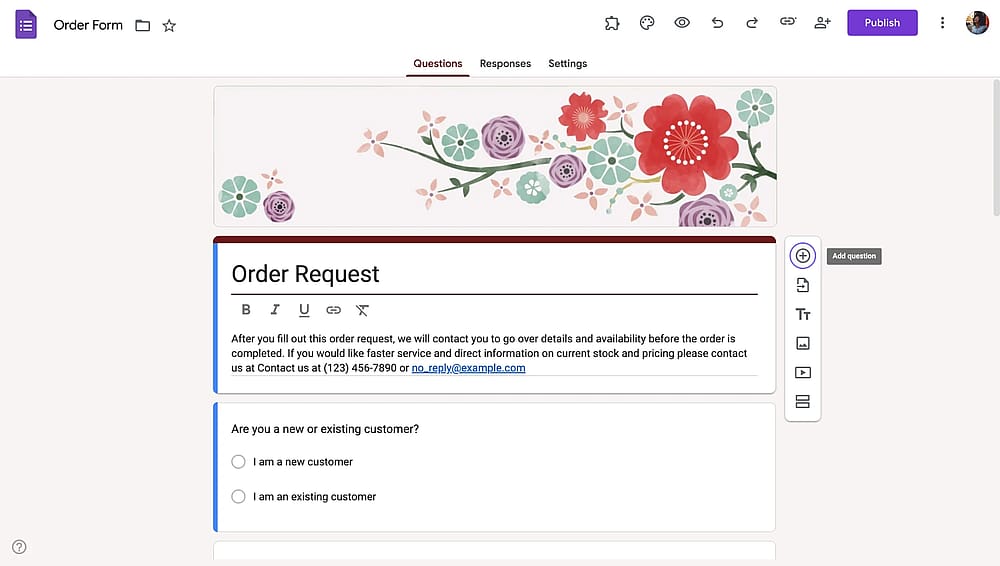
Add your questions to the order form
Remember Google Forms has no dedicated product field. You're using a multiple-choice or dropdown question to stand in for a product catalog, which means no product photos, no per-item pricing logic, and no automatic total calculation. Customers must figure out the math themselves, and so must you when reviewing orders.
3. Add a payment method to your form
Now that you've completed your order details and essential information for your clients, it's time to learn how to collect payments easily in Google Forms. You have three workaounds to collect payments on Google Forms order forms.
A. Install a payment add-on
Click the three-dot menu at the top right of the form editor, select Add-ons, and search for Payment in the Google Workspace Marketplace. Once installed, the add-on connects Stripe, Square, or PayPal to your form and handles checkout after submission. A big downside: some of the add-ons charge a per-transaction fee on orders over $2.50, which adds up if you're processing regular orders.
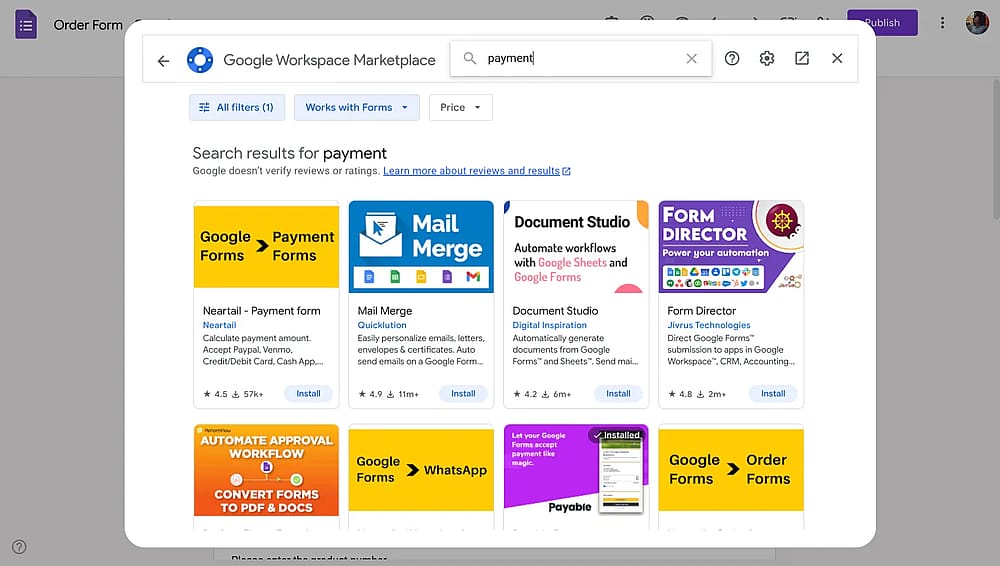
Google Forms payment add-ons
B. Redirect to a payment link
Go to the form's Settings, open Presentation, and edit the confirmation message to include a payment link (a Stripe payment page, a PayPal.me link, or any direct checkout URL). This separates order collection from payment, which works fine for businesses that confirm orders before charging or that invoice separately.
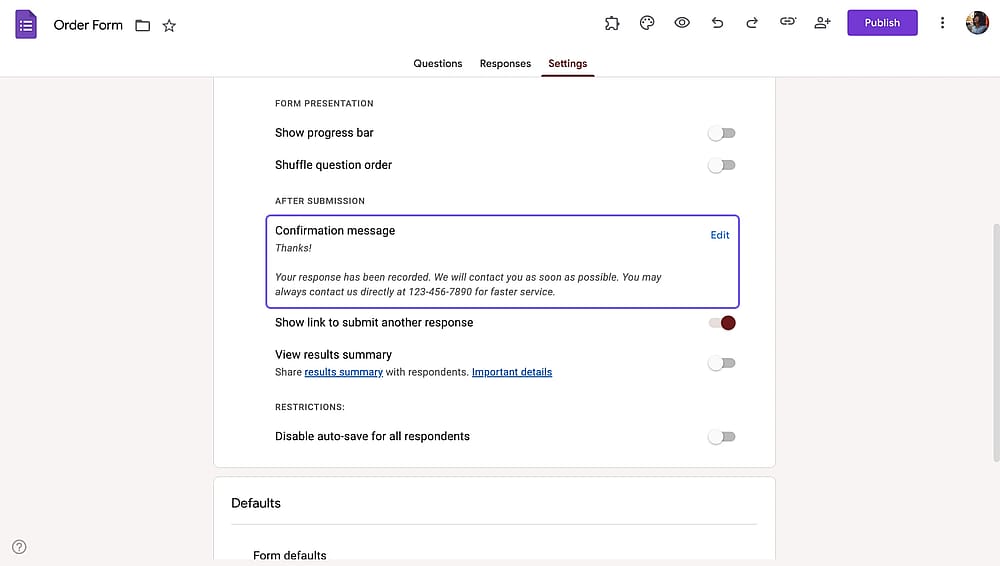
Adding payment links to Google Forms confirmation message
C. QR code for payment apps
Use the Add image button in the form editor to upload a QR code linking to PayPal, Square, Venmo, or Google Pay. A low-friction option for local or low-volume businesses.
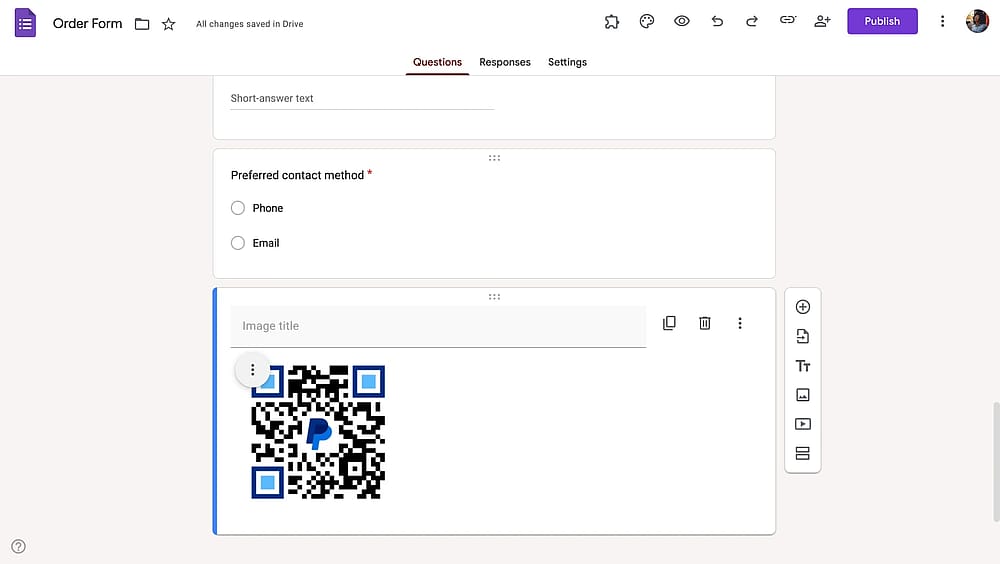
Adding QR code to a Google Form for payments
4. Configure response settings and notifications
Go to the Responses tab and click the Google Sheets icon to automatically send all order submissions to a spreadsheet. This becomes your running order log. Name the spreadsheet clearly and bookmark it somewhere accessible.
In Settings, configure a few important things:
- Enable Collect email addresses so you can send order confirmations
- Turn off Restrict to users in your organisation so customers outside your Google Workspace can place orders
- Turn off Limit to 1 response so customers can place more than one order over time
In the Responses tab, use the three-dot menu to set up email notifications so you're alerted immediately when a new order comes in.
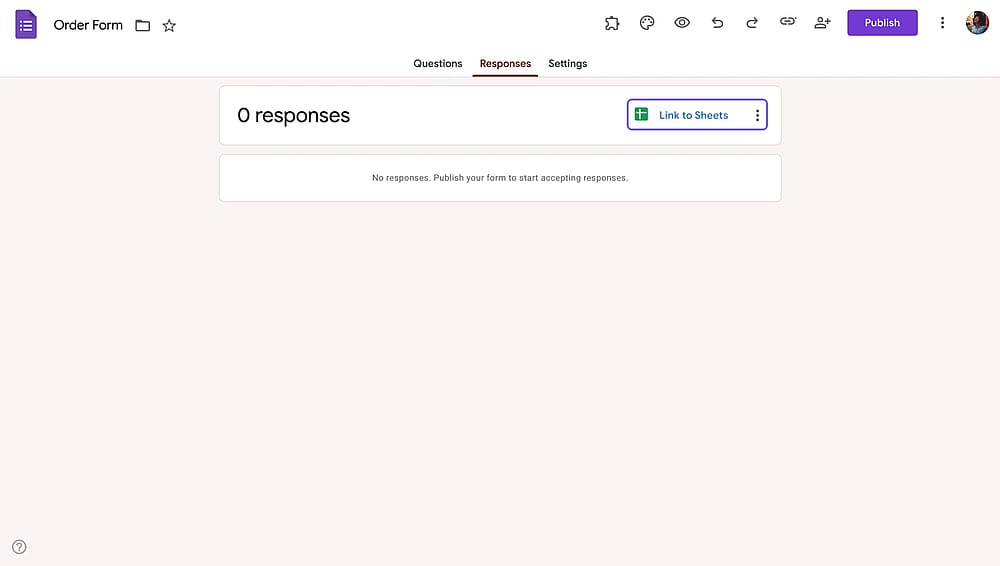
“Link to spreadsheet” option on Google Forms
Pro tip Customize your form to enhance its appeal. Google Forms lets you add images, adjust colors, and include your company logo for a more professional look. By pressing the paint palette icon, you can access helpful options like form themes, colors, header images, and text fonts.
5. Test your order form and share
For Google order forms, previewing is not enough. Fill out the form yourself as if you were a customer. Place a test order, follow the payment instructions, and check that the confirmation message is clear and helpful. Send it to one or two people on your team to catch anything confusing before it goes live.
Once you're happy, click the Send button to share via email, copy the shareable link to post on your website, social media, or WhatsApp, or use the embed code to place the form directly on a webpage.
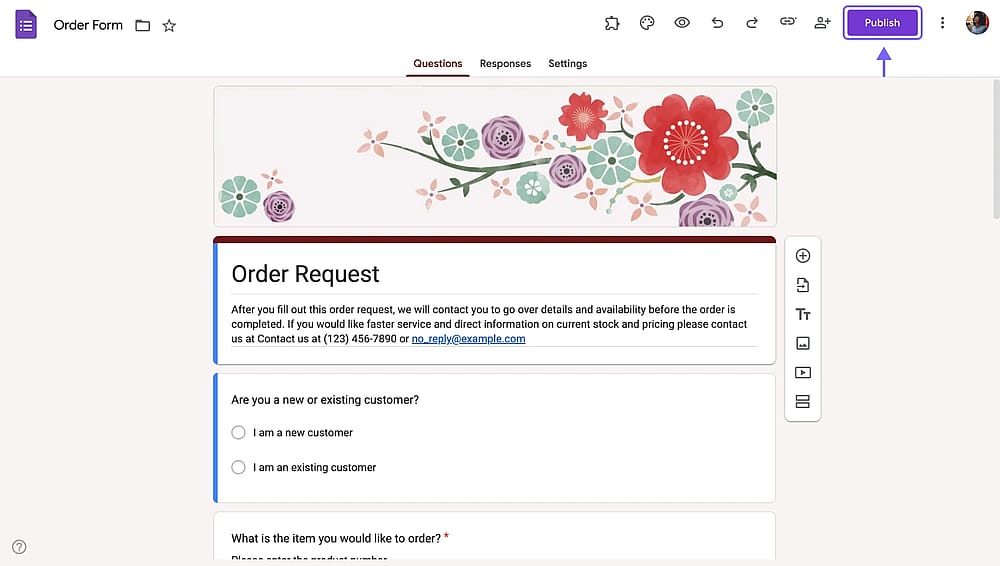
The share button on a Google Forms order form
Limitations of Google Forms for order forms
Google Forms works for basic order collection, but it has real gaps once your needs go beyond a simple list of options. To visualize, here’s a comparison table that shows how a dedicated form builder, like forms.app supports order form creation versus how Google Forms works for order forms:
Feature/Tool | Google Forms | forms.app |
Product catalog field | ||
Auto-calculated order totals | ||
Built-in payment collection | ||
Product variants (size, color, etc.) | (As separate questions) | (Handled within product basket field) |
Conditional logic | Basic | Advanced |
Submission limits & close dates | ||
Form templates | 17 | 5,000 |
Customization options | Basic | Advanced |
How to create an order form with forms.app
forms.app is a powerful online form builder tool with rich features and design capabilities. It has a dedicated product listing field, payment field, and terms and conditions field within its arsenal of 30+ form fields. So you will find every field and setting for making your online order forms with forms.app.
Here’s a helpful guide on how to create an order form in seconds using forms.app:
1. Log in to forms.app and create a form
To get started, log in to forms.app using your email, Google account, or Apple account. If you don't have an account yet, you can easily create one for free with just a few clicks.
You have several options to start creating your online order form using forms.app. First, you can select one of many customizable online order form templates from forms.app's library.
If you'd like to have something custom, you can use forms.app’s AI form generator to build your form in just a few seconds.
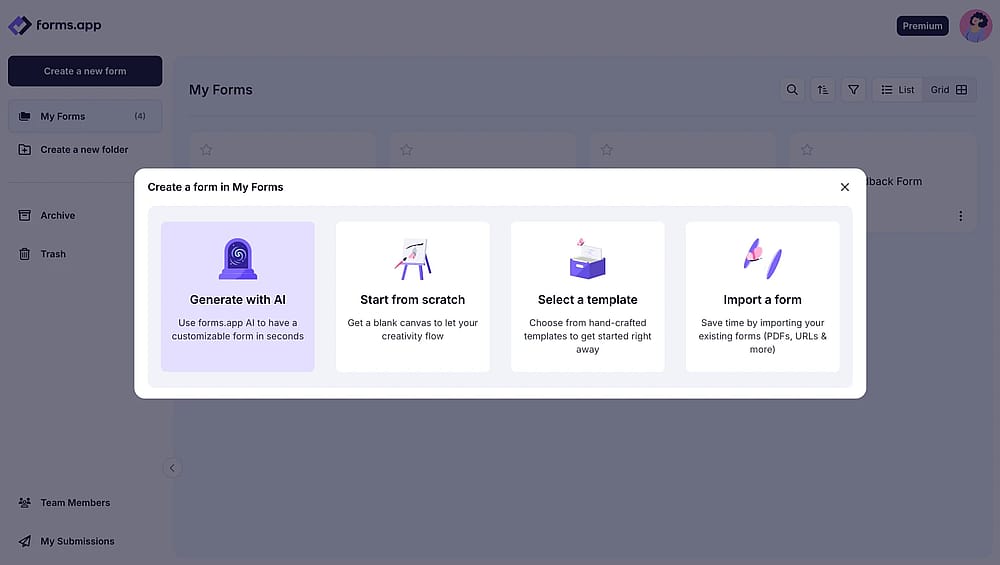
Choosing from blank form, form templates, AI form generator, or import options
2. Set up your product catalog with the Product Basket field
This is the feature that makes the biggest practical difference for online order forms. The Product Basket field lets you list products with photos, descriptions, variant options (size, color, flavor), quantity selectors, and per-item pricing. It’s basically an e-commerce field for your forms.
As customers make selections, their running total updates automatically. It works like a lightweight storefront inside your form, with none of the complexity of building a full e-commerce site.
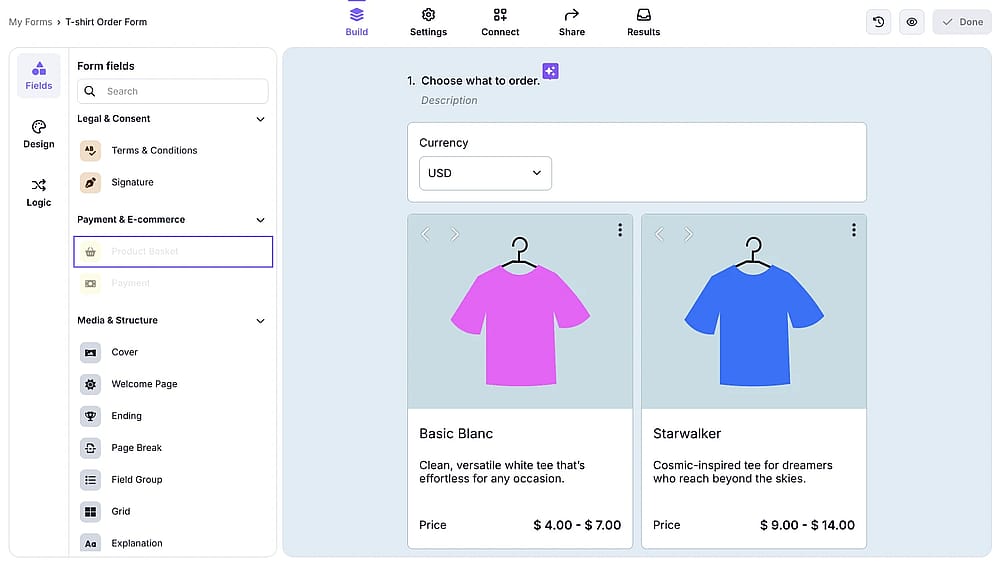
Adding a product basket field to an order form on forms.app
3. Add a payment field to your forms.app order form
Select the Payment field from the left menu and connect to Stripe or PayPal directly.
forms.app requires no add-ons and doesn’t have per-transaction fees on its own. Customers complete payment as part of the form. A testing mode lets you verify the whole flow before going live.
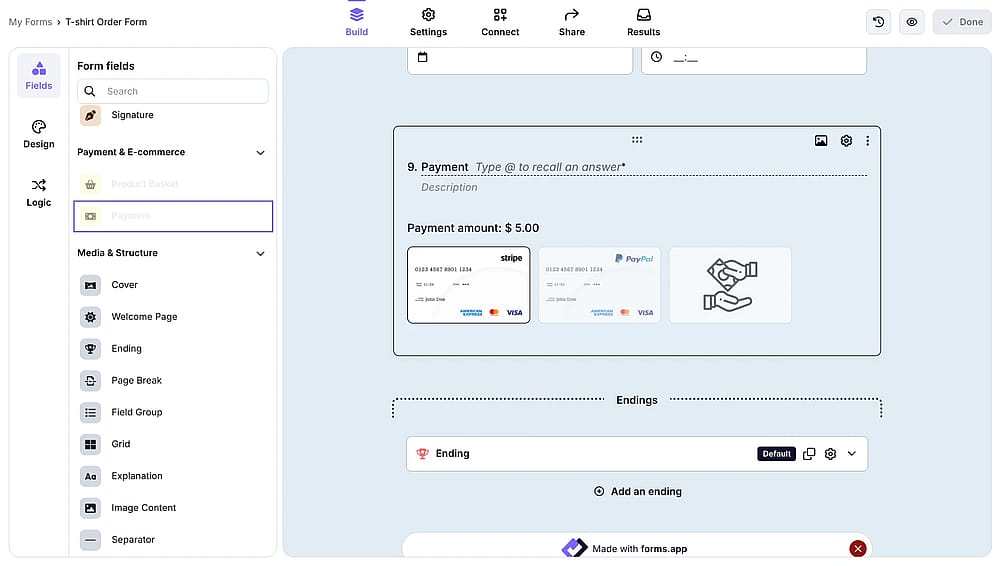
Adding a payment field to an order form on forms.app
4. Customize your order form
After adding your form fields, click on the Design tab to customize the look of your form. You can change the fonts, colors, and other advanced design elements to match your company's style.
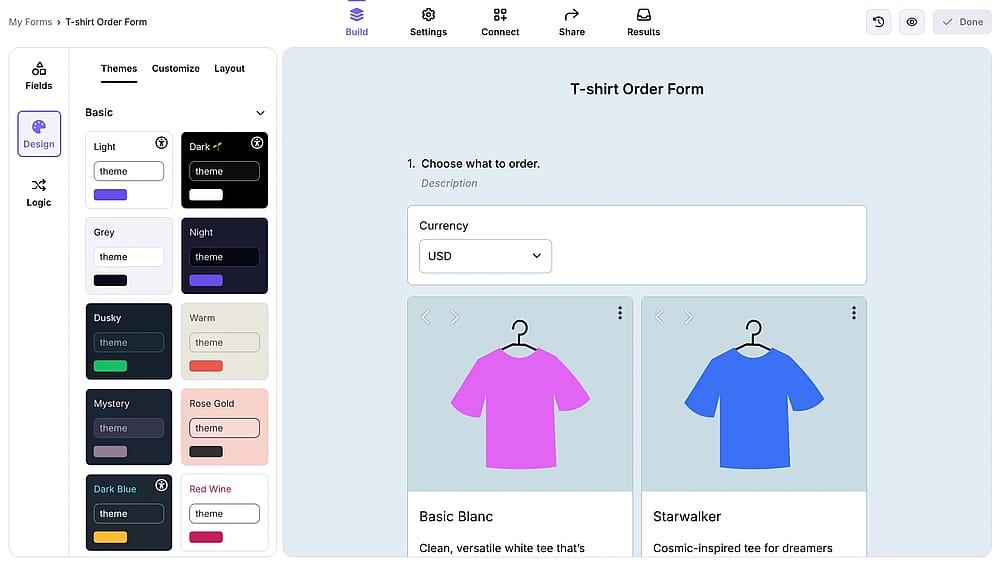
The form design settings within forms.app
5. Adjust general settings
Once you've set up the payment options, you may need to adjust the settings of your order form. To do so, go to the Settings tab. From there, you can set up email notifications to receive order details, create a custom welcome or thank you page for customers, and integrate with other apps like Google Sheets or Mailchimp.

The form notification settings on forms.app
6. Share your order form
After completing your order form, you can easily embed it into a website or share it via email. You also have the option to post it on social media platforms or generate a QR code for quick access.
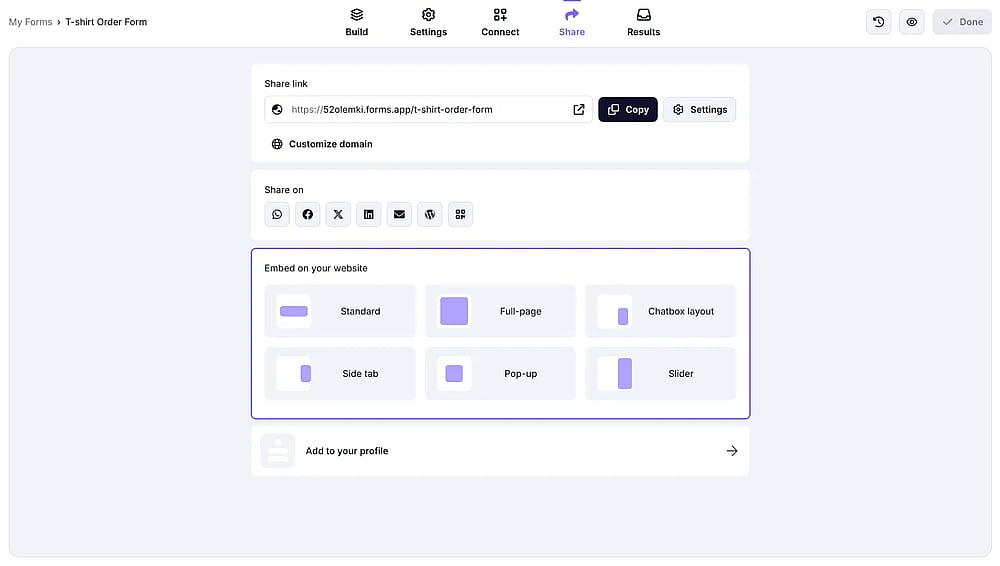
The form share settings on forms.app
Whether you have an Instagram store or want to share the form on your brand's website, you can do so within seconds!
Why do you need online order forms for your business?
Whether you own a charming bakery, a little bookstore, or are simply planning to sell your products on your website. Online order forms can be incredibly useful for your business, helping you collect payments and manage operations quickly. Below, you can explore some key benefits of using web order forms that can contribute to the success of your company:
- Fast ordering: Order forms are not just easy for customers; they're simple for businesses, too. Organizations can set up order forms and accept payments with little effort, while customers find it a breeze to use them to place orders. Web order forms help users pick what they need quickly and easily.
- Safe payment process: Crafting an online order form helps you offer customers a variety of payment methods, providing a secure transaction for both parties. By integrating secure payment processing into your order form, you can accept payments through credit cards, digital wallets, and other popular ways.
- Enhanced customer experience: Online order forms offer customers the flexibility to place orders whenever and wherever they want, making the buying process more accessible. This enjoyable and convenient shopping experience can increase client satisfaction and loyalty, ultimately benefiting your business.
- Custom form creation: Online forms can be customized to match your brand's style, providing an impressive look and a professional shopping experience. Using a powerful form builder tool, you can add necessary form fields or directly use pre-designed order form templates for better results.
Frequently asked questions about order forms in Google Forms
Yes. Google Forms can collect order details like product selections, quantities, delivery information, and customer contact details. It works well for simple, low-volume order collection. The main limitations are that it has no built-in payment field, can't display product images, and can't auto-calculate order totals, so it's not a full checkout experience.
Yes. When you open Google Forms, there's a pre-built order form template available in the template gallery. It gives you a starting structure with basic fields, but it doesn't include product images, pricing logic, or a payment field. You'll need to customize it significantly for most real business use cases.
No. Google Forms has no formula or calculation capability. Customers have to manually calculate what they owe, and you need to verify each order against your pricing separately. If auto-calculated totals are important to your workflow, forms.app's Product Basket field handles this automatically as customers make selections.
Google Forms doesn't have a built-in payment field. The most common approach is to install an add-on from the Google Workspace Marketplace. Alternatively, you can include a payment link or QR code in the form or in the confirmation message after submission.
Yes. Google Forms supports images within multiple-choice options or within the question itself.
forms.app is the strongest free option for businesses that need product listings with images, auto-calculated totals, and payment collection in one place. The free plan includes the Product Basket field, Stripe and PayPal integration, conditional logic, the AI form generator, and 5,000+ templates. Paid plans offer higher response limits and additional features.
Key points to take away
Google Forms is a solid free option for straightforward order collection, let’s say if you just need a short list of products, a few customer details, and manual payment follow-up.
Once you need customers to browse products with multiple images, see a running total, and pay in the same step, Google Forms shows its limits. The workarounds work, but they make the process longer, add friction for customers, and require extra work for you on every single order.
forms.app is a form builder with a dedicated field for an online order form. If you're taking orders online and if you’re taking “taking orders” seriously, forms.app is your obvious choice over Google Forms for online order forms.
Contributors
Researched & written by
forms.app, your free form builder
- Unlimited responses
- Unlimited questions
- Unlimited team members