
How to create a feedback form on Google Forms

TL;DR
1. Go to Google Forms and start with a blank form or pick a ready-made template
2. Give your form a clear title and a brief description so respondents know what to expect
3. Add questions by clicking the + icon and choosing the right question type for each one
4. Use conditional logic to show or hide follow-up questions based on previous answers (optional)
5. Customize the look of your form from the palette icon, colors, fonts, and a header image
6. Configure your settings: email collection, response limits, and a confirmation message
7. Preview the form as a respondent, then share it via link, email, or website embed
8. View responses in the Responses tab or link directly to Google Sheets
For more design freedom, AI form creation, and a smoother respondent experience, try forms.app
Creating feedback forms on Google Forms gives your team the ability to get essential data to make changes or not make changes in your processes, products, services, or something else entirely.
In this article, you will learn what a feedback form is, the types of feedback forms you can create on Google Forms, how to create a feedback form with Google Forms, and a better alternative for making your forms. Furthermore, you will also learn several tips and sample questions to make the best feedback form possible.
First things first: What is a customer feedback form?
A feedback form is a type of form that organizations, businesses, or companies use to learn people’s thoughts, comments, complaints, or suggestions about the service or product they offer.
Types of feedback forms you can create on Google Forms
Feedback forms are not a one-size-fits-all tool. Depending on your audience and goal, the structure, tone, and questions of your form will look quite different. Google Forms supports all of the following types out of the box. However, some will feel more constrained than others when you need more advanced layouts or designs.
1. Customer feedback forms
Customer feedback forms are the most common type and the most straightforward way to collect customer feedback. Businesses use them to understand how customers feel about a product, service, or recent purchase. These forms typically include satisfaction ratings, open-ended comments, and questions about specific features or interactions.
2. Employee feedback forms
Employee satisfaction and pulse survey forms are used internally by HR teams or managers to gauge how employees feel about their work environment, workload, team culture, or management. These often require anonymous submissions, which Google Forms supports with a simple settings toggle.
3. Event feedback forms
Event feedback forms are sent to attendees after a conference, workshop, webinar, or company event. They focus on the overall experience, organization, content quality, speakers, venue, and whether attendees would come back or recommend the event.
4. Course feedback forms
Training and course feedback forms help educators, L&D teams, and course creators understand whether learning materials are effective and whether participants felt supported. These often include questions about content clarity, pacing, and practical usefulness.
5. Website feedback forms
Website or in-app feedback forms are used to collect opinions about a digital experience, navigation, design, load speed, or a specific page or feature. They are often short and embedded directly on a website or triggered after a specific action.
6. Service feedback forms
Service feedback forms apply to any interaction-based context: a customer support ticket, a restaurant visit, a healthcare appointment, or a consultancy session. The goal is to assess the quality of a specific interaction rather than an ongoing relationship.
How to make a feedback form in Google Forms
Now that we’ve covered the types of feedback forms, it is time to learn how to create a feedback form in Google Forms. Understanding these steps and implementing them correctly will help you create a Google Form with the highest success rate and ensure an increase in engagement for your business.
1. Open Google Forms and choose a starting point
Go to docs.google.com/forms and sign in with your Google account. You will land on the homepage, where you can either click Blank form to start from scratch or browse the Template gallery for pre-built Google Forms templates. For the purposes of showing this
Pro tip Google Forms includes a customer feedback template that covers the basics. It is worth using if you are creating a customer or product feedback form for the first time.
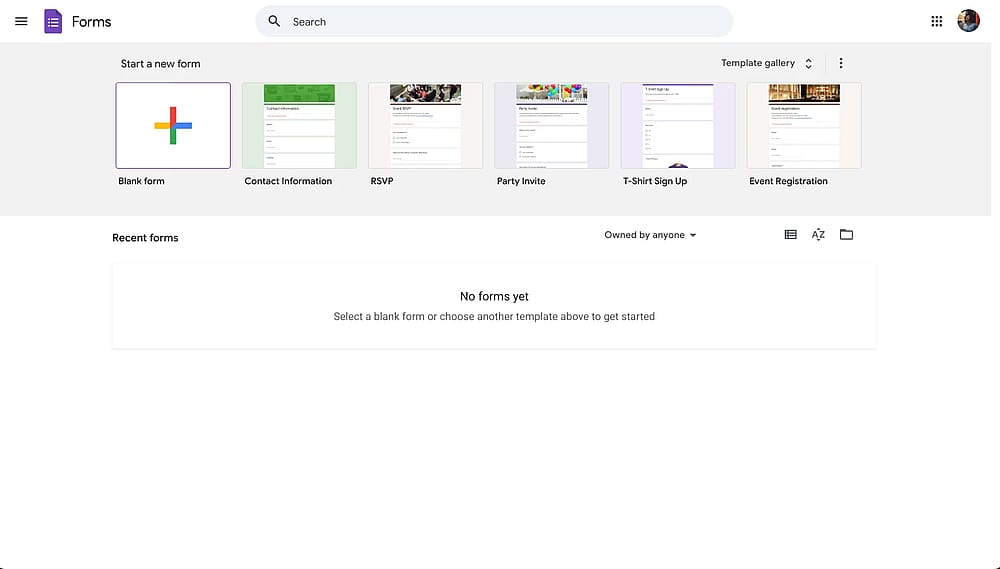
Google Forms dashboard
2. Add a title and description to your feedback form
Click on the form title at the top and replace "Untitled form" with a name that clearly tells respondents what the form is about, for example, "Event feedback - May workshop" or "Product experience survey." Add a short description below to explain the purpose, how long it will take, and whether responses are anonymous. This small step reduces drop-off by setting expectations upfront.
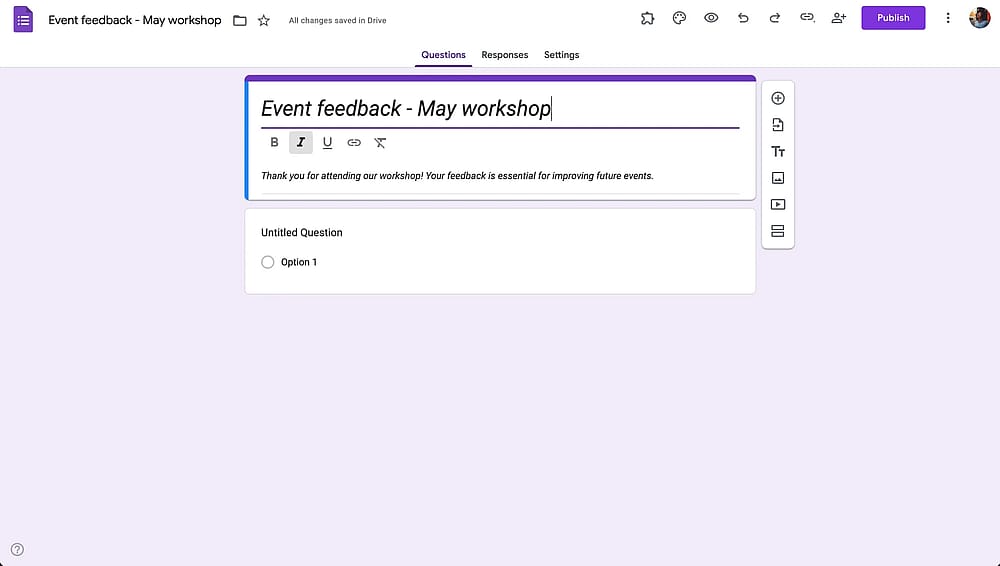
Adding titles and description to Google Forms
3. Add your questions and answers
After you create a Google Form and name it, it is time to add your questions and answers and edit them. You can have many question types on your form, including multiple-choice questions. To add them, click on the plus sign within a circle on the right side of the form and then add your question. To make customizations, click on any question and make your changes.
The question types most suited to feedback forms are:
- Multiple choice: good for single-select questions like overall satisfaction or preferred contact method
- Rating: For star/heart shape linear scales.
- Checkboxes: useful when respondents might select more than one answer
- Linear scale: ideal for rating questions (e.g., 1–5 or 1–10)
- Multiple choice grid/checkbox grid: lets you rate several items on the same scale in one compact block
- Short answer: for brief open-ended responses like names or one-line comments
- Paragraph: for longer written feedback or suggestions
Keep your form to the point. Forms with fewer than 10 questions consistently receive higher completion rates than longer ones.
Pro tip You can use sections to add branching logic to your Google Forms feedback form. Take a look at our article on conditional questions on Google Forms to see all the steps.
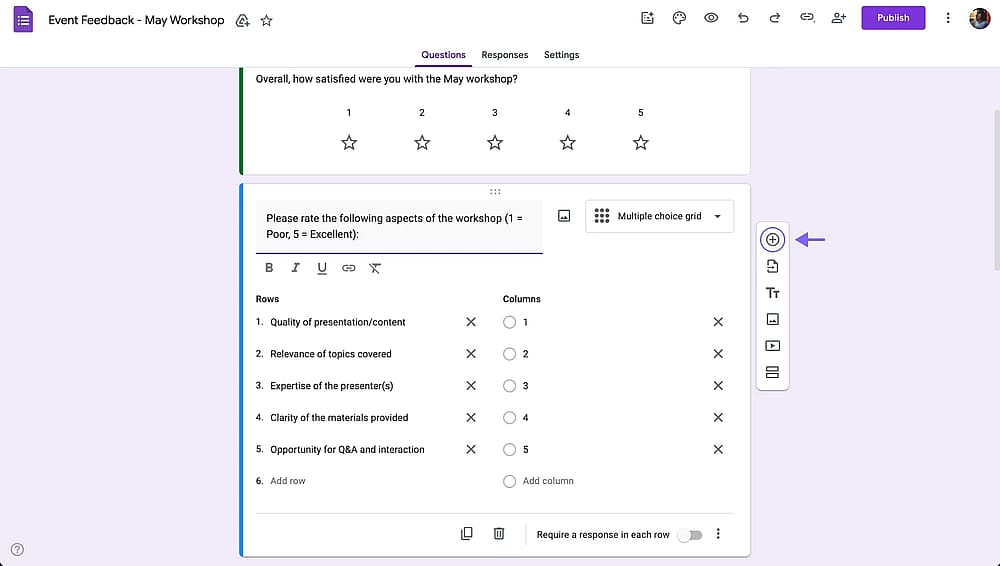
Add question button on Google Forms
4. Customize your customer feedback form
After adding your questions and answers and making the necessary customizations to the form's contents, you can focus on the visual aspects of the customer feedback form. Nearly all visual customizations are controlled by clicking on the palette icon at the top right corner of the page. You can change the fonts and colors from the customization menu or add header images.
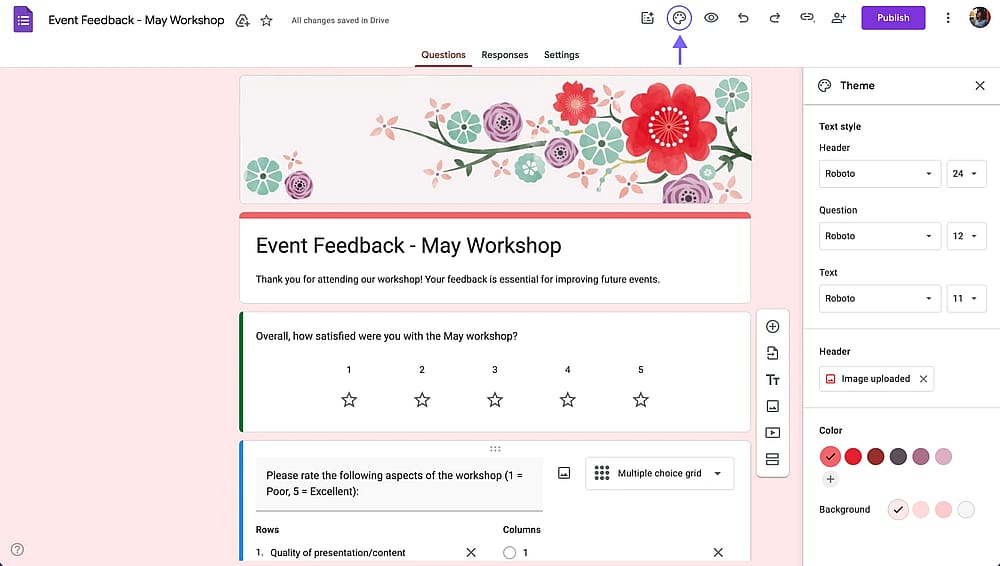
Theme options on Google Forms
5. Change Google Form settings
Before you click on the “Send” button, you must go to the “Settings” section to customize your form's settings, such as how to collect and protect your responses, how to present your form, and the default settings of your application form. When you are done, you can share your form with your target.
Key settings for Google Forms feedback forms are:
- Collect email addresses: decide whether to require a Google sign-in or ask for email voluntarily
- Limit to 1 response: prevents duplicate submissions (requires sign-in)
- Allow response editing: lets respondents go back and change their answers after submitting
- Confirmation message: customize the text people see after they submit
Under the Presentation tab within Settings, you can also shuffle question order and show a progress bar.
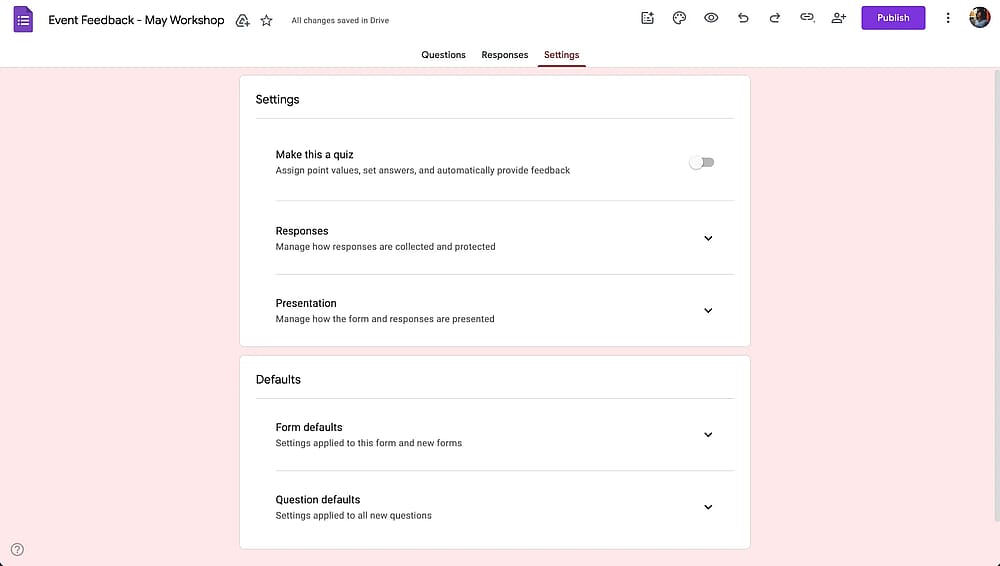
Configuring Google Form settings
6. Preview and share your form
Click the eye icon in the top toolbar to preview the form exactly as respondents will see it. Fill it out yourself to check for any awkward phrasing, broken logic, or missing required fields. Once you are satisfied, click the Send button to share it. Your options include a direct link, email, website embed code, or a QR code.
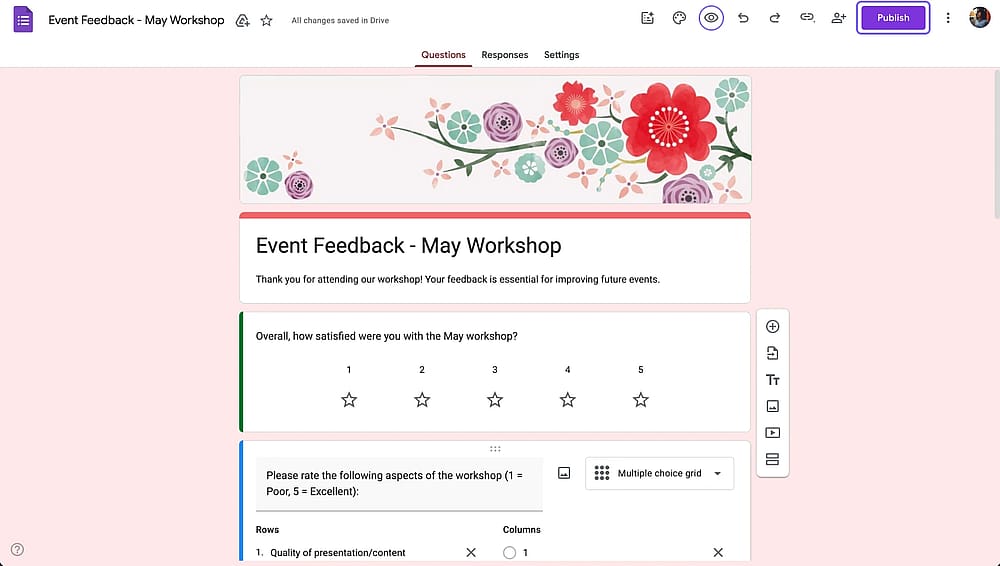
The preview and publish buttons on Google Forms
Sample questions for your Google Forms feedback form
The right questions depend on what type of feedback you are collecting. Below are ready-to-use question sets for the most common feedback form types. You can copy these directly into your Google Form or adapt them to fit your context.
Customer and product feedback
- How satisfied are you with your overall experience? (Linear scale: 1–5)
- How easy was it to use our product / service? (Linear scale: 1–5)
- Which aspect of the product do you value most? (Multiple choice)
- What, if anything, prevented you from getting the most out of the product? (Paragraph)
- How likely are you to recommend us to a friend or colleague? (Linear scale: 0–10)
- Is there anything you would like to see added or improved? (Paragraph)
Event feedback
- How would you rate the event overall? (Linear scale: 1–5)
- How well-organized did you find the event? (Linear scale: 1–5)
- Which sessions or segments did you find most valuable? (Checkboxes)
- Was the length of the event appropriate? (Multiple choice: Too short / About right / Too long)
- How likely are you to attend a future event from us? (Linear scale: 1–5)
- What would make the next event even better? (Paragraph)
Employee satisfaction
- How satisfied are you with your role and responsibilities? (Linear scale: 1–5)
- Do you feel your contributions are recognized by your team and management? (Multiple choice: Yes / Sometimes / No)
- How would you rate communication within your team? (Linear scale: 1–5)
- Do you have access to the tools and resources you need to do your job well? (Multiple choice: Yes / Mostly / No)
- How likely are you to recommend this company as a great place to work? (Linear scale: 0–10)
- What is one thing the company could do to improve your experience at work? (Paragraph)
Training and course feedback
- How would you rate the overall quality of the training? (Linear scale: 1–5)
- Was the content relevant to your day-to-day work? (Multiple choice: Very relevant / Somewhat relevant / Not relevant)
- How clear and easy to follow was the material? (Linear scale: 1–5)
- Did the pace of the training feel right? (Multiple choice: Too slow / About right / Too fast)
- What topics would you like covered in more depth in future sessions? (Paragraph)
- Would you recommend this training to a colleague? (Multiple choice: Yes / No / Maybe)
How to analyze feedback form results in Google Forms
Once responses start coming in, click the Responses tab at the top of your form editor. Google Forms presents results in three views:
- Summary gives you a visual breakdown of all responses at once, with bar charts and pie charts for closed-ended questions and a list of text responses for open-ended ones. This is the fastest way to spot patterns.
- Question lets you step through the form question by question, seeing how respondents answered each one individually. This is useful for reviewing responses to a specific question in depth.
- Individual shows each respondent's complete submission, one at a time. Helpful when you need to review someone's full set of answers in context. For example, when triaging a support issue or following up on a low satisfaction score.
Pro tip For more powerful analysis, click the Google Sheets icon in the Responses tab to link your form to a spreadsheet. You can also export responses as a CSV file from the three-dot menu in the same tab. Also, check out our article on how to create Google Form reports for more details and steps.
Limitations of Google Forms for feedback collection
Google Forms is free, widely available, and works well for straightforward use cases. But there are real constraints worth knowing about before you invest time building something more complex.
- Visual customization is minimal: You can change the header image and accent color, but you cannot adjust field styles, button designs, spacing, or overall layout beyond what the theme editor allows. If you need a form that matches your brand properly, Google Forms will always look like Google Forms.
- There is only one layout option: All questions are shown in a single list or split across pages using sections. There is no option for a conversational one-question-at-a-time layout, which tends to produce better completion rates for longer forms.
- No multiple endings: Every respondent sees the same confirmation screen. If you want to show a different thank-you message based on how someone answered, say, a different message for satisfied vs. dissatisfied respondents, that is not possible natively in Google Forms.
- Respondents cannot save progress and return later: If someone closes the form mid-way through, their answers are lost. For longer feedback surveys, this is a meaningful drop-off risk.
- No built-in custom PDF generation from responses: If you need to automatically produce a formatted document, a summary report, a review record, or a personalized output, from each submission, Google Forms has no way to do that without external tools or scripts.
- Notification and integration options are limited: You can receive an email per submission, but advanced routing, sending specific responses to different team members, triggering Slack messages, or pushing data to a CRM, requires add-ons or third-party automation tools like Zapier.
A better alternative for feedback forms: forms.app
Google Forms is the most well-known and widely-used form builder on the internet. However, if customer satisfaction and professionalism are essential to you, and if you want to impress everyone by creating visually appealing forms, try forms.app. Here are the steps for creating a better customer feedback form using forms.app:
1. Choose a template, start from scratch, or use forms.app AI
forms.app offers not only one but hundreds of customer feedback form templates, which are also free. You can choose to select one of our templates for the base of your form or start from scratch with a blank form. Furthermore, you can use the forms.app AI to help you create the best customer feedback form customized to the needs of your business.
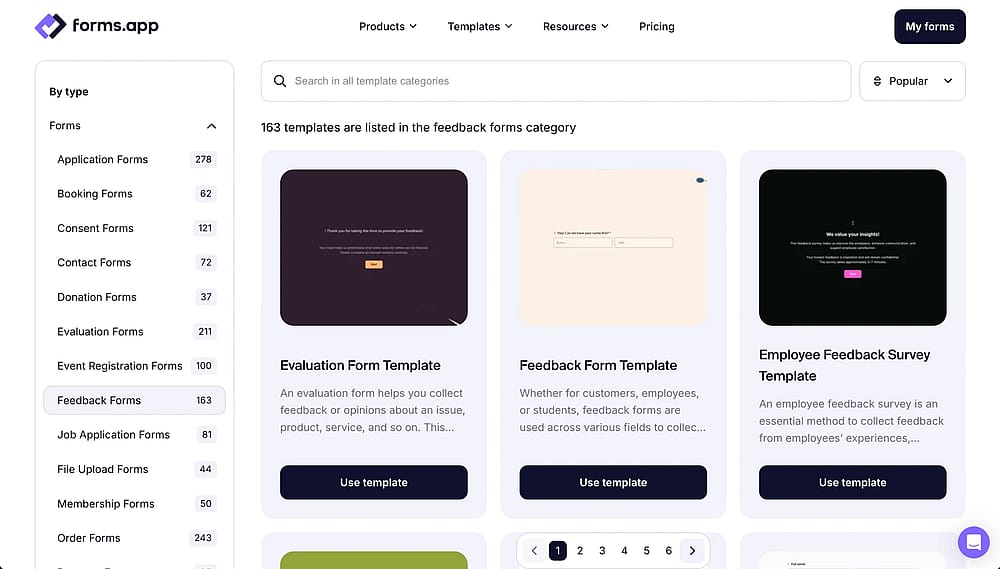
Choose a feedback template on forms.app
2. Edit the questions or add your own
After choosing your base, you can add questions or edit existing ones from our templates. Simply click on any question you would like to edit and change anything from the title of the question, the answers, and the description.
💡 You can also use forms.app AI to edit questions. Click the colorful icon next to your question title to rephrase or rewrite your question using forms.app AI.
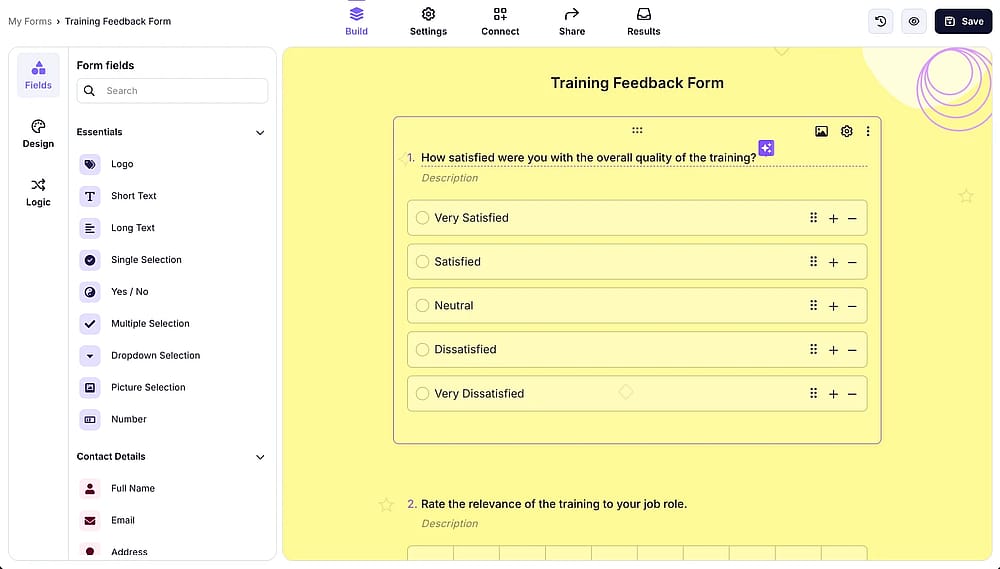
Add your feedback questions
3. Use different rating questions
Another reason why forms.app is a better form-building tool in its vast selection of questions. Depending on your preference and your business needs, you can choose from our extensive selection of rating questions, such as a selection matrix, opinion scale, or star rating. To access those questions, go to the “Fields” tab and look for any question you would like to add.
💡 We also recommend adding a “File upload” section to allow customers to upload photos of any defects and issues.
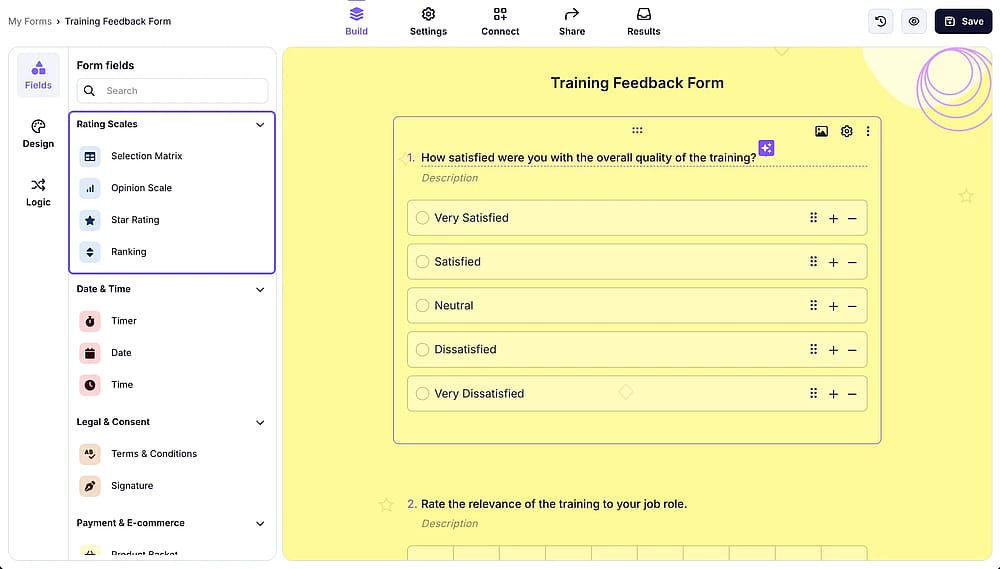
Use various question types
4. Customize the form design
After you finish adding and editing to create a set of questions that satisfies you, you can now customize the visuals of the form with the help of the large selection of options of forms.app. To customize the visuals of the form, go to the “Design” tab within the “Build” section and make any visual changes to the theme of the form.
You can also make further changes, such as font colors, border radiuses, and other settings, from the “Customize” section of the “Design” tab.
💡 The design tab also allows you to have animated themes for your survey. Go to the end of the design tab to choose an animated theme.
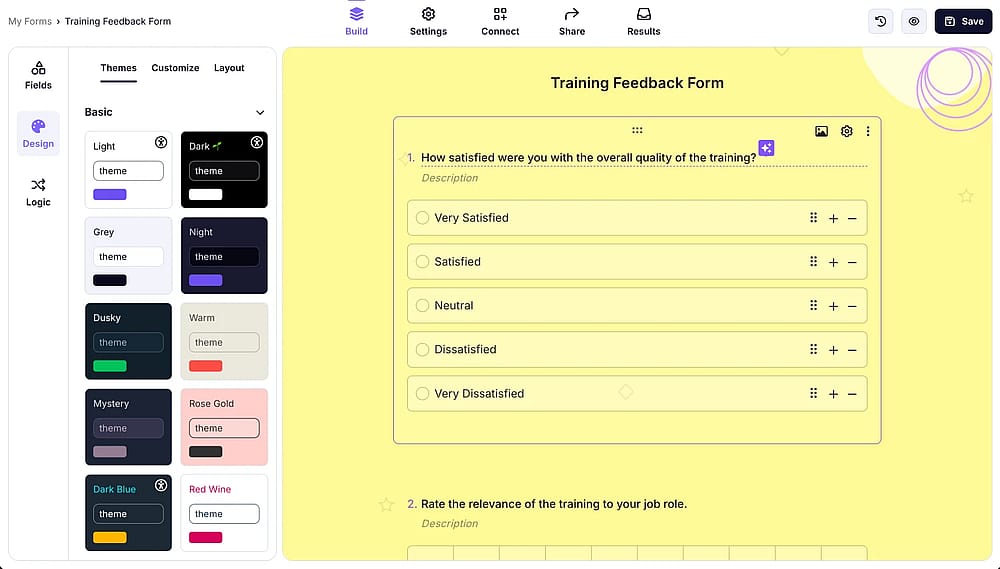
Customizing the design of your form
5. Preview your feedback form
After you are done creating, you can preview your customer feedback form by clicking the eye icon. This feature allows you to look at your form as a customer to see any mistakes or lacking parts.
You can also connect your form to several databases using the “Connect” section. The connect section allows you to pair the results of your form with whatever type of database your business or organization uses, such as your Google account.
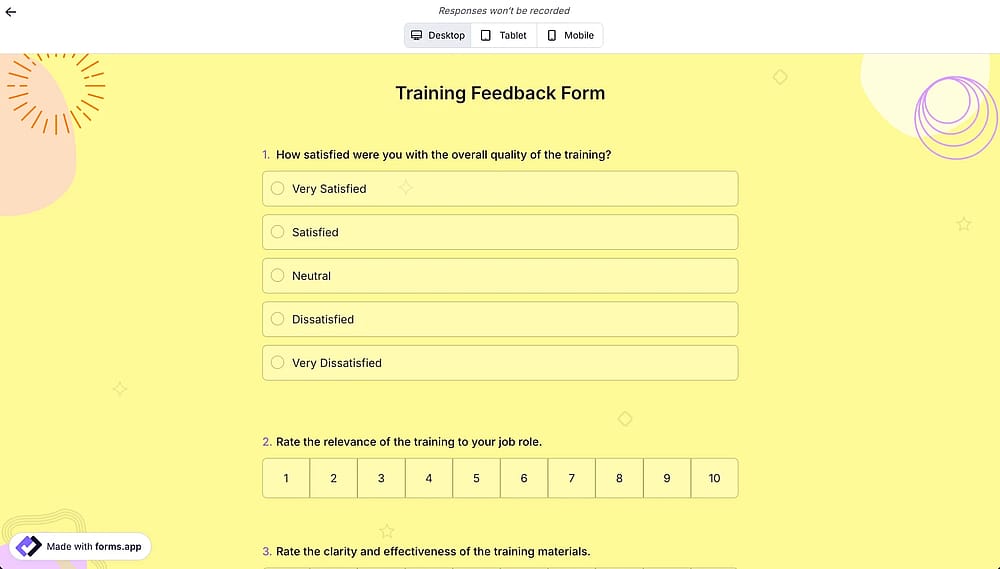
Test your form
6. Share your customer feedback form
Ultimately, you can share your feedback form with your customers by going to the “Share” section. This section is not just for sharing; it also allows you to customize your survey's URL or embedding. The embedding feature allows the form to pop up wherever you want on your website. You can choose between selections of full-page, side tab, slider, and more.
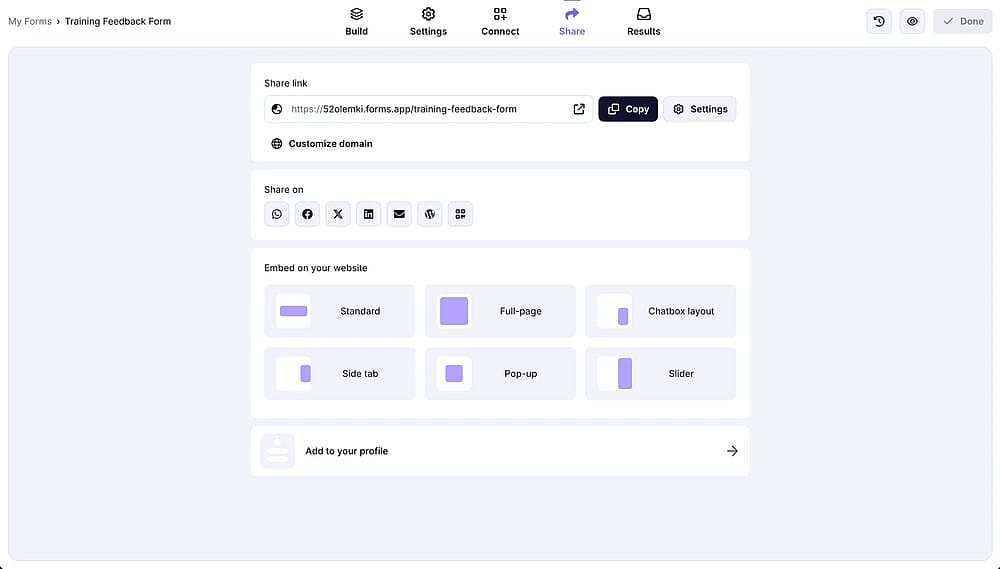
Share your form
7. Analyze your results
While you may think that forms.app only offers help when creating your form, it also helps collect and analyze the results of your customer feedback form. After you share your form, you can see the results and responses, how many people have filled it out, and what they had to say about it by going to the “Results” section.
Furthermore, you can also see the statistics and analytics of your form by going to the “Statistics” tab to see the number of responses, submission percentage, views, and much more. You can also see which devices or platforms people have used to fill out your form or where they are from.
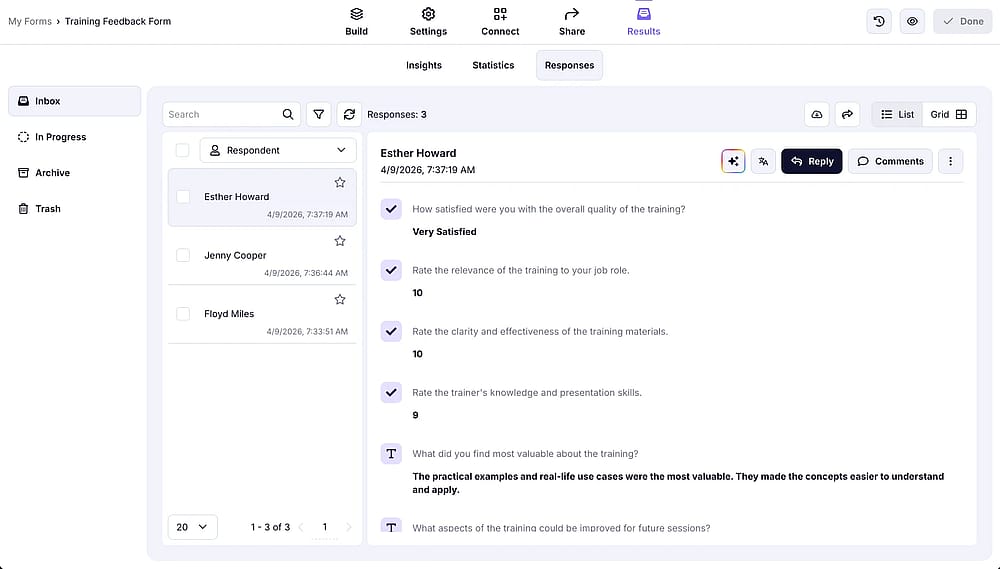
Analyze your results
10 Tips to follow for a better customer feedback form
Since you have learned how to create a customer feedback form, it is time to understand the details. While they may not seem important, these details are crucial to creating the best form possible. Creating the best form will not only allow you to grow your customer base but also prevent you from making the same mistakes with your future projects. Here are 10 tips to create the best customer feedback form possible:
- Remember to collect information about the customers, such as their names, phone numbers, and email addresses, so that you can contact them again in the future.
- Allow customers to rate several aspects of your service and product by having various question types.
- Try to keep your form short to increase the rate of completion.
- Use precise language to avoid any misunderstandings.
- Add your business's contact information to allow customers to reach out to you for further questions.
- Share your form on social media platforms or embed it on your website to increase participation.
- Make sure to add a file upload section for visual information.
- Add a “Suggestions” section to let customers write out any issues or requests they may have.
- Pay attention to your form design to showcase your creativity and professionalism.
- Send an automated response email to increase your brand reputation.
Final words
In summary, a good customer feedback form can be the most significant investment you can make in your business. If you follow our steps to create it, the process takes no time or money. A solid customer feedback form has many incredible benefits, from increasing customer engagement to better marketing strategies, and it is an excellent way to boost your brand reputation and outreach.
Google Forms is a capable tool for building feedback forms quickly and at no cost. If your needs are straightforward, a short survey and basic question types, it does the job well. But its limitations in design, layout flexibility, and advanced features become apparent as soon as you need anything beyond the basics.
For teams that want to make a better first impression, collect richer data, and give respondents a smoother experience, forms.app offers the same ease of use with significantly more capability. You can start for free and upgrade only if you need to.
- April 2026 - Completely revisited the article and updated the guide
Contributors
Researched & written by
forms.app, your free form builder
- Unlimited views
- Unlimited questions
- Unlimited notifications