45+ Remote work survey questions to boost productivity
Summarize with
Every year, more companies lean into remote work, and every year the same question comes up: how do you actually know if it's working?
As a remote worker myself, I ran my first remote work survey a few years ago for a small distributed team, and what surprised me most was the gap between the rating-scale answers and the open-text ones. People rated their work-life balance "good," then described answering messages at 11 pm in the comment box. That gap is why a survey like this is worth building carefully.
Below are 45+ remote working survey questions organized by category, notes on which question type works best where, and a short guide to scoring results and building your own survey.
Why run a remote work survey
Remote work statistics show that sharing a well-built survey y can help companies understand what employees actually need in a distributed workplace. Here are some reasons to run:
🔍 Identify productivity challenges managers wouldn't otherwise see.
✨ Improve engagement by acting on what's actually making remote work isolating.
💬 Strengthen communication by surfacing collaboration gaps early.
⚖️ Gauge work-life balance, since remote work blurs the line between "on" and "off."
One honest caution: a survey only builds trust if you act on it. My first survey got a 90%+ completion rate mainly because I'd told the team members upfront what I planned to change.
How to choose the right remote worker survey questions
Pick one or two goals per cycle rather than asking everything at once. When I built my own survey online, swapping some "always/often/sometimes/never" questions for a 1–5 rating scale raised completion; a scale takes one click, while multiple choice makes people stop and read every label.
45+ must-ask remote work survey questions
Building a strong remote work environment long-term depends on consistent employee feedback. These questions cover time zone challenges, video calls, and how the employee experience compares to a traditional office environment, so you can act on what actually matters.
General questions
1. How satisfied are you with your overall remote work experience?
2. How would you rate your productivity when working remotely?
3. How often do you feel connected to your team?
4. Do you have the tools and resources to work effectively from home?
5. How would you describe your work-life balance?
6. How comfortable is your home workspace?
7. How often do technical issues affect your work?
8. Does your manager support you adequately in a remote setup?
9. Do you receive clear communication about goals and expectations?
10. How manageable is your workload?
11. What's the biggest challenge you face while working remotely? (open text)
12. How likely are you to recommend remote work to others?
Questions for managers
I've found these work best as a separate form; managers answer more candidly when they're not scrolling past 50 unrelated employee questions first.
13. How confident are you in managing your team remotely?
14. Are you satisfied with the tools provided for remote management?
15. How do you rate your ability to resolve conflicts remotely?
16. Do you have sufficient visibility into your team's performance?
17. Do you feel equipped to support your team's mental health remotely?
18. Do you feel recognized by upper management for your work as a remote manager?
Work from home survey questions for employees
Asking engaging questions to remote workers keeps you stay connected even though you are not at the office. It might be easier to understand employees’ feelings or experiences at the office; however, these questions will make you understand your remote team members better.
19. Do you have the tools and technology to work effectively from home?
20. How productive do you feel compared to working in the office?
21. How often do you experience distractions while working from home?
22. What usually distracts you? (open text - pairs well with Q21 for real detail)
23. Do you feel isolated or disconnected from colleagues?
24. Are you able to take adequate breaks during your workday?
25. Would you prefer to continue working from home in the future?
Wellbeing and work-life boundaries
This category is easy to skip, thinking it's too personal, but kept anonymous, it tends to get the most honest, detailed answers of the whole survey.
26. Can you disconnect from work at the end of the day without guilt?
27. Does your manager respect your working hours outside of them?
28. How often do you feel stressed or overwhelmed while working remotely?
29. Do you feel comfortable telling your manager when your workload is too heavy?
Communication and collaboration
Communication is the key. Do not forget to add some questions under this category to fully understand your remote team members.
30. Do important decisions reach you before you hear about them secondhand?
31. Do you know when to use a call versus an async message?
32. Is the number of meetings you attend each week appropriate?
33. Can you find documents and past decisions without asking a colleague?
34. What's one communication habit your team should start, stop, or continue? (open text - the single most useful question in my own survey)
Hybrid teams
Hybrid schedules split time between home and office, which can create disconnected experiences without consistent communication and recognition.
35. Do you prefer working from home, the office, or a mix?
36. What would your ideal remote-to-office ratio look like?
37. Does communication stay effective when some teammates are remote and others in-office?
38. Do you feel equally recognized regardless of where you worked that day?
Performance
Self-reported performance questions skew generous almost every time - a "not well" answer here is a stronger signal than it looks, since people rarely rate themselves down.
39. How would you rate your overall performance while working from home?
40. How often do you meet your deadlines while working remotely?
41. Has working from home improved or decreased your efficiency?
42. How well are you able to focus on tasks?
43. Are you able to prioritize tasks effectively?
44. Does remote work hinder or enhance your ability to innovate?
45. Do you feel your remote work performance is recognized by your manager?
Bonus: Work from home interview questions
For hiring managers vetting remote candidates, a few prompts work better live than any survey:
- "Walk me through your typical remote workday." Look for concrete routines, not "I just get it done."
- "Tell me about a technical or communication issue you resolved while remote."
- "How do you stay motivated without in-person accountability?"
- "How do you separate work time from personal time at home?"
Score for specificity and self-awareness rather than a "correct" answer.
Scoring and interpreting results
On a 5-point scale: 4–5 is healthy, 3–3.9 is a yellow flag worth checking against the open-text answers, and below 3 needs a direct action plan. Watch for suspiciously uniform high scores — that often means people don't feel safe giving honest feedback. Treat one survey as a snapshot; the real signal comes from comparing it to the next one.
How to create a remote work survey without coding
My first survey lived in a shared spreadsheet, fine for six people, but it fell apart at scale with no branching logic and no mobile-friendly layout. Moving the same questions into an online survey tool (I've used forms.app) fixed that:
1. Start from a template or build from scratch, or generate a first draft with an AI prompt like "give me a 10-question remote work survey," then swap in the questions above.
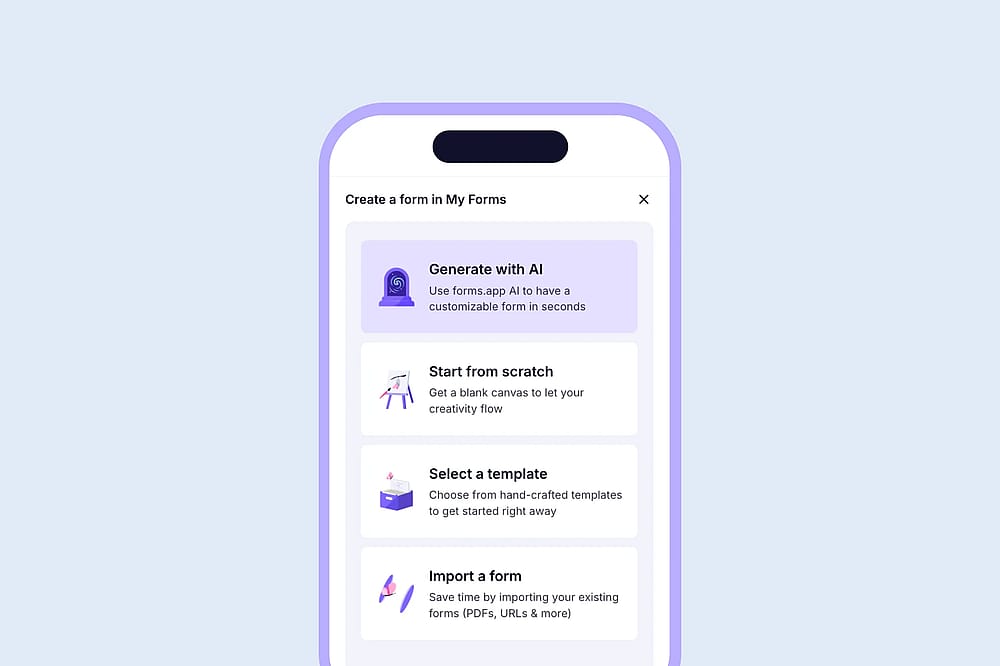
Choose a way to start
2. Add your own work-from-home interview questions and answers.
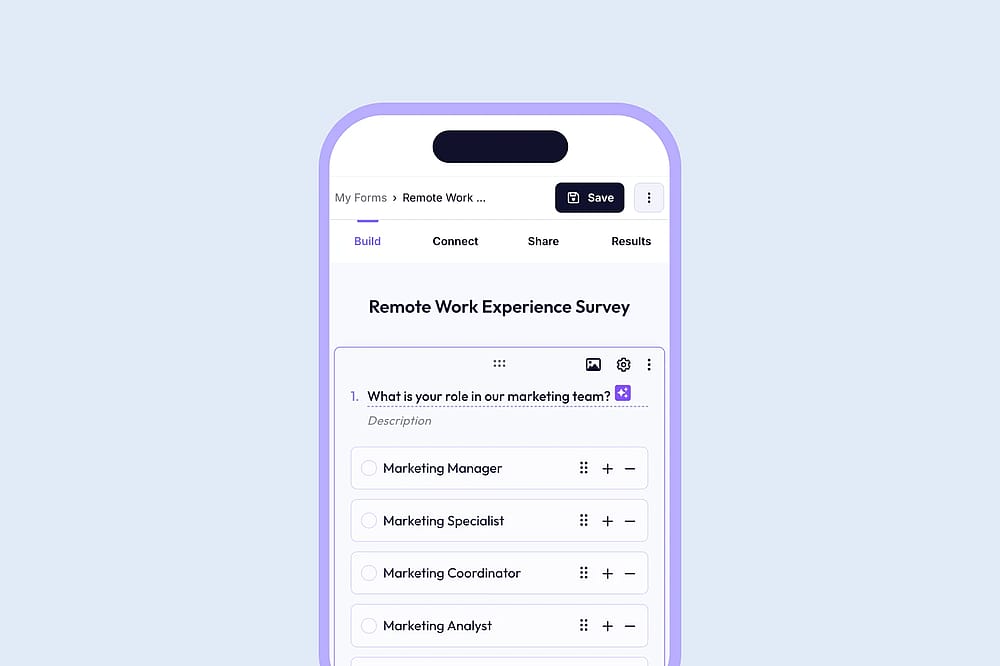
Add the questions
3. Customize question types, order, and any conditional logic (e.g., routing managers to their own section).
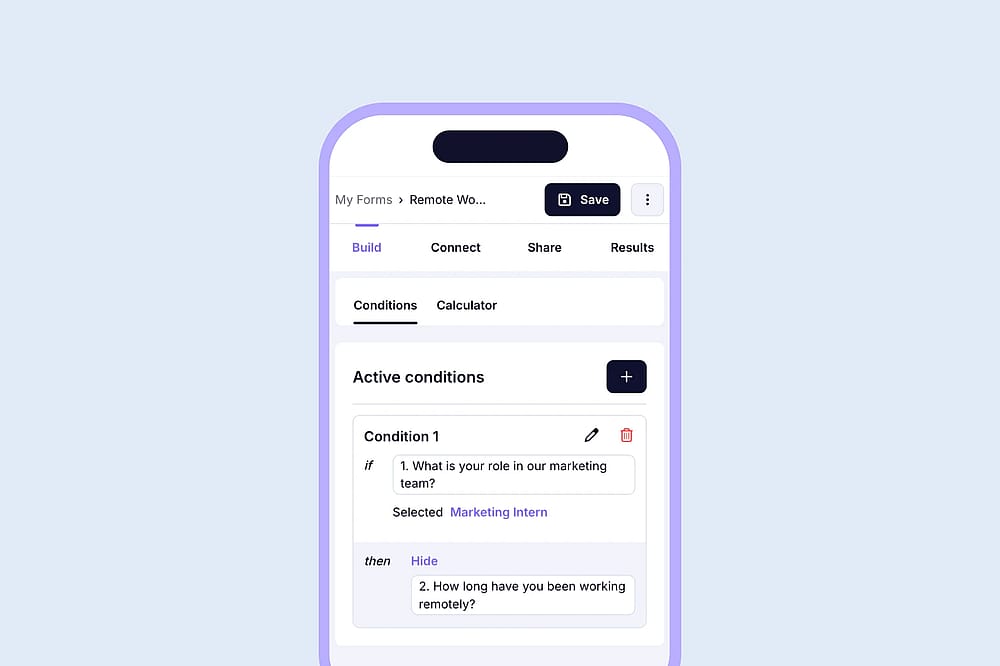
Add conditional logic
4. Share the link with a short note on why you're running it. This raises completion more than the design does.
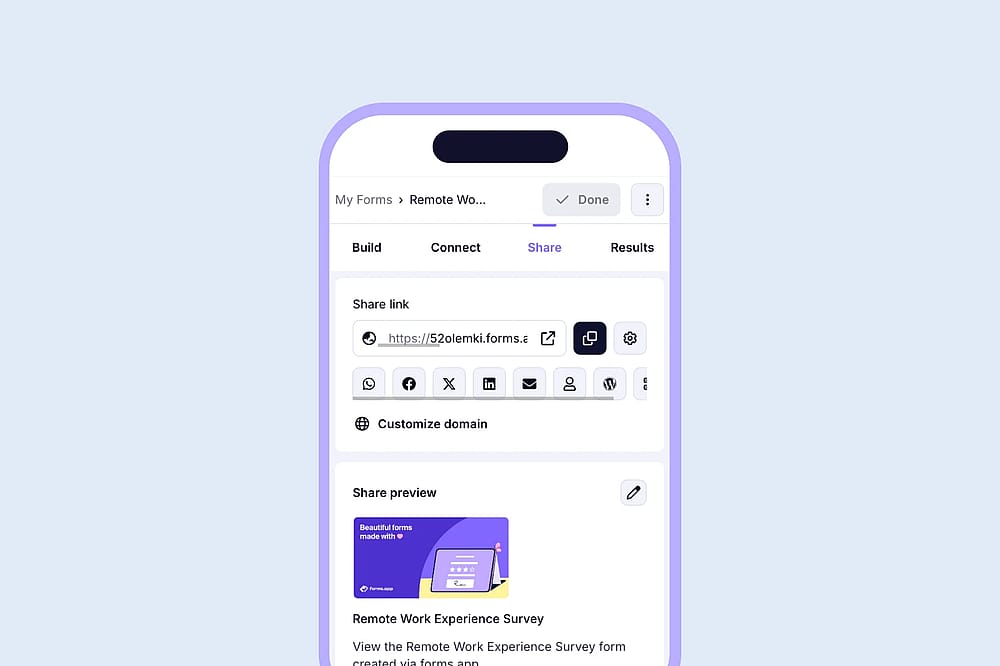
Share your remote work survey
5. Analyze results using the scoring approach above, share findings, and repeat next quarter.
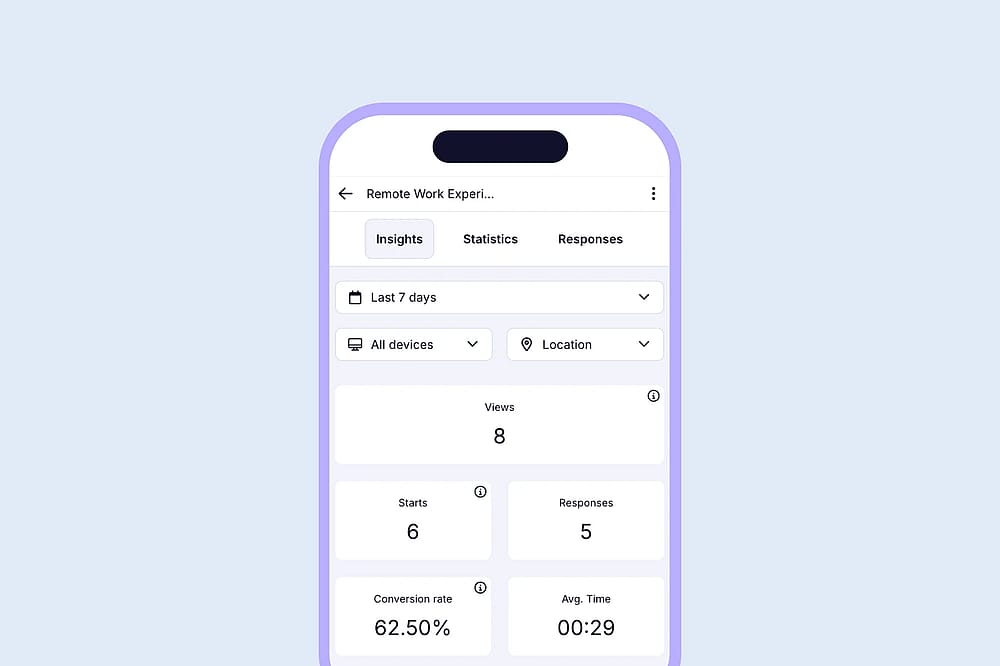
Analyze the form results
Expert tips
👤 Keep it anonymous. When I switched a manager-effectiveness question from named to anonymous, the average score dropped nearly a full point.
🧠 Limit open-ended questions to three or four; past that, completion drops.
🔑 Design for mobile - a good share of my responses came in from people on their phones between meetings.
🤝 Follow up on what you found. This is the step most companies skip.
📊 Repeat the survey. Comparing round two against round one is what proves the changes actually worked.
Common mistakes to avoid
- Surveying without acting on the results.
- Asking about a benefit that isn't actually on the table (I did this once with an equipment budget that didn't exist).
- Averaging results company-wide instead of by team, which hides where the real problems are.
- Asking double-barreled questions, such as "Are you satisfied with your salary and career growth?", which makes it impossible to know which issue employees are actually responding to.
Final words
Remote work surveys exist to answer one question: is your team's setup actually working, or does it just look fine from the outside? The questions aren't the hard part; matching the right question type to each one, and following through on the answers, is. Good luck with your survey!
FAQ
20–30 for a full review; 3–5 rotating for regular pulse checks.
Yes, almost always. It produces more honest answers on manager effectiveness and wellbeing.
Yes. Just add a question on how many days someone typically works away from the office, so you can segment results by that.
Contributors
Researched & written by
forms.app, your free form builder
- Unlimited responses
- Unlimited questions
- Unlimited team members