Save up to 60% on yearly plans and enjoy our biggest offer of the year. Limited time only. 🍂
See pricing

Rating polls: Advantages, questions, tips & more
Summarize with
For marketers and survey designers, the goal is simple: Move beyond guesswork and get respondents to rate their experience with precision. Whether you are evaluating product features or overall user experience, the right types of survey questions make the difference between "noise" and actionable data.
In practice, the most commonly used rating scale in customer feedback forms is the 5-point Likert scale, which strikes the right balance between simplicity for respondents and sufficient range for meaningful results. Star ratings come in as a close second, especially in e-commerce and app reviews, where a quick visual response feels natural.
Rating polls are the gold standard for turning vague opinions into a measurable numeric rating scale. While open-ended questions provide context, rating scales allow you to quantify customer support quality and employee engagement at scale.
In this guide, we’ll explore the most effective types of rating scales, provide a long list of rating scale examples, and show you how to build your own for free with forms.app.
TL;DR: Rating polls at a glance
What they are: A structured method for survey respondents to evaluate a product or service using set response options.
Key types:
1. Numeric rating scale: (e.g., 1–10) for granular data.
2. Likert scale: To measure agreement levels.
3. NPS: For long-term loyalty and market research.
What is a rating poll & when to use it
A rating poll is a short survey that asks people to evaluate something, a product, service, experience, or opinion, using a defined scale.
❗ Unlike survey ranking questions (which use rank order to compare items), rating polls focus on the specific value of a single item to ensure higher response rates.
Rating polls work best when you need measurable feedback fast. They are commonly used for customer feedback after a purchase or support interaction, employee satisfaction, course and teacher evaluations, market research, and live event feedback.
The most common formats are the Likert scale (Strongly agree → Strongly disagree), star rating (1 to 5 stars), numeric scale (1 to 10), NPS scale (0 to 10, measuring how likely someone is to recommend you), and multiple-choice rating options. Each suits a slightly different context, but all share the same goal: turning opinions into data you can measure.
💡 Expert tip: One of the most effective uses we see is a post-purchase star rating poll sent automatically after order delivery.
A simple 3-question form (overall satisfaction, delivery experience, and one open-ended follow-up) consistently delivers significantly higher response rates than longer feedback surveys. Research published in PMC confirms that shorter surveys produce higher response and completion rates, with completion rates for long surveys dropping to 37% compared to 63% for shorter versions.
25+ rating poll question examples
Using a variety of response options, from the numeric rating scale to the Likert scale, is the best way to get respondents to rate their experiences accurately. Below is a long list of categorized rating-scale question examples you can copy and paste directly into your form.
General experience questions
General experience questions help you measure how people feel about an interaction, event, or situation without tying it to a specific product or service.
1. How would you rate your overall experience with us today?
a) Excellent
b) Good
c) Average
d) Poor
e) Very poor
2. On a scale of 1 to 10, how likely are you to recommend us to a friend or colleague?
3. How satisfied are you with the communication you received throughout the process?
a) Very satisfied
b) Satisfied
c) Neutral
d) Dissatisfied
e) Very dissatisfied
4. On a scale of 1 to 5, how well did we meet your expectations?
5. On a scale of 1 to 5, how much did your experience match what we promised?
💡 Expert tip: The “Neutral” option in a 5-point scale can be misleading. Many people choose it just because it’s the easiest option, not because they truly feel neutral. If you want clearer answers, try using a 4-point or 6-point scale. This removes the middle option, encouraging people to choose a side.
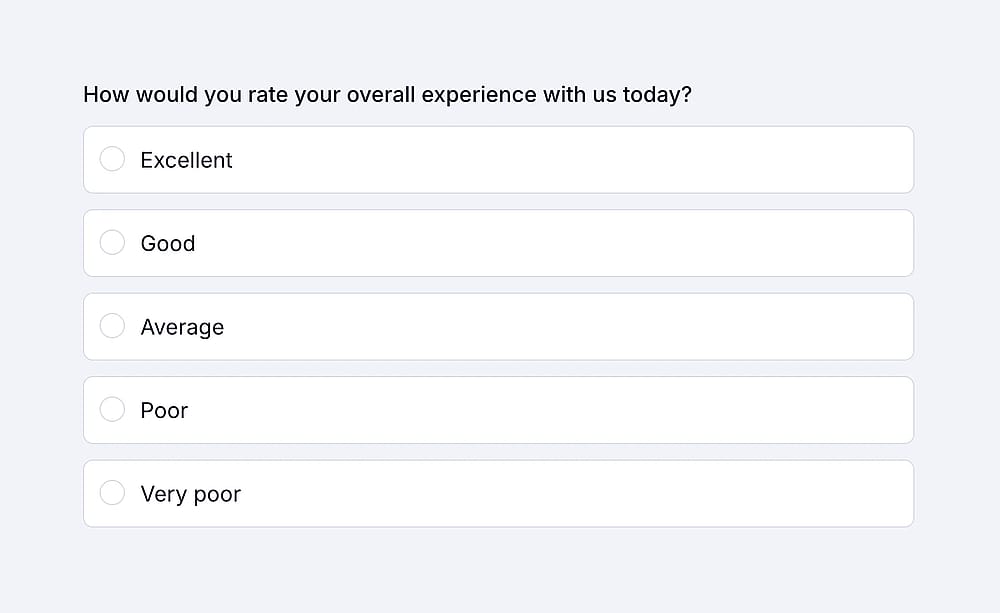
A rating poll question asking about general experience
Product & service feedback
These types of questions help businesses identify what is working and what needs improvement.
💡Questions given below are perfect for market research and measuring customer opinions about product features.
6. In your opinion, how well does our product meet your expectations in terms of quality?
a) Exceeds expectations
b) Meets expectations
c) Below expectations
d) I have not used the product yet
7. On a scale of 1 to 10, how pleased are you with the features of our product?
8. How would you rate the alignment of our product prices with your budget?
a) Excellent value
b) Good value
c) Fair value
d) Poor value
9. How happy are you with the way we delivered your order?
a) Very happy
b) Happy
c) Neutral
d) Unhappy
e) Very unhappy
10. Would you consider purchasing from us again in the future?
a) Definitely
b) Probably
c) Not sure
d) Definitely not
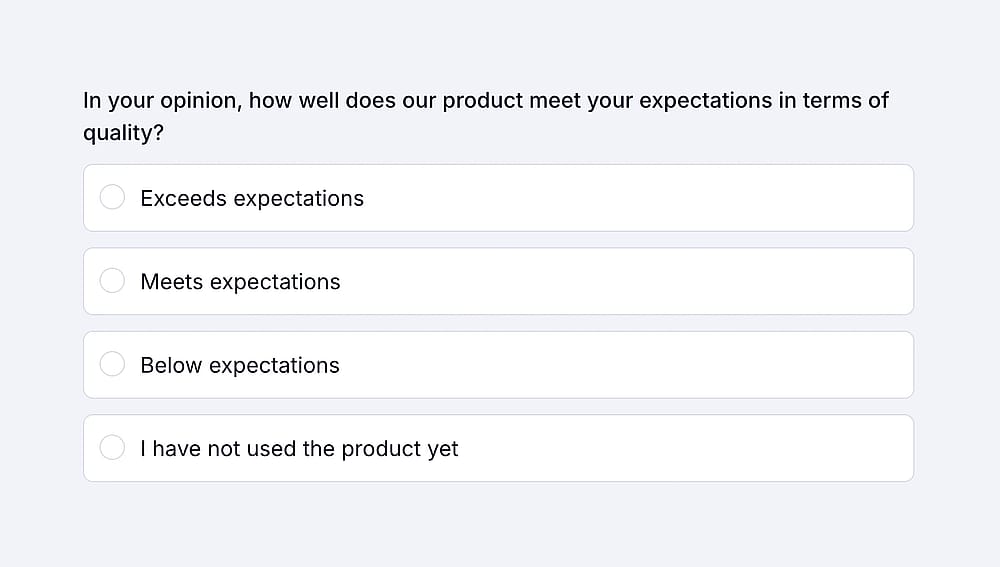
A rating poll question asking about product satisfaction
Employee engagement questions
Listening to what your employees have to say can make a meaningful difference in workplace culture and productivity.
11. My manager makes sure we all understand the company's purpose and direction.
a) Strongly agree
b) Agree
c) Somewhat agree
d) Disagree
e) Strongly disagree
12. On a scale of 1 to 5, how excited are you to come to work each day?
13. How closely did your onboarding or training materials align with your actual job duties?
a) Completely aligned
b) Mostly aligned
c) Somewhat aligned
d) Not aligned at all
14. On a scale of 1 to 10, how likely are you to recommend this company as a great place to work?
15. On a scale of 1 to 5, how much do you agree with the statement: "My company invests in building a positive workplace culture"?
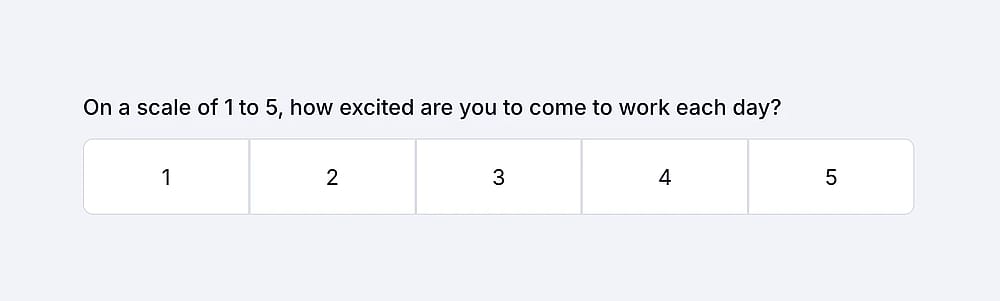
A rating poll question asking about employee engagement
Student & teacher feedback
These rating scale examples for students cover everything from course content and classroom experience to teacher performance and school facilities, making them ideal rating scale examples for students in education at all levels.
16. Is the course content meeting your expectations? a) Yes, it exceeds my expectations b) Yes, it meets my expectations c) No, it does not meet my expectations
17. On a scale of 1 to 10, how much does your teacher motivate you to learn more?
18. How would you rate your overall academic experience in this course? a) Excellent b) Good c) Average d) Poor
19. Do you feel the school provides everything you need to learn effectively? a) Strongly agree b) Agree c) Neutral d) Disagree
20. On a scale of 1 to 5, how valued do you feel as a student in your classes?
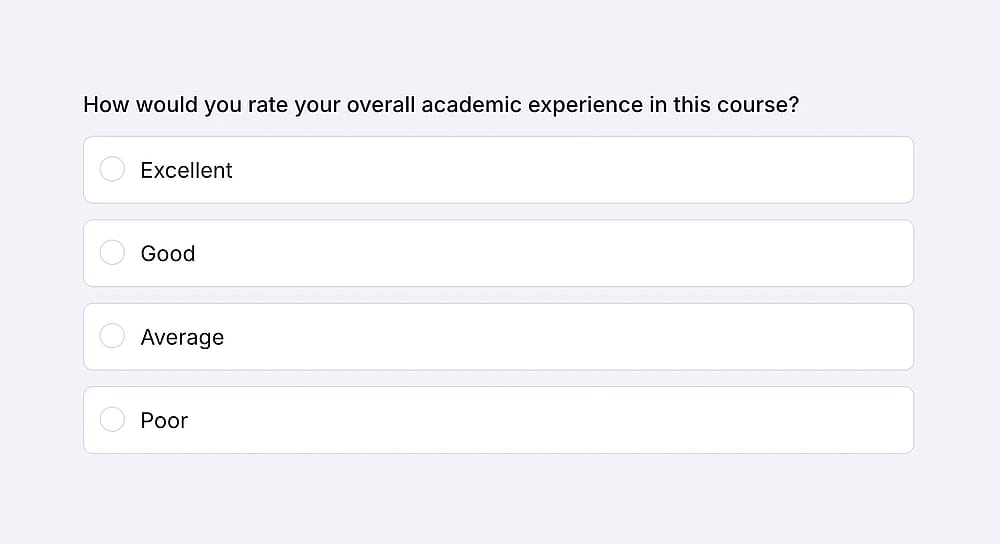
A rating poll question asking about student experience
Bonus: Funny poll questions
Not every poll needs to be serious. Adding a touch of humor to your surveys can boost completion rates and make respondents feel more comfortable sharing honest answers.
21. On a scale of 1 to 10, how would you rate your ability to function before your first coffee of the day?
22. How would you rate your skill at pretending to be busy when your boss walks by?
a) Olympic-level
b) Pretty convincing
c) Needs work
d) I always get caught
23. On a scale of 1 to 5, how well do you handle Mondays?
24. Rate how often you say "I'll start my diet on Monday" and actually follow through.
a) Every single time
b) Sometimes
c) Rarely
d) Monday never comes
25. On a scale of 1 to 5, how well do you actually follow the "serving size" on snack packaging?
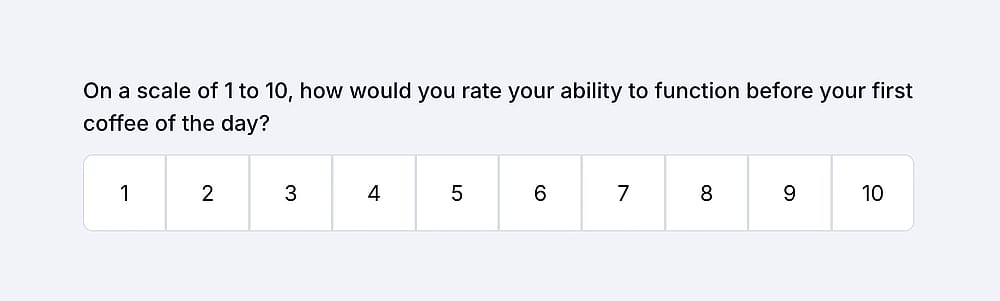
A fun rating poll question
Common mistakes to avoid
Even well-intentioned rating polls can produce misleading data if a few key details are overlooked. Here are the most common mistakes to watch out for before you hit publish:
1. Using too many scale points
More options don't always mean better data. Most respondents default to round numbers on a 10-point scale, which skews results. A 5-point scale almost always gives you cleaner, more reliable data.
Regarding the research on the optimal number of response categories in rating scales, the best number of rating scale options is around 7.
2. Forgetting to label your endpoints
A rating scale, 1–5, poor to excellent,< means nothing if respondents don’t know which end is positive. Always label both ends clearly, “1 = Very dissatisfied (poor), 5 = Very satisfied (excellent)”.
3. Asking about things people haven't experienced
If a customer has never used your return process, rating it is just a guess. Always include a "Not applicable" option, otherwise you're collecting noise, not real data.
💡Expert tip: In customer satisfaction polls, we found that adding a single "I haven't experienced this" option reduced forced responses significantly and made the remaining ratings far more trustworthy.
4. Making every question a rating question
Numbers tell you what is broken; open-ended questions tell you why. A poll made entirely of scales gives you scores with no context to act on.
5. Using double-barreled questions
A double-barreled question asks about two things at once, for example, "How satisfied are you with our price and delivery speed?" If a respondent loves the price but hates the delivery, there is no honest answer.
Expert tip: A quick way to catch double-barreled questions before publishing: read each question and check if it contains the word "and." If it does, it probably needs to be split.
How to create rating polls for free
Building a rating poll is a quick process, but following the right steps ensures you get the most accurate data from your audience:
1. Define your aim and choose your questions
Before using any tool, decide what you want to measure, whether it’s user satisfaction, feature importance, or event success, and focus on one main goal per poll.
Then, write clear questions (e.g., “How would you rate the ease of use?”) and choose a suitable scale like stars, hearts, or a 1–10 rating.
2. Choose a professional poll tool
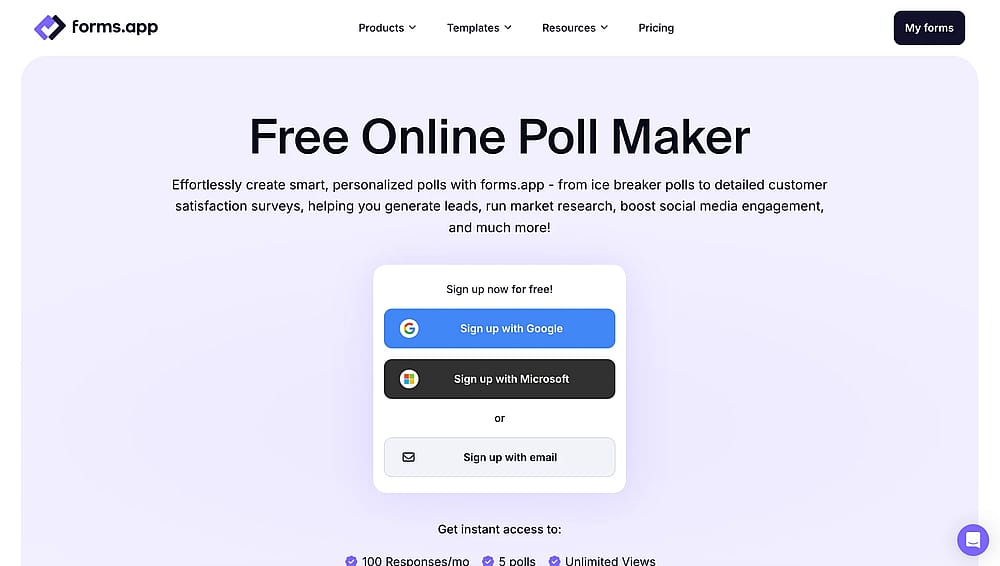
Open forms.app to create your free poll
There are many online tools available for gathering feedback, but you want one that is fast and offers high customization for free. forms.app’s poll maker is an ideal solution here; it allows you to create professional rating polls in minutes with a user-friendly interface that doesn't require any coding.
3. Add your own questions
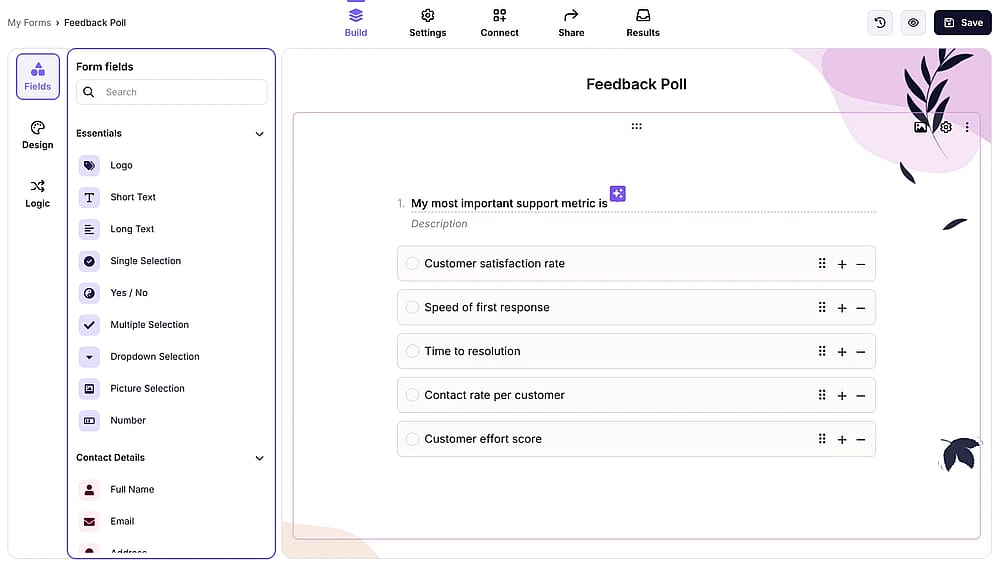
Add your questions from the field menu on the left
Add your questions manually or use the ones included in your chosen template. You can mix question types, rating scales, multiple choice, and open-ended, depending on what insights you need.
4. Customize the design
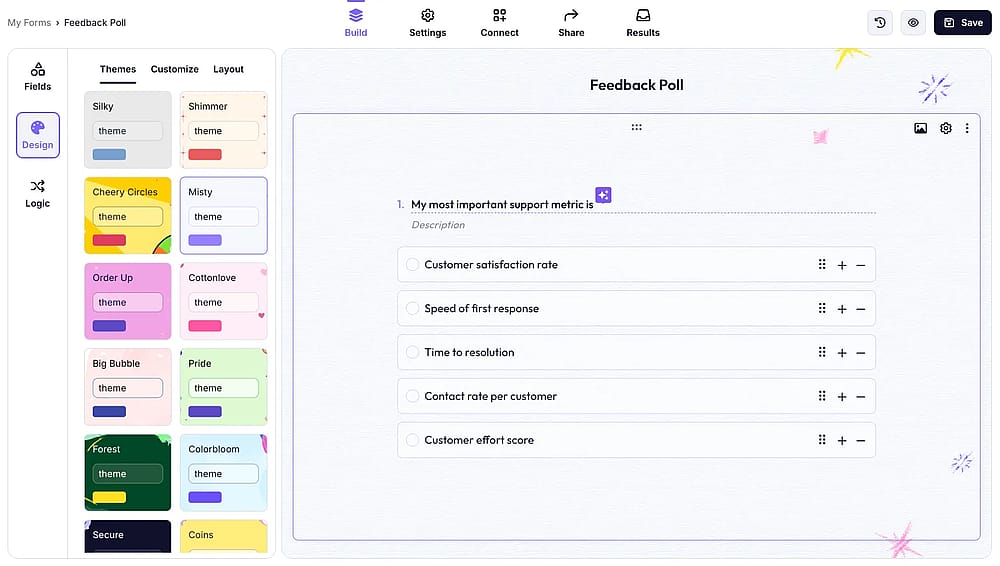
Customize your poll by accessing the ‘Design’ tab
Match the poll to your brand by adjusting colors, fonts, and background. You can also add your logo and tweak the theme to fit your style.
5. Connect to your tools
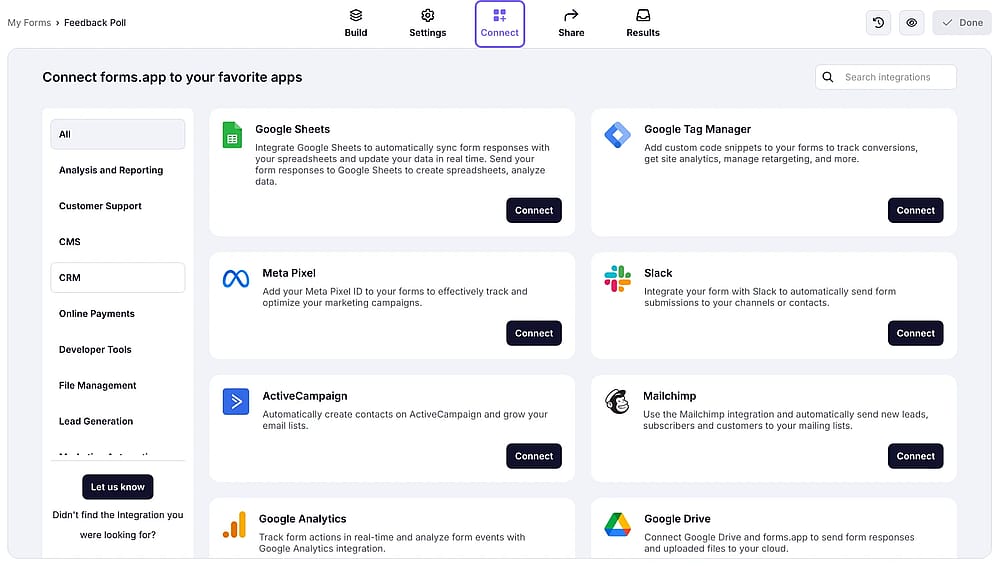
Open the ‘Connect’ section to access the integrations
Use the Connect tab to sync responses with Google Sheets, Microsoft Excel, or ActiveCampaign for reporting. For customer support and sales teams, you can connect your poll with WhatsApp, Messenger, etc.
6. Share your poll & analyze results
Embed the poll on your website, share it on social media, send it by email, or generate a QR code. You can also set visibility to public, limited, or private depending on your audience.
Once the responses start coming in, check the Results tab to see your submissions and valuable insights.
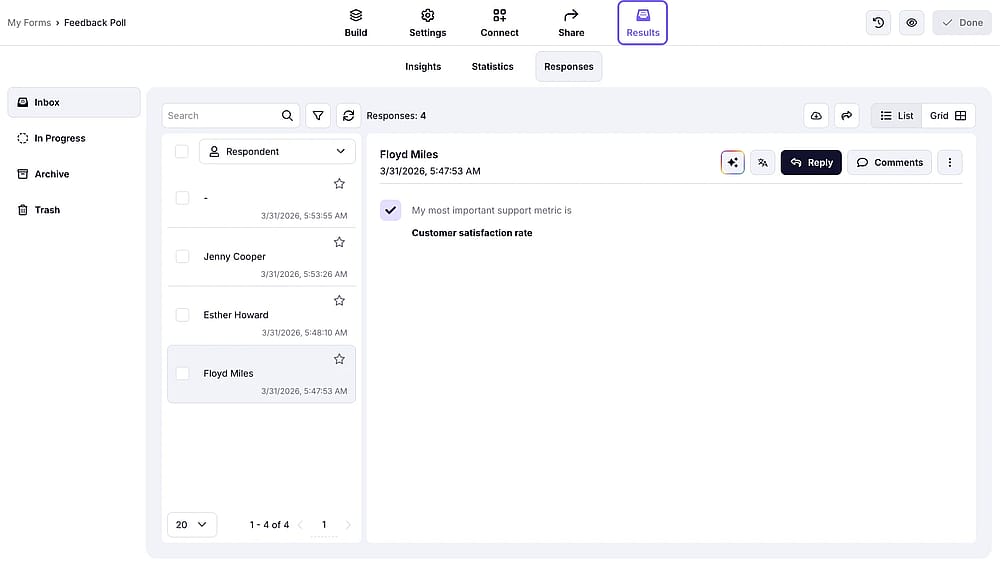
Click the ‘Results’ button to manage your form submissions
Conclusion
Opinions are everywhere, but raw opinions don't move businesses forward; structured data does. Rating polls give you a reliable, repeatable way to measure what people actually think, not just what they say in passing. Whether you're checking in on customers, employees, or students, the questions you ask today shape the decisions you make tomorrow.
Frequently asked questions (FAQs)
A rating question asks respondents to evaluate each item independently on a fixed scale. A ranking question asks them to order multiple items relative to each other. Rank order question examples include asking employees to rank their top three benefits or asking customers to prioritize product improvements.
Use rating questions when you want to measure each item on its own merits, and ranking questions when you need to understand priorities.
Yes, and it is highly recommended. A rating scale tells you what people think; a follow-up text box tells you why. Adding an open-ended question after a low rating, in particular, can reveal specific issues that numbers alone would never surface.
An emoji scale works best when your audience is younger, less formal, or when the survey is short and conversational, such as a quick post-purchase check-in or an event feedback form.
Numeric scales are better suited for professional or analytical contexts where precise measurement and data comparison matter more.
Contributors
Researched & written by
forms.app, your free form builder
- Unlimited responses
- Unlimited questions
- Unlimited team members