Save up to 60% on yearly plans and enjoy our biggest offer of the year. Limited time only. 🍂
See pricing

Phone surveys: Expert guide, pros, cons & best practices
Summarize with
Reaching a live human being is harder than ever. Data from the American Association for Public Opinion Research (AAPOR) shows that telephone response rates have plummeted over the last two decades. Yet, despite this decline, telephone surveys remain one of the most reliable ways to capture nuanced, high-quality data.
Unlike self-administered online surveys, where respondents often rush or misinterpret prompts, telephone surveys leverage a live interviewer. Today, professional research relies on CATI (Computer-Assisted Telephone Interviewing) systems. CATI technology guides interviewers through dynamic scripts on-screen, automatically managing skip logic and data entry to eliminate human error.
A phone survey is a data collection method where a researcher asks respondents pre-scripted questions over a phone call.
The 3 main types of phone surveys
Not all telephone surveys are conducted the same way. When conducting modern market research, choosing the right method depends on your budget, your target audience, and how you plan to collect data. Understanding these distinctions is crucial for a successful campaign.
1. CATI (Computer-Assisted Telephone Interviewing)
This is the gold standard for professional phone interviews. A live interviewer speaks with the respondent, frequently reaching them on their mobile phone, while using a computer program to view the script and log answers instantly. While it is the most rigorous method and yields the highest-quality data, it also carries the highest cost.
2. IVR (Interactive Voice Response / Automated)
Often referred to as automated or "robocall" surveys, IVR relies on a pre-recorded voice script. Respondents answer by pressing keys on their keypad or speaking simple words. IVR is highly cost-effective and scalable, but it suffers from low completion rates and is strictly limited to simple, closed-ended questions.
3. Mixed-mode surveys
An increasingly common approach that combines methodologies to maximize reach. For example, a researcher might initiate contact via a live call to a mobile phone and follow up with an online questionnaire link, allowing teams to collect data flexibly across different demographics.
Comparing types of phone surveys
Phone Survey Type | Best For | Cost | Response Rate |
|---|---|---|---|
CATI (Live Interviewer) | Complex, in-depth research | High | High |
IVR (Automated/Robo) | Simple, high-volume feedback | Low | Low |
Mixed-Mode | Maximizing reach & budget | Medium | High |
When should you choose a phone survey?
While online forms are the default for modern research, they do not accurately represent the general population. There are distinct scenarios where telephone surveys are not just a viable alternative, but the only way to ensure valid results.
1. Reaching hard-to-reach demographics
If your target audience includes older adults, rural residents, or communities with limited internet access, digital-only methods will bias your data. Phone calls remain the most effective bridge to these groups, ensuring their voices are included in your research.
2. High-stakes projects requiring strict quality control
When data integrity is paramount, phone interviews offer unparalleled oversight. Using CATI systems allows project managers to listen to live calls, monitor interviewer bias, and ensure that survey questions are read exactly as intended. This level of real-time quality control is impossible with self-administered online surveys.
3. Handling complex or sensitive topics
When collecting information on nuanced, emotional, or complicated subjects, a live interviewer can read the room. They can provide standardized clarifications if a respondent misunderstands a question and probe deeper into open-ended answers without leading the participant.
4. The missed angle: B2B research & Tight timelines
The strategic advantage competitors miss! Most guides assume phone surveys take longer than online ones. However, the opposite is often true. Executives and busy professionals rarely click on emailed survey links, their spam filters block them, or they simply ignore them. A direct, professional phone call can bypass the inbox clutter, securing a response in days rather than weeks.
The strategic advantages of telephone surveys
Most guides will tell you that phone surveys are just "faster than mail and cheaper than in-person interviews." While true, surface-level analysis misses the real methodological power of phone interviews. To truly understand why top research firms still invest in this channel, you have to look at the psychological and operational advantages.
1. The psychology of human contact (higher completion rates)
An unsolicited email or pop-up survey is incredibly easy to ignore, delete, or close out. A live human voice changes the dynamic entirely. While response rates have declined, the completion rates, the percentage of people who finish the survey once they actually pick up, remain remarkably high. Human contact builds a rapid micro-rapport that digital screens simply cannot replicate.
2. The power of conversational probing
In market research, the most valuable data often hides in the follow-up. If a respondent gives a vague answer to an online form, that data point is a dead end. In telephone surveys, trained interviewers can probe deeper using standardized, non-leading prompts (e.g., "Can you tell me a little more about that?"). This allows you to collect data with a level of qualitative depth that rivals a mini-focus group.
3. Real-time field agility
With CATI (Computer-Assisted Telephone Interviewing) systems, data is captured and centralized the moment a call ends. This offers massive operational benefits:
- Immediate quality control: Project managers can review responses on day one to catch any systemic misunderstandings of the survey questions.
- Live quota management: If you have already reached your quota for a specific demographic within the general population, the system automatically stops serving those numbers, saving you time and budget.
💡 Editor’s tip: Online respondents often quit when forced to type long answers. On a call, people naturally love to talk. We leverage this by placing complex, open-ended survey questions in the middle of our phone scripts, right after the interviewer has established a comfortable conversational rhythm.
The disadvantages of phone surveys
While the benefits are significant, conducting market research via phone has become increasingly challenging. Understanding these limitations is essential for managing your budget and protecting your data integrity.
1. Declining response rates & "Robocall fatigue"
The rise of spam calls and stricter mobile filtering means people rarely answer calls from unknown numbers. Additionally, negative caller ID labeling (such as "Spam Risk" or "Telemarketer") makes it incredibly difficult to get the general population to pick up, drastically lowering the efficiency of a cell phone survey.
2. High operational costs
Unlike online questionnaires that run automatically, phone interviews require a heavy upfront investment. You must budget for specialized software (such as CATI), call infrastructure, and fair wages to hire, train, and manage skilled interviewers.
3. Structural & Cognitive limitations
- The 15-minute wall: While online respondents can save progress and return later, phone respondents lose patience quickly. Keeping scripts under 15 minutes is a strict rule.
- No visual aids: You cannot show respondents product packaging, logo designs, or complex matrix scales. Everything must be communicated verbally.
- Social desirability bias: Because respondents are talking to a live person, they are statistically more likely to overstate positive behaviors or hide unpopular opinions to avoid feeling judged.
4. Sampling bias
Achieving a truly random sample is incredibly difficult today. Due to this systemic sampling bias, landline databases skew heavily toward older demographics, while a modern cell phone survey skews younger and is plagued by unassigned or rapidly changing phone numbers.
5. The missed angle: TCPA & GDPR legal risks
Most guides ignore the legal realities of collecting information over the phone. In the US, the Telephone Consumer Protection Act (TCPA) carries massive fines for dialing mobile phone numbers using automated dialers without prior consent. If you are conducting an outbound customer satisfaction study, you must ensure your dialing technology complies with these evolving laws to avoid catastrophic lawsuits.
This head-to-head comparison addresses the most critical gap in current competitor articles. By contrasting these two methodologies directly, you provide high-value clarity for researchers trying to choose the right tool for their project.
Phone surveys vs. Online surveys
When deciding how to collect data for your next project, the choice usually comes down to telephone surveys versus digital questionnaires. Both have distinct advantages, but they serve completely different research goals.
While phone interviews offer unmatched data depth and strict quality control, online surveys dominate in speed, budget, and sheer scalability.
Feature | Phone Surveys (CATI) | Online Surveys |
|---|---|---|
Cost Per Response | High (Requires staffing & infrastructure) | Very Low (Software-driven) |
Fieldwork Speed | Slow to Medium (Requires manual dialing) | Instantaneous (Rapid deployment) |
Response/Completion Rate | Higher completion once connected | Lower response rates (Easy to ignore) |
Depth of Data | High (Interviewers can probe and clarify) | Medium to Low (Relies on text inputs) |
Audience Reach | Excellent for older & rural demographics | Best for tech-savvy & younger demographics |
Visual Elements | None (Entirely verbal) | High (Supports images, videos, matrix scales) |
Compliance Risk | High (TCPA, GDPR, and caller ID laws) | Low (Opt-in email/web consent) |
How to conduct a phone survey (step-by-step)
Executing a successful cell phone survey requires balancing rigorous methodology with human empathy. Here is the blueprint professional research firms use to deploy, manage, and analyze telephone-based campaigns.
1. Define objectives & Population
Establish exactly what you want to learn and who you need to reach. Whether measuring customer satisfaction or sampling the general population, your target audience dictates your sourcing strategy.
2. Design a phone-friendly script
Writing for the ear is different than writing for the screen. Put short, closed-ended survey questions first to build momentum. Avoid complex matrix scales and keep the total duration under 10–15 minutes to prevent drop-outs.
3. Source clean, compliant lists
To collect data legally, ensure your database of phone numbers is verified. You can use existing internal customer lists, pre-vetted opt-in research panels, or Random Digit Dialing (RDD) for broad geographic targeting.
4. Train your interviewers
Your data is only as good as the people gathering it. Interviewers must be trained on strict script adherence to avoid phrasing bias, conversational rapport to lower hang-up rates, and standardized probing techniques.
5. Run a pilot test
Never launch fully on day one. Soft-launch with 10–20 live calls to test the script flow, check your CATI software routing, and ensure the wording doesn't confuse respondents.
6. Monitor quality in real time
Once fully live, supervisors must utilize CATI tools for continuous quality control. Listen to live calls and review audio logs daily to ensure interviewers remain neutral while collecting information.
7. Clean & Weight data
Scrub your final dataset for incomplete responses. If your final sample skews older or more rural than intended, apply statistical weights so your findings accurately mirror your target demographic.
Best practices for high-yield phone surveys
Most guides offer generic advice like "be polite" and "speak clearly." But executing a high-performing campaign requires tactical tweaks that directly counter robocall fatigue and short attention spans. Use these expert strategies to maximize your response rates and secure clean data.
1. Master the 10-second hook
You have exactly ten seconds to convince a respondent not to hang up. Your introduction must immediately establish credibility, explain the purpose of the call, and clarify that you are collecting information, not selling a product.
- Weak intro: "Hello, my name is John, and I'm calling from ABC Research to ask you some questions today..."
- Strong intro: "Hello, this is ABC Research. We are conducting a brief, 5-minute study on local community safety. Your number was chosen randomly, we are not selling anything, and your answers are completely confidential."
2. Pre-notify via SMS
Let them know a professional researcher will be calling from a specific number to gather their feedback. This transforms a suspicious, unknown call into a warm, expected interaction.
3. Flip the script architecture
While online questionnaires can mix question types freely, phone scripts must be strategically layered:
- The 12-question limit: Try to cap your core script at 12 questions. Anything longer risks high mid-survey abandonment.
- Easy wins first: Start with simple, multiple-choice inquiries to get the respondent comfortable talking.
- Save the deep drops for last: Place your open-ended questions and demographic questions at the very end. By that point, the respondent has invested several minutes and is highly likely to finish the call.
4. Implement a smart callback strategy
Never count a missed call as a dead lead. Implement an automated callback protocol within your CATI software. If a respondent doesn't answer, recycle the number to be dialed at a completely different time of day. If they pick up but say they are busy, immediately offer a scheduled callback window (e.g., "I completely understand. Would tomorrow at 6:00 PM work better for you?").
5. Always record calls (with explicit consent)
You cannot manage what you do not measure. Make call recording a standard procedure for absolute quality control. Ensure your script features an explicit, legally compliant consent disclosure right at the start. Use these recordings to audit interviewer neutrality, resolve data anomalies, and train underperforming staff.
Bonus: Use an online survey builder alternatively
If phone surveys are not what you are looking for, you can switch to an online survey builder. In a few simple steps, you can immediately create one and share it with your audience.
Step 1: Sign in or log in to your forms.app account. Choose a ready template or generate with AI.
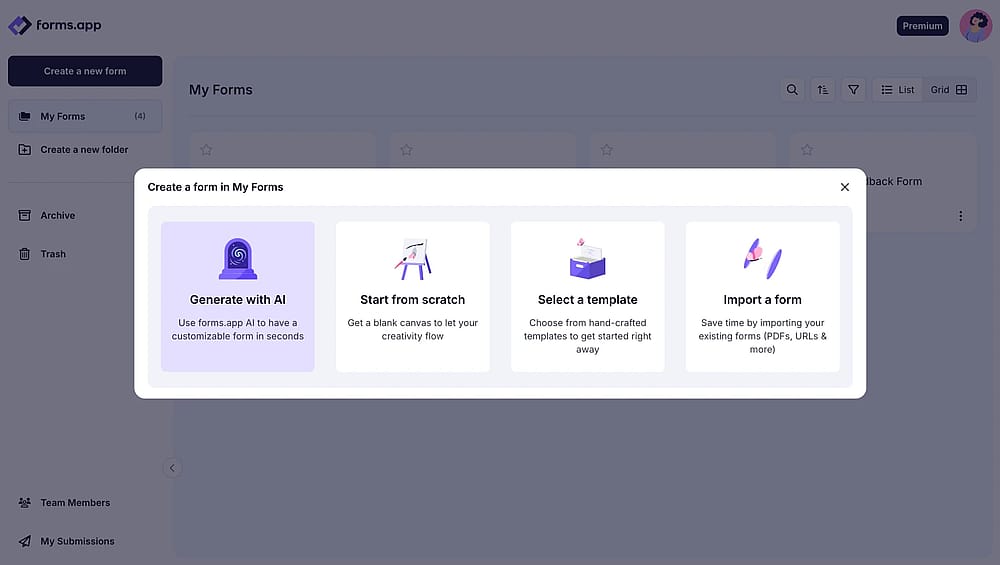
Choose a way to start
Step 2: Add your own survey questions or edit the existing ones.
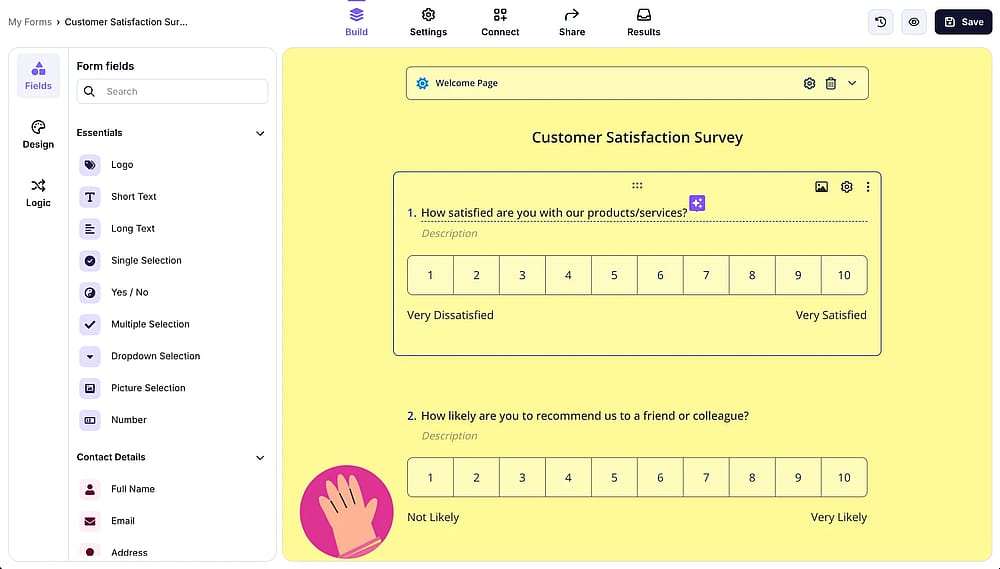
Change the questions
Step 3: Change the style of your survey. From themes to question colors, design the survey as you wish.
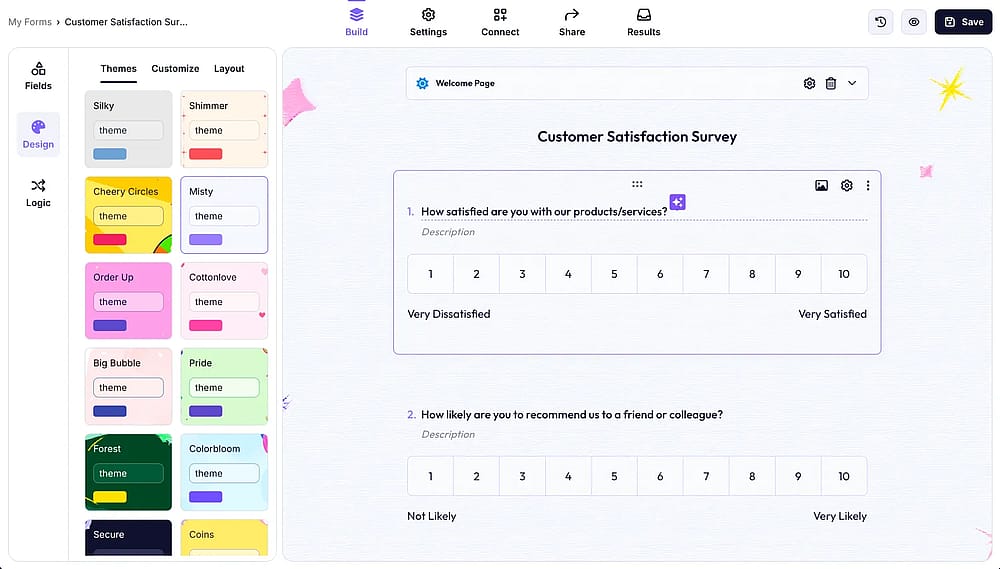
Change the style of your survey
Step 4: After previewing and testing it, it’s time to share. You can send the survey via a QR code or directly share the link.
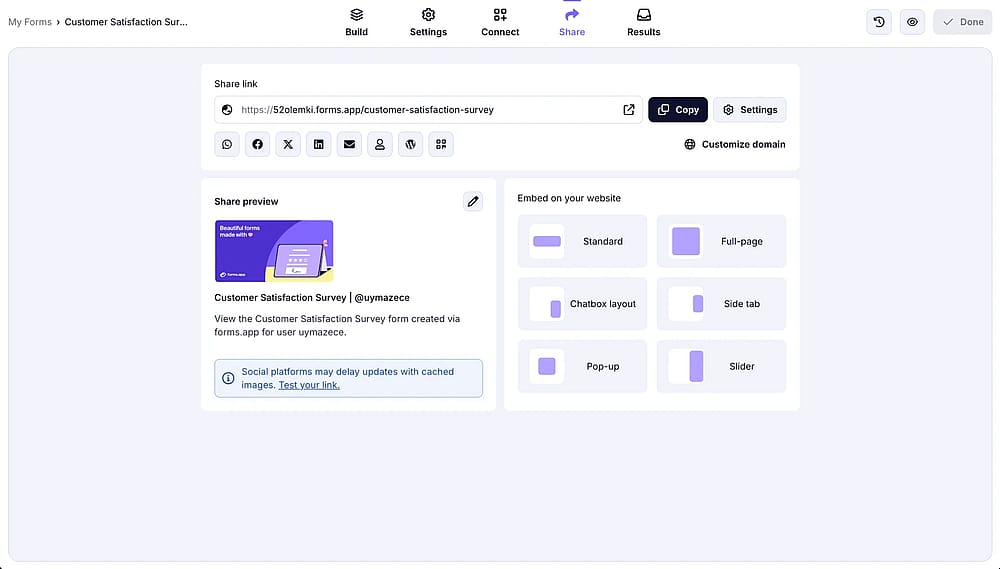
Share your survey
Step 5: Analyze the results. From the responses tab, you can see the drop-off rates and other essential statistics & insights based on your survey.
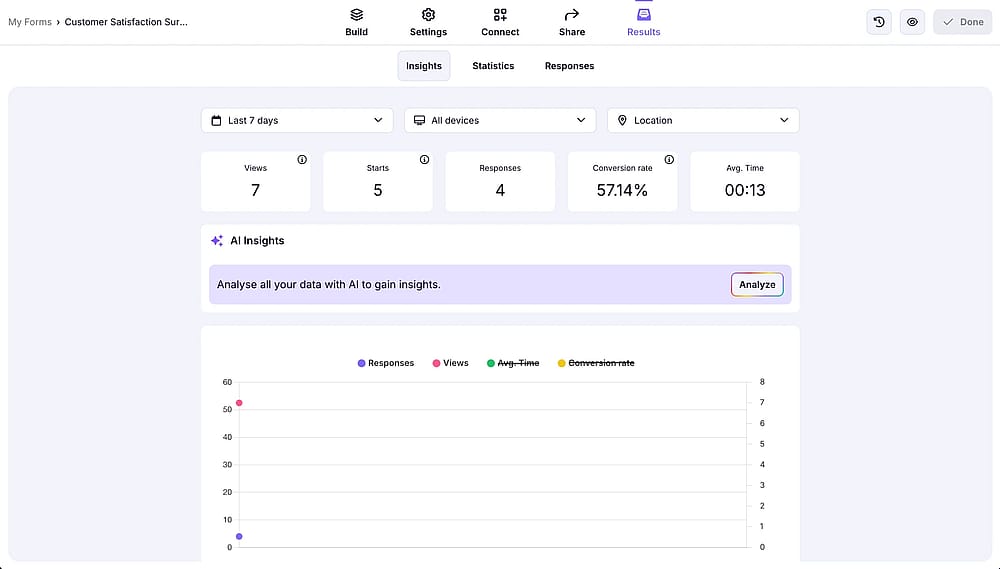
Check the survey results
Conclusion
Phone surveys remain an indispensable tool when you need deep qualitative insights, strict quality control, or access to hard-to-reach demographics. However, for the vast majority of modern research, online surveys deliver a faster, more cost-effective, and highly scalable alternative.
The success of your data collection doesn't just depend on the methodology you choose; it depends on using the right tool for the job.
If you are looking to launch a fast, responsive, and logic-driven questionnaire without the overhead of a call center, sign up for forms.app’s survey builder and start collecting high-quality data in minutes.
Frequently asked questions (FAQs)
Neither is universally better; it depends on your goals. Phone surveys excel at collecting deeply nuanced data, reaching specific demographics, and minimizing straight-lining behavior. Online surveys are superior when you have a limited budget, need visual elements, require massive scalability, or need to deploy your project on an incredibly tight timeline.
A phone survey should feature short, closed-ended questions first to build quick momentum and rapport. Avoid complex matrix grids or lengthy rating scales that are difficult to process verbally. Save your deep, open-ended probing questions and sensitive demographic criteria for the final third of the script.
To boost your response rates, send a branded pre-notification SMS 10 minutes before dialing to build trust. Always call during peak historical connection window, such as mid-week mornings or early evenings, and use advanced dialing software to automatically manage callback schedules for missed connections across different time zones.
Contributors
Researched & written by
forms.app, your free form builder
- Unlimited responses
- Unlimited questions
- Unlimited team members