Save up to 60% on yearly plans and enjoy our biggest offer of the year. Limited time only. 🍂
See pricing

How to customize the font in Google Forms
Summarize with
Customizing the font in Google Forms gives you an invisible boost. It helps your form look and feel a little more you. Having a suitable typeface directly correlates with the engagement you will get from your website or through social media. Therefore, changing the font in Google Forms is a critical part of customizing your form.
Even if you don’t focus on the typeface, you still notice it.
It may seem like a simple -and sometimes useless- thing. However, the font you choose is essential and has an impact on people’s behaviour. In this article, we will discuss why fonts matter in a form, show you a detailed guide on how to customize the font in Google Forms, a better option for general customization, and answer frequently asked questions about fonts in Google Forms.
How do you customize the font in Google Forms?
Customizing your Google Form also includes having the right Google Forms font style. It is time to look at how to change the fonts within Google Forms, plus a bonus way to get more fonts.
- Open Google Forms
- Click on the “Customize” button (Palette icon on the top menu)
- Choose the fonts for the header, question, and text
- Click “More fonts” to get more fonts to choose from
1. Open Google Forms
Go to Google Forms and open a form of your choice. You can also create a new Google Form by clicking on the + icon.
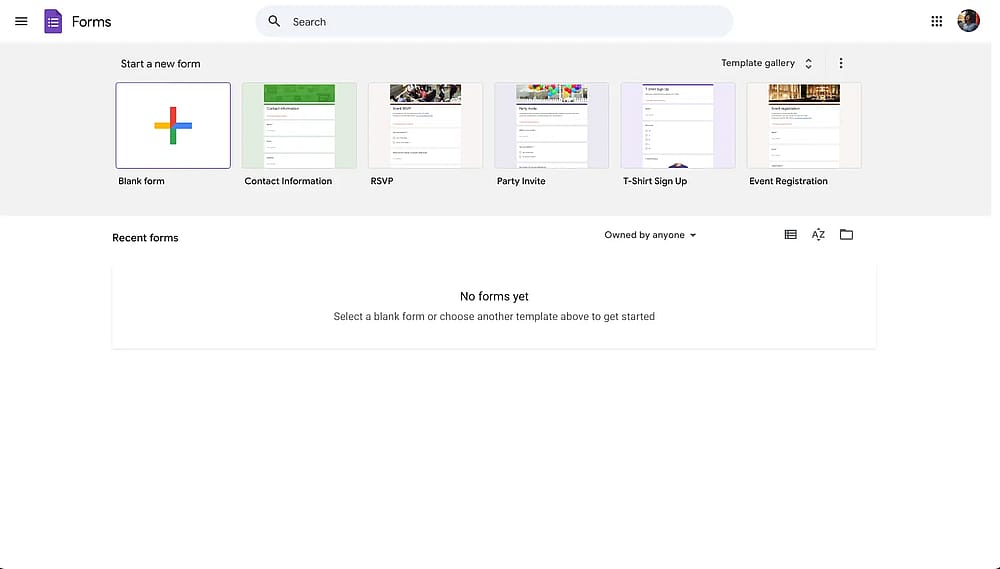
An image showing the dashboard of Google Forms
2. Click on the “Customize” button (Palette icon on the top menu)
Once you open a Google Form, click on the palette icon (🎨) to open the customization menu.
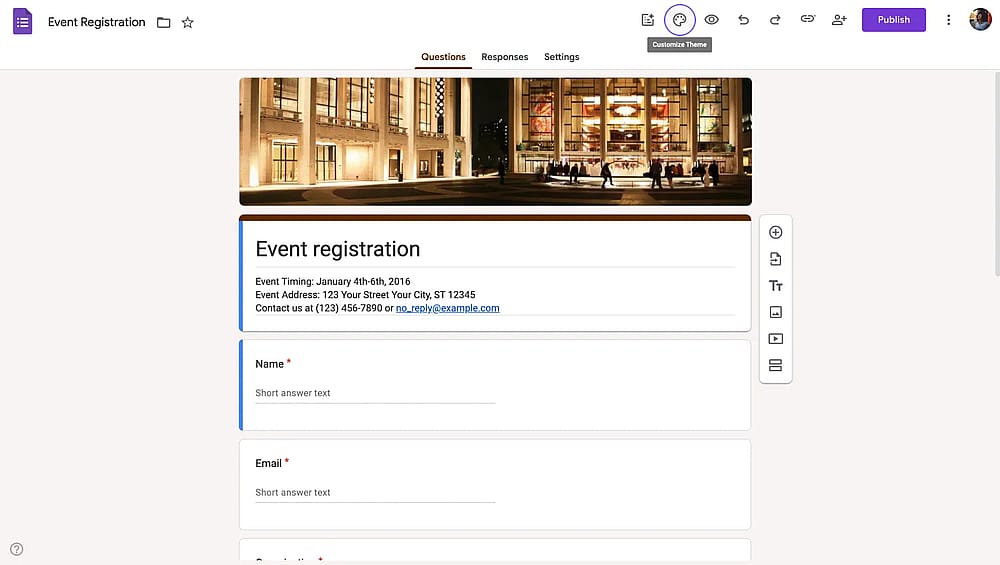
An image highlighting the palette icon
3. Choose the fonts for the header, question, and text
On the customization menu, you will see font options you can see the suit in different form styles. Simply choose the font of your choice for the header, question, and text. You can also change the font size for these elements here.
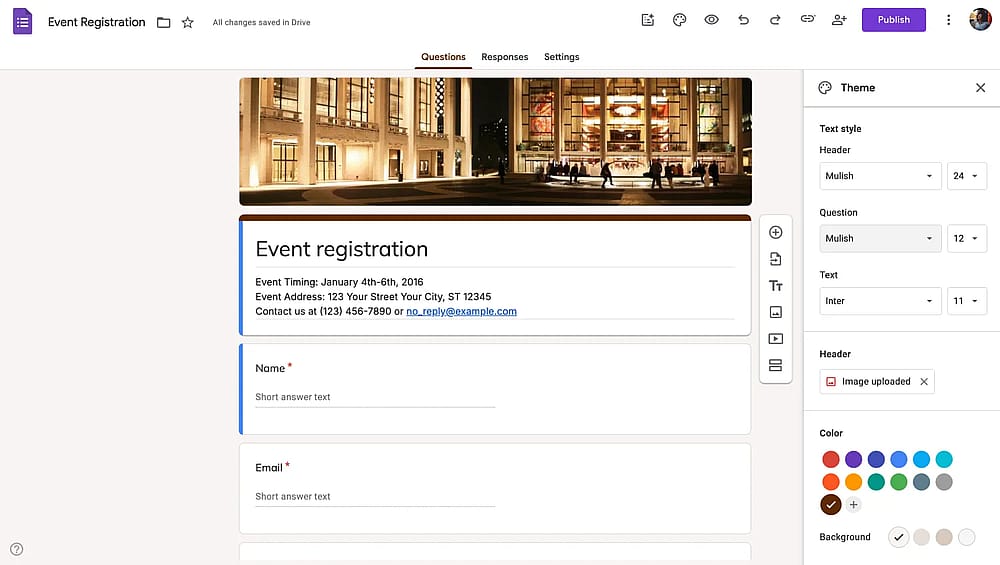
The font options under the customization menu
💡 Google Forms uses Roboto as its default font.
4. Click “More fonts” to get more fonts to choose from
To get more font options, simply click on “More fonts” within the dropdown menu. This action will take you to a menu where you can find different fonts for every language.
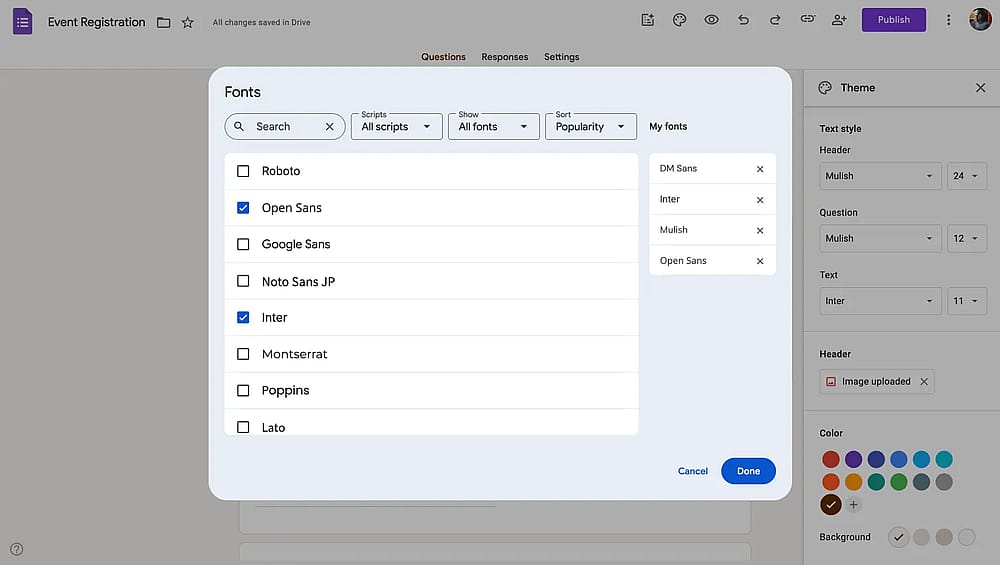
The “More Fonts” pop-up
💡 While some add-ons for Google Forms claim they offer more fonts, this is not the case.
Limitations of Google Forms Font Customization
Google Forms allows you to use any font from Google Fonts. However, knowing Google Forms' limitations will help you make informed decisions.
1. No Native Font Color Changes: The biggest complaint from users is the inability to change font colors without add-ons. You're stuck with dark gray or black text, which limits branding options significantly.
2. Cannot Upload Custom Brand Fonts: If your company uses a specific licensed font, you cannot upload it to Google Forms. This makes perfect brand matching impossible.
3. No Granular Typography Controls: You cannot adjust: Line height, Letter spacing, Font weight variations, Text shadows, effects, or Individual question styling.
4. Limited Size Control: The size options are limited on Google Forms. Between 18-24 for headers, 12-18 for questions, and 9-12 for texts.
forms.app: A Better Alternative for Form Customization
While it is simple to understand and use Google Forms, it has its limitations, especially in customization. forms.app offers more versatility and room for creativity in every way possible. With an all-around form builder like forms.app, you can create professional-looking forms out-of-the-box.
Feature/tool | Google Forms | forms.app |
Font Families | All Google Fonts | All Google Fonts |
Changing font Color | ||
Individual Element Styling | with CSS | |
Custom Font Upload | ||
Form layout | Standart | Step view + List view |
Custom CSS | ||
Smooth transitions | ||
Conditional logic | Limited | Advanced |
Border radius | Standart | Changeable |
Background image | ||
Animated backgrounds |
How to change fonts on forms.app
To change the font on a form created with the forms.app, go to the “Design” tab in the “Build” section of the form and click “Customize.” At this tab, you can change not only the font itself but also the color of every individual section, such as the color of the questions and answers.
1. Open or create a form on forms.app
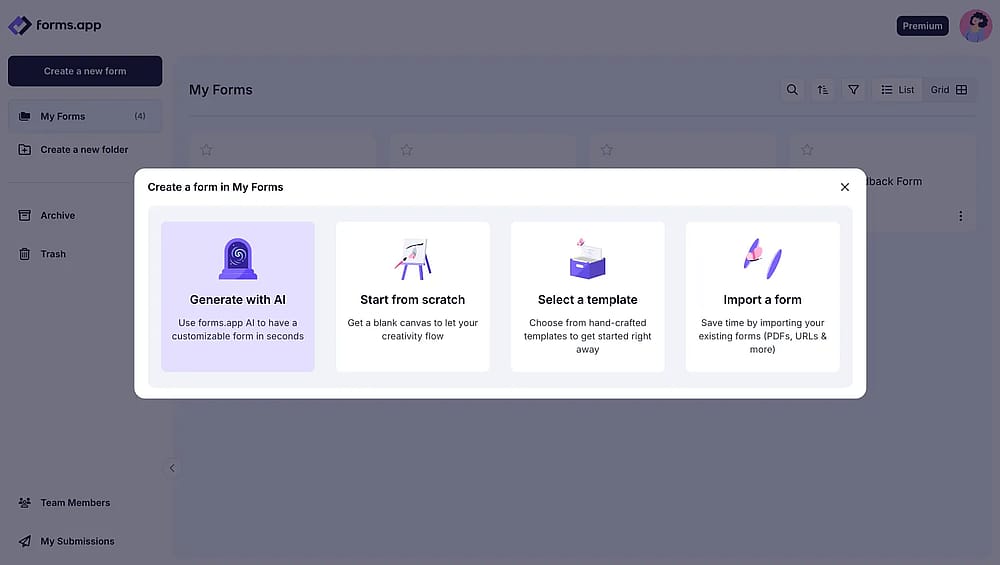
Form creation options on forms.app
2. Go to the “Design” tab
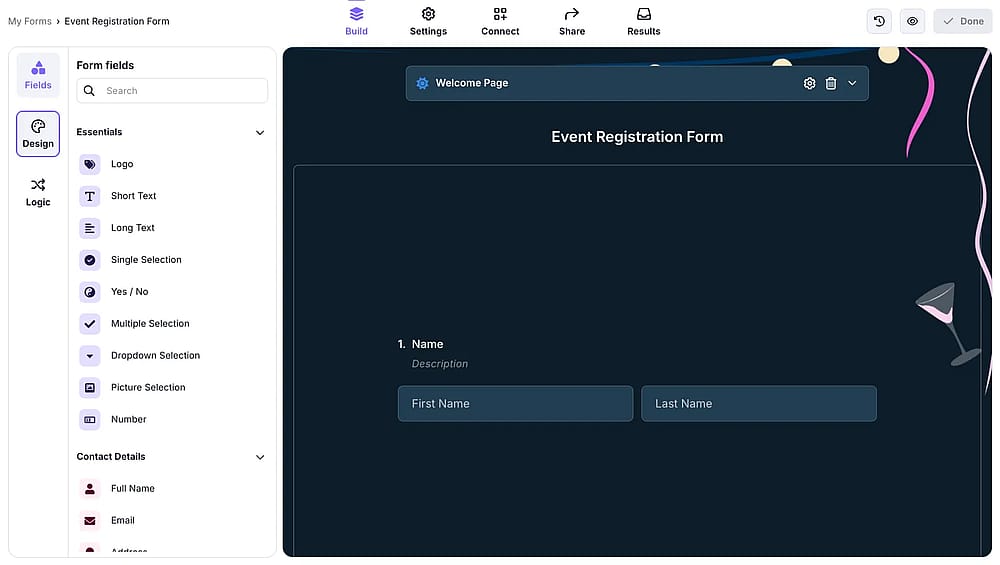
An image highlighting the design tab on forms.app
3. Switch to “Customize” and choose the font family of your choice
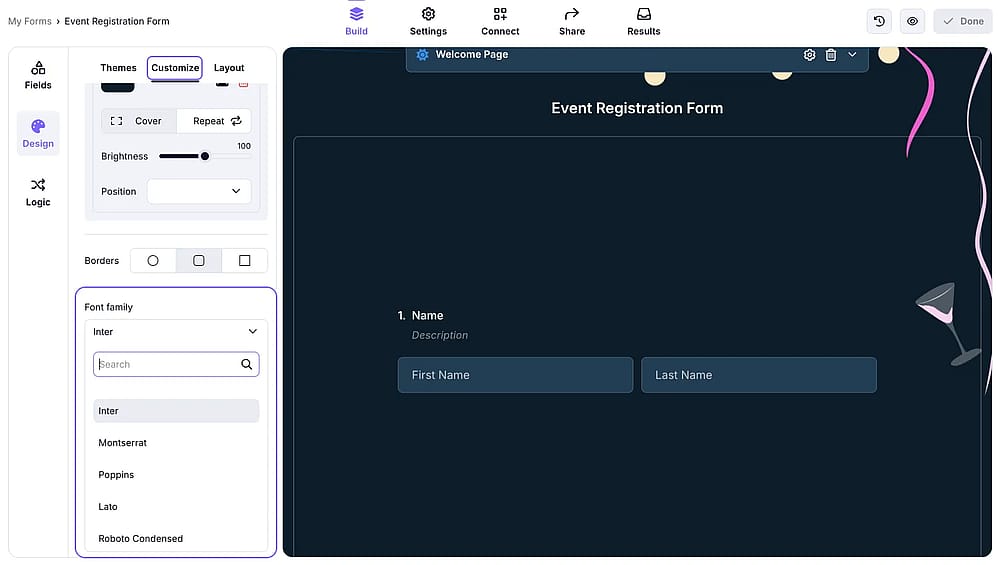
Font options on forms.app
Why do fonts matter in Google Forms?
Fonts, in general, are considered typography among designers. As typography is seen as an actual science, choosing suitable font options, font sizes, font colors, and the correct variety of fonts can make or break whatever you are creating. Expert designers have long researched the psychology of fonts. Therefore, choosing the right font for your Google Form can increase your success more than you thought.
💡 The sans serif font is the first typeface ever created, and it has been found to be more readable in large bodies of text. (LinkedIn)
Frequently asked questions about the fonts in Google Forms
Now that we have understood how to change the fonts of your form using both forms.app and Google Forms and touched upon why fonts matter and how they affect applicants, it is time to answer frequently asked questions about the Google Forms fonts to eliminate any confusion about the fonts and the design process.
To format text in Google Forms, simply click on the question that you would like to change the format of, select the parts of the text that you would like to customize, and click on the symbols below the text box for your preferred option.
💡 You can only change the format of the texts within questions; you cannot change the format of the answer texts.
There are many ways to customize your form in Google Forms. To access all the customization options, click on the palette icon at the top-right corner of the page. From there, you can change everything from the form's color to the fonts.
To customize a specific question, click on the question itself and select one of the options on the right side, such as adding an image, a description, a video, or even a separate section within the question.
To change font size:
- Click the palette icon (🎨) in the top right
- In the Customize theme panel, find the font size controls
- Select from: Small, Normal, Large, or Extra Large
- The change applies to all text proportionally
The size change affects headers, questions, and descriptions throughout your form. You cannot set different sizes for different elements without add-ons.
No, in native Google Forms, you cannot assign different fonts to individual questions. When you select a font theme, it applies to the entire form. All questions use the same font from your chosen theme.
Unfortunately, you cannot have Google Forms change the text color naturally. You have to use an add-on. You can see how you can download add-ons by going to the “Using add-ons to get more fonts” heading and downloading any add-ons that allow you to change the text color within your form.
Every form in Google Forms comes standard with the font “Roboto.” However, there are differences in font sizes. The header size is 24, the questions are 12, and the size for every text outside of questions and the header is 11.
Key points to take away
While many people overlook it when customizing the form, choosing the right font for your form is one of the most important things regarding the design aspect, as it can affect even people's psychological approach to the form. Therefore, knowing which font to choose and how to customize your form is highly important.
We have discussed why fonts matter within a form, shown you how to customize the font within Google Forms, and provided a better alternative for having more customization options over your fonts with forms.app. We have also answered several FAQs regarding Google Forms fonts. While Google Forms offers a good amount of customization, we recommend trying out forms.app to see the difference for yourselves.
Contributors
Researched & written by
forms.app, your free form builder
- Unlimited responses
- Unlimited questions
- Unlimited team members